
The best headphone amplifiers are the JDS Labs Atom Amp 2 for a powerful, low-noise analog desktop system, the FiiO K7 for an affordable DAC-and-amplifier combination, the Topping L70 for balanced connectivity and flexible gain, and the RME ADI-2/4 Pro SE for advanced control and studio-grade features.
As an Amazon Associate we earn from qualifying purchases at no extra cost to you.
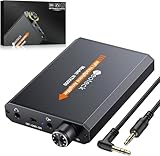


Top 3 picks at a glance
Best headphone amplifiers at a glance
| Model | Best for | Rated output examples | Gain and noise strengths | Approximate market range |
|---|---|---|---|---|
| JDS Labs Atom Amp 2 | Pure desktop amplification | Up to about 2.65 W per channel at 32 ohms; about 502 mW at 300 ohms | 1x and 4.5x gain; very low output impedance and noise | Usually $120–$160 |
| FiiO K7 | Best all-in-one value | Up to about 2 W at 32 ohms through balanced output; about 560 mW at 300 ohms balanced | Low/high gain; 4.4 mm balanced and USB DAC | Usually $180–$220 |
| Topping L70 | Balanced desktop systems | Up to about 2.6 W at 32 ohms balanced; roughly 350 mW at 300 ohms | Three gain levels, including negative gain; extremely low output impedance | Usually $300–$400 |
| RME ADI-2 DAC FS | Detailed EQ and monitoring control | High-power headphone output, plus a separate IEM output | Selectable gain, digital volume control, parametric EQ, exceptionally configurable output controls | Usually $1,000–$1,300 |
| FiiO K11 | Small, inexpensive desktop setups | Up to about 1.4 W at 32 ohms balanced; lower output from the single-ended jack | Low/high gain; USB, optical and coaxial DAC inputs | Usually $130–$180 |
Power figures vary with the output used, power supply, distortion limit and manufacturer measurement method. Treat them as useful comparisons rather than perfectly interchangeable laboratory results.
How much amplifier power do your headphones need?
Impedance alone does not determine whether an amplifier is suitable. Headphone sensitivity is equally important. A 300-ohm headphone with high sensitivity may be easier to drive than a low-sensitivity 32-ohm planar magnetic model.
A practical calculation uses the headphone’s sensitivity and your desired peak level. Suppose a headphone is rated at 100 dB SPL for 1 mW, and you want 110 dB peaks. Every additional 10 dB requires roughly ten times the power, so the target is approximately 10 mW. Adding 10 dB of headroom for musical peaks brings the requirement to about 100 mW.
That is not a demand for continuous 100 mW listening. It is a reserve that helps avoid clipping on dynamic recordings. For a 300-ohm headphone, 100 mW requires:
Voltage = square root of power multiplied by resistance
Voltage = √(0.1 × 300) = about 5.5 volts RMS
This explains why an amplifier can advertise plenty of wattage at 32 ohms yet struggle with high-impedance headphones: voltage swing, rather than raw wattage, becomes the limiting factor.
Head-to-head: which amplifier fits each setup?
JDS Labs Atom Amp 2: the clean analog choice
The Atom Amp 2 is the strongest recommendation when you already own a DAC and want a transparent amplifier without paying for features you will not use. Its low output impedance works well with both sensitive in-ear monitors and full-size headphones, while its high-power output provides useful headroom for many planar and high-impedance designs.
Its 1x low-gain setting is particularly useful for sensitive headphones because it keeps the volume control in a more usable range and reduces the chance of channel imbalance at very low volume. Use the higher gain only when the low-gain setting cannot reach your preferred level without running close to maximum.
The trade-off is connectivity. This is an analog amplifier, not a DAC, and it does not provide a balanced headphone output. Pair it with a USB DAC, audio interface or line-level source using RCA connections.
FiiO K7: the easiest all-in-one recommendation
The K7 combines a USB DAC, headphone amplifier, line output and balanced 4.4 mm headphone connection in a compact desktop enclosure. It is a strong match for a gaming PC because one USB cable handles the digital audio connection, while the front-panel output selection makes it easy to switch between headphones and powered speakers.
Its balanced output has substantially more power than its single-ended output, especially with difficult headphones. Balanced wiring does not automatically improve sound quality, but in this case it gives the amplifier a larger voltage and power budget. Use the balanced connection only with a correctly wired balanced headphone cable; do not use an adapter that combines left and right grounds.
The K7 has a low/high gain switch rather than the more elaborate gain systems found on premium amplifiers. That is enough for most users, although owners of very sensitive IEMs may prefer an amplifier with a negative-gain option.
Topping L70: best for a modular balanced system
The L70 is aimed at users who want a dedicated amplifier with balanced inputs and outputs, remote control, preamp functionality and unusually flexible gain settings. Its gain options include negative gain, unity gain and high gain, making it easier to match the amplifier to both sensitive earphones and power-hungry headphones.
Use negative gain for sensitive IEMs, unity gain for typical dynamic headphones and high gain only when you need more voltage. This approach is preferable to leaving every headphone on maximum gain: lower gain generally gives you a more usable volume range and reduces the risk of accidental over-leveling.
The L70 makes the most sense with a separate DAC that has balanced outputs, such as a compatible Topping DAC or another unit with genuine left and right XLR line outputs. It is less attractive if your source is only a laptop headphone jack or a basic USB dongle.
RME ADI-2 DAC FS: best for control rather than maximum wattage
The RME ADI-2 DAC FS remains a specialist choice for listeners who want to adjust the system precisely. Its appeal is the combination of selectable output modes, parametric equalization, loudness compensation, crossfeed, display controls and separate outputs for demanding headphones and sensitive IEMs.
For gaming, its EQ can correct broad tonal preferences without installing software that operates only on one computer. For example, you can create one profile for competitive games with reduced bass and clearer upper mids, then another for music with a fuller low end. Its interface takes longer to learn than a simple volume knob, but it rewards users who want repeatable settings.
Choose it for signal management and customization, not simply because its specification sheet lists a high-end DAC chip. If you only need enough power and a volume control, a less expensive amplifier will provide better value.
FiiO K11: best for a small desk
The K11 is a compact alternative to the K7. It includes USB, optical and coaxial digital inputs, a display, line output and both single-ended and balanced headphone connections. Its small footprint suits a narrow gaming desk, laptop station or secondary room.
It has less headroom than larger balanced amplifiers, but it is sufficient for many dynamic headphones and moderate-sensitivity planars. Select high gain only after confirming that low gain cannot reach your preferred listening level. The K11 is a sensible choice when space and cost matter more than maximum output reserves.
Decision matrix for common headphone setups
| Your situation | Recommended choice | Why |
|---|---|---|
| You already have a DAC and use 32–300 ohm headphones | JDS Labs Atom Amp 2 | High output, low noise and simple analog operation |
| You need USB audio, a DAC and balanced headphone output | FiiO K7 | One compact unit covers the main desktop requirements |
| You use IEMs and full-size headphones on the same desk | Topping L70 | Negative, unity and high gain provide better level matching |
| You want hardware EQ, loudness and crossfeed | RME ADI-2 DAC FS | Extensive onboard processing and output control |
| You have limited desk space and several digital sources | FiiO K11 | Small enclosure with USB, optical and coaxial inputs |
Gain, output noise and balanced connections
Output noise matters most with sensitive IEMs. A high-power amplifier can be technically excellent yet produce audible hiss if its gain is too high or its noise floor is poorly controlled. Start with the lowest gain available, set the computer’s output near a normal level, and raise the amplifier volume gradually.
A good setup sequence is:
- Set the amplifier to low or negative gain.
- Set the operating system volume to around 70–90 percent rather than leaving it at maximum.
- Play a familiar recording and increase the amplifier volume slowly.
- Switch to high gain only if the desired loudness requires the knob to approach its maximum.
- When changing headphones, lower the volume first because sensitivity can differ by more than 10 dB.
Balanced output is valuable when it provides more power or helps integrate equipment with long balanced interconnects. It is not a guarantee of lower noise, and it does not make a headphone inherently higher fidelity. A single-ended amplifier with adequate voltage, current and low output impedance is often the correct choice.
Footprint and connection checklist
Measure the usable depth of your desk, including room for rear cables. The K11 is easiest to place in a crowded setup. The K7 and Atom Amp 2 occupy a small-to-medium desktop footprint. The L70 and RME units need more horizontal space and benefit from leaving room around their controls and connectors.
- Gaming PC only: USB DAC/amplifier combinations such as the K7 or K11 reduce cable clutter.
- PC plus powered monitors: choose a unit with a selectable line output or preamp mode.
- Console and TV sources: optical input is useful when USB compatibility is uncertain.
- Multiple balanced components: choose the L70 or a similar dedicated balanced amplifier.
- Sensitive IEMs: prioritize low noise, low gain and low output impedance over headline wattage.
Bottom line
For most desktop gamers, the FiiO K7 is the most complete value because it combines DAC functionality, useful power and balanced connectivity. Choose the JDS Labs Atom Amp 2 when you already have a DAC and want maximum simplicity, the Topping L70 when gain flexibility and balanced integration matter, the FiiO K11 for a compact desk, and the RME ADI-2 DAC FS when EQ and signal-control features are more important than price.


