
The best 3D printers in 2026 are the Bambu Lab A1 mini for inexpensive beginners, the Bambu Lab A1 for larger everyday projects, the Bambu Lab P1S for fast enclosed printing, and the Prusa MK4S for long-term reliability and repairability.
As an Amazon Associate we earn from qualifying purchases at no extra cost to you.

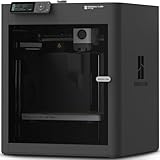


Top 3 picks at a glance
Best 3D printers by budget and use case
| Printer | Typical market range | Build volume | Best for | Main limitation |
|---|---|---|---|---|
| Creality Ender-3 V3 SE | Usually $170–$250 | 220 × 220 × 250 mm | Lowest-cost entry into FDM printing | More manual tuning and less polished software |
| Bambu Lab A1 mini | Usually $200–$300 | 180 × 180 × 180 mm | Reliable beginner printing and small parts | Small build area; limited to cooler materials |
| Bambu Lab A1 | Usually $350–$500 | 256 × 256 × 256 mm | Most home users and multicolor projects | Open frame is unsuitable for some engineering plastics |
| Creality K1C | Usually $450–$650 | 220 × 220 × 250 mm | Fast enclosed printing and carbon-fiber-capable materials | More moving parts and maintenance than a basic bedslinger |
| Bambu Lab P1S | Usually $550–$750 | 256 × 256 × 256 mm | Fast, enclosed general-purpose printing | Proprietary ecosystem and limited screen interface |
| Prusa MK4S | Usually $800–$1,100 | 250 × 210 × 220 mm | Repairability, documentation, and dependable long-term ownership | Open frame and higher initial cost |
| Bambu Lab X1 Carbon | Usually $900–$1,300 | 256 × 256 × 256 mm | Premium automation and abrasive-material workflows | Costs more without increasing the build volume |
| Elegoo Mars 5 Ultra | Usually $250–$400 | Approximately 153 × 78 × 165 mm | Highly detailed miniature and model printing | Resin handling, washing, curing, and ventilation are required |
Our recommendations, explained
Best cheap beginner printer: Creality Ender-3 V3 SE
The Ender-3 V3 SE is a sensible choice when the purchase budget is the priority. Its 220 × 220 × 250 mm volume is large enough for functional brackets, cosplay components, desk organizers, and gaming-PC accessories. Automatic bed leveling, a direct-drive extruder, and support for common PLA, PETG, and TPU reduce the setup burden compared with older entry-level printers.
The trade-off is ownership time. Budget machines may need more attention to belt tension, eccentric rollers, first-layer calibration, and filament routing. It can produce excellent parts, but it is not the best choice if “reliable” means starting a print remotely and rarely checking it.
Best first 3D printer: Bambu Lab A1 mini
The A1 mini is one of the best 3D printers for a beginner who values predictable results over maximum size. Automatic calibration, a quick-change nozzle system, good slicer profiles, and a flexible build plate make the first successful print relatively easy. It is particularly well suited to miniatures, replacement clips, cable guides, controller stands, and small PC mods.
Its 180 mm cube build area is the decisive limitation. A 180 mm dimension can accommodate a compact part, but not a large helmet panel or full-size enclosure. The open frame also makes it a poor platform for ABS, ASA, and other materials that benefit from a warm, draft-free chamber. PLA and PETG are the practical choices.
Best all-rounder: Bambu Lab A1
The A1 keeps the A1 mini’s beginner-friendly automation while expanding the build volume to 256 mm in every direction. That difference is substantial: the printable cube has roughly 2.9 times the volume of the A1 mini’s 180 mm cube. It is a strong fit for household parts, cosplay sections, terrain, tabletop accessories, and multicolor PLA projects when paired with the appropriate automatic material system.
Print quality is typically very good at normal layer heights, with clean walls and consistent first layers. Speed settings should not be confused with detail: a fast profile can complete a simple bracket quickly, but small text, overhangs, and thin walls may look better at 0.12–0.20 mm layer height than at an aggressive high-speed setting.
Best enclosed value: Bambu Lab P1S
The P1S is the better step up when you want speed, a 256 mm cube, and an enclosure. The enclosure helps control drafts and reduces the difficulty of printing materials such as ABS and ASA, although it is not a substitute for ventilation or a printer designed for industrial high-temperature work. PLA and PETG remain its easiest materials; abrasive carbon-fiber filaments require a hardened nozzle and suitable filament path components.
It is louder than a slow, open-frame printer because of motion, cooling fans, and enclosure airflow. In a bedroom or quiet office, the noise can be noticeable during acceleration and rapid travel. A sturdy table, vibration-damping feet, and a slower “silent” or quiet profile can make it less intrusive, but they also reduce throughput.
Best for repairability: Prusa MK4S
The MK4S costs more than many enclosed competitors, but its value is different. It emphasizes documentation, replaceable components, mature firmware, a large user community, and a design intended to remain serviceable. That matters when calculating total ownership cost over several years rather than comparing only the checkout price.
Its open frame is excellent for PLA, PETG, and TPU, but less suitable for warping-prone ABS and ASA unless the printer is placed in a controlled enclosure. It is also not the fastest-looking choice on paper, yet dependable first layers and predictable maintenance can save more time than a higher headline speed.
Best premium FDM printer: Bambu Lab X1 Carbon
The X1 Carbon is aimed at users who want extensive automation, rapid printing, monitoring features, and better support for abrasive engineering filaments. Its hardened wear-resistant components make materials containing carbon fiber or glass fiber more practical than on a basic brass-nozzle machine. The 256 mm cube is the same general class as the P1S, so the premium is mainly for automation, sensing, interface, and material flexibility rather than extra size.
Best for miniature detail: Elegoo Mars 5 Ultra
A resin printer such as the Mars 5 Ultra can produce finer miniature details than an FDM printer because it cures liquid resin in thin layers. It is a strong option for tabletop figures, display models, and intricate props where surface detail matters more than large volume.
Resin printing has a different ownership cost. You need resin, a wash container or washing station, curing equipment, nitrile gloves, paper towels, filters, and suitable ventilation. Uncured resin should not be handled casually or poured into drains. For functional household parts, FDM is usually less messy and more economical.
Decision matrix: match the printer to your situation
| Your situation | Recommended direction | Why |
|---|---|---|
| You want the simplest small printer | A1 mini | Automatic calibration and low learning curve |
| You mainly print PLA parts larger than 180 mm | A1 | More usable build volume without a major complexity jump |
| You need ABS or ASA occasionally | P1S or K1C | An enclosure reduces drafts and warping |
| You print carbon-fiber materials frequently | K1C or X1 Carbon | Hardened wear-resistant components are important |
| You want to repair the machine for years | Prusa MK4S | Strong documentation and serviceability |
| You prioritize miniature surface detail | Mars 5 Ultra or another modern resin printer | Resin technology resolves finer features than typical FDM |
What total ownership really costs
Filament is only part of the budget. A typical 1 kg spool of PLA or PETG usually costs $18–$30. If a printed part uses 120 g of material, the filament cost from a $24 spool is:
120 g ÷ 1,000 g × $24 = $2.88.
Add roughly 10–20% for supports, purge material, failed starts, and test pieces, and the practical material cost becomes about $3.17–$3.46. A multicolor system can consume extra purge filament, so decorative parts may cost noticeably more than their model weight suggests.
Electricity is usually not the major expense. Suppose a printer averages 120 watts while printing for six hours, and electricity costs $0.20 per kilowatt-hour:
0.12 kW × 6 hours × $0.20 = $0.14.
That estimate excludes standby consumption and is not a universal measurement; heated beds, enclosures, ambient temperature, and material change the average. Nozzle replacements, build plates, lubricant, desiccant, and occasional spare fans or belts matter more over time. Resin users should additionally budget for cleaning fluid, gloves, filters, failed prints, and safe waste handling.
Print quality, speed, and noise: what specifications miss
For FDM, a 0.4 mm nozzle and a 0.20 mm layer height are a practical starting point. Use 0.12 mm for visible curved surfaces or small text, and 0.28 mm when speed and strength matter more than fine detail. A smaller 0.25 mm nozzle can improve tiny lettering, but it increases print time and is more vulnerable to partial clogs.
High advertised speed is most useful on large, simple parts with long straight walls. Small parts spend more time accelerating, changing direction, and cooling, so the real time saving can be modest. For reliable everyday printing, start with the manufacturer’s standard profile, then adjust one variable at a time.
Noise depends on the printer, surface, speed, fan profile, and room. Open-frame bedslingers can have prominent bed movement; enclosed core-XY machines often produce a steady fan and motor sound. If the printer shares a room with a workstation, place it on a rigid, level surface and avoid hollow furniture that amplifies vibration.
How to get reliable first prints
-
Dry the filament when needed. If PETG crackles, produces cloudy walls, or strings heavily, dry it according to the spool manufacturer’s guidance. Moisture turns into steam inside the hot end and degrades surfaces.
-
Clean the build plate. Wash it with dish soap and water, dry it with a clean towel, and avoid touching the print area. Finger oils can cause first-layer failures even when leveling is correct.
-
Use a conservative first layer. Start around 0.20 mm layer height, 20–25 mm/s first-layer speed, and a 0.4 mm nozzle. The slower first layer gives the printer more time to maintain contact and exposes leveling problems early.
-
Choose sensible temperatures. Begin near the middle of the filament manufacturer’s temperature range, then use a temperature tower if the surface or bridging quality is poor. Excessive heat can increase stringing; insufficient heat weakens layer bonding.
-
Inspect the first five minutes. If lines are round and separate, lower the nozzle slightly or rerun calibration. If the nozzle drags through ridges, raise it slightly. Do not keep running a print that is visibly peeling or accumulating plastic around the nozzle.
Final buying advice
Choose the A1 mini if your parts fit within 180 mm and you want the least intimidating entry point. Choose the A1 for a larger open-frame workhorse, the P1S or K1C for enclosed high-speed printing, and the MK4S when repairability and long-term ownership matter more than headline specifications. Choose a resin printer only when miniature detail justifies the extra handling and safety equipment. For most gaming-PC accessories and household parts, a reliable FDM printer, dry filament, and a well-tuned standard profile deliver more value than the most expensive machine.


