Top 3 picks at a glance


Best Pool Table Lights for Billiard Rooms
The best pool table lights for billiard rooms are fixtures that cover the playing surface evenly, hang at the correct height, and deliver bright neutral-white light without glare; for most home rooms, that means a dedicated three-shade fixture over a 7- or 8-foot table, mounted with the lower edge about 32–36 inches above the cloth.
Match the Fixture to Your Table Size
Fixture length matters more than the number of shades. A light that is too short leaves the head and foot rails dim, while an oversized fixture can create excessive brightness around the table and dominate a compact room.
As an Amazon Associate we earn from qualifying purchases at no extra cost to you.
| Table size | Recommended fixture length | Typical shade count | Target light at the cloth | Recommended LED load |
|---|---|---|---|---|
| 6–7 feet | 40–48 inches | 2 or 3 | 500–700 lux | 60–90 watts total |
| 8 feet | 48–60 inches | 3 | 600–800 lux | 75–110 watts total |
| 9 feet | 60–72 inches | 3 or 4 | 700–900 lux | 90–140 watts total |
| 10–12 feet | 72–96 inches | 4 or a commercial linear fixture | 800–1,000 lux | 120–180 watts total |
These are practical starting points rather than strict regulations. Lux describes light arriving at the cloth, while lumens describe the light emitted by the fixture. A fixture’s lumen rating does not tell the whole story: a narrow shade, high ceiling, glossy finish, or poor reflector can reduce usable light even when the advertised lumen number is high.
Choose the Right Fixture Style
Three-shade billiard light
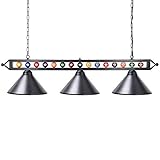
A three-shade bar is the safest choice for most 7- and 8-foot home tables. The shades spread light along the table’s length and are usually easier to position than several separate pendants. Look for a bar approximately 48–60 inches long with opaque or semi-opaque shades and downward-facing reflectors.
Traditional metal billiard fixtures work well in game rooms with industrial, traditional, or pub-style decor. A glass-shade fixture can look lighter in a low-ceiling room, but clear glass may expose the bulbs and create glare. Frosted glass or frosted LED bulbs are more forgiving.
Four-shade or linear commercial fixture
Large 9-foot tables and tables in rooms with ceilings higher than 9 feet benefit from four shades or a purpose-built linear LED fixture. A long, diffused fixture reduces bright spots between bulbs and is often better than increasing the wattage of a short three-shade light.
Recessed or track lighting
Recessed lights can work when a hanging fixture would obstruct a low ceiling, but they require careful placement. Use multiple wide-beam fixtures distributed over the table rather than two narrow spotlights. Track lighting is flexible, though exposed track heads can produce distracting reflections on polished balls and cue shafts.
Set Mounting Height Before You Buy
Measure from the playing surface, not from the floor. For most residential rooms, position the bottom of the shades 32–36 inches above the cloth. This height gives useful coverage while keeping the fixture out of the normal cueing area.
- Low ceiling, approximately 7.5–8 feet: use a compact fixture and begin at 34–36 inches above the cloth. Choose shallow shades to preserve headroom.
- Standard 9-foot ceiling: 32–36 inches above the cloth is usually appropriate.
- High ceiling: use an adjustable downrod or suspension cables. Do not simply hang the fixture much higher; light spreads out and becomes less even.
- Players frequently use elevated cue shots: favor the upper end of the range and check that the fixture does not interfere with the cue at the table’s center.
Have someone hold a cardboard mock-up or an unpowered fixture at the proposed height while another person stands at each rail. If a seated player can see an exposed bulb directly, lower the fixture only if cue clearance remains safe; otherwise use a diffuser, larger shade, or frosted bulb.
Pick Color Temperature and Brightness
For billiards, 3500K–4000K is the most versatile range. A 3500K bulb gives a slightly warm appearance without making green or blue cloth look muddy. A 4000K bulb provides a cleaner, more neutral view of ball colors and is useful in a contemporary room or a room that doubles as a practice space.
- 2700K–3000K: warm and attractive for a pub atmosphere, but potentially too yellow for precise color judgment.
- 3500K: a balanced choice for most home billiard rooms.
- 4000K–5000K: crisp and useful for serious practice, but can look harsh if the room already has cool white lighting.
Use high-CRI LED bulbs or integrated LEDs where possible. A color-rendering index of 90 or higher helps the cloth, balls, and markings appear more natural. Dimmability is valuable: full output is useful for practice and cleaning, while 60–75% output can make the room more comfortable during casual play.
A Worked Brightness Calculation
Suppose an 8-foot table needs approximately 750 lux across a playing area of 4 by 8 feet. Converting the area to square metres gives about 2.97 square metres. The theoretical light requirement is:
750 lux × 2.97 square metres = approximately 2,230 lumens arriving at the cloth.
Because shades, distance, beam spread, and room surfaces reduce delivered light, allow roughly 30–50% extra output. That produces a practical target of about 3,000–4,500 lumens from the fixture.
For example, three LED bulbs rated at 1,200 lumens each provide 3,600 lumens in total. At 10 watts per bulb, the fixture uses only 30 watts while offering more light than three old 60-watt incandescent bulbs. If the shades are deep or the ceiling is unusually high, choose a fixture closer to 4,500–5,000 total lumens rather than relying on wattage alone.
Decision Matrix for Different Billiard Rooms
| Your situation | Best specification | Why it fits |
|---|---|---|
| 7-foot table in a compact room | 40–48-inch, two- or three-shade fixture; 3500K; 2,500–3,500 lumens | Provides coverage without making the room feel crowded |
| 8-foot table used for regular practice | 48–60-inch three-shade fixture; CRI 90+; 3500–4000K; 3,500–4,500 lumens | Balances visual accuracy, coverage, and comfortable brightness |
| 9-foot table with a 10-foot ceiling | 60–72-inch three- or four-shade fixture; 4000K; 4,500–6,000 lumens | Compensates for the greater table length and mounting distance |
| Low ceiling or multipurpose room | Shallow diffused linear LED fixture or carefully aimed recessed lighting | Reduces head clearance problems and visual glare |
| Dark walls and ceiling | High-CRI, dimmable fixture with a wide diffuser; add 10–20% output | Dark surfaces absorb more reflected light |
| Glossy table finish or visible bulb glare | Opaque shades, frosted bulbs, or a diffused linear design | Controls reflections and protects players’ sight lines |
Installation Checks That Prevent Common Problems
Check 1: Center the fixture on the table
Center the fixture over the table’s length and width, not necessarily in the room. If the table is offset to leave space for a sofa or cue rack, the light should still follow the table.
Check 2: Confirm cue clearance
Place a cue across the center of the table and raise it as though playing an elevated shot. Walk around the table and check for contact with shades or suspension hardware. This matters particularly with 7-foot tables in low-ceiling rooms.
Check 3: Inspect the rails and corners
With the lights on, stand at each corner and compare the brightness of the head, center, and foot of the table. If the center is bright but the rails are dark, the fixture is probably too short, too high, or using narrow-beam bulbs. A longer fixture or wider diffuser is a better fix than simply installing higher-wattage lamps.
Check 4: Eliminate flicker
Use LED bulbs marked as dimmable if the circuit includes a dimmer, and choose a dimmer rated for LED loads. Flicker can be distracting during ball movement and may appear in phone or video recordings even when it is not obvious to the eye.
What to Look for in the Best Pool Table Lights for Billiard Rooms
- A length appropriate to the table rather than the room alone.
- Adjustable suspension hardware for precise height control.
- 3500K–4000K color temperature for a natural, clear playing view.
- CRI 90 or better when accurate color matters.
- Approximately 600–900 lux at the cloth, depending on table size and use.
- Frosted bulbs, reflectors, or diffusers that prevent direct glare.
- LED efficiency and a compatible dimmer for adjustable brightness.
- A finish and shade shape that do not obstruct sight lines from the rails.
For most buyers, the strongest all-around choice is a dimmable three-shade LED billiard fixture around 48–60 inches long, producing roughly 3,500–4,500 lumens at 3500K–4000K and mounted 32–36 inches above the cloth. Move toward a longer four-shade or linear design for a 9-foot table, and prioritize shallow, diffused construction when ceiling height or glare is the limiting factor.
Frequently asked questions
Are lumens or lux more useful when comparing pool table lights?
Lux is more useful for estimating how much light reaches the playing surface, while lumens describe the light emitted by the fixture. A high lumen rating does not guarantee even illumination because shade shape, mounting distance, reflectors, glossy finishes, and beam spread affect delivered light. For billiards, the article recommends approximately 600–900 lux at the cloth, depending on table size and use.
Should I choose bulbs or an integrated LED billiard fixture?
Either option can work, but high-CRI LED bulbs or integrated LEDs are preferred where possible. LED efficiency helps provide useful brightness without relying on old incandescent wattage, and a dimmable design allows full output for practice or cleaning and reduced output for casual play. If using bulbs, frosted versions can help reduce glare from exposed bulbs or clear shades.
Can a pool table light match a room with a low ceiling?
Yes, but choose a compact fixture with shallow shades or a shallow diffused linear LED design. In a room with an approximately 7.5–8-foot ceiling, begin with the fixture’s lower edge 34–36 inches above the cloth while preserving cue clearance. Recessed lighting can also work when a hanging fixture would obstruct the ceiling, provided multiple wide-beam fixtures are distributed over the table.
How can I reduce glare from billiard light fixtures?
Use opaque or semi-opaque shades, downward-facing reflectors, frosted glass, frosted bulbs, or a diffused linear design. Clear glass can expose bulbs and create glare, while track heads may reflect from polished balls and cue shafts. If a seated player can see an exposed bulb, use a diffuser, larger shade, or frosted bulb, provided the fixture remains clear of elevated cue shots.
Do dark walls change how bright a billiard room should be?
Yes, dark walls and ceilings absorb more reflected light, so the article recommends adding 10–20% output. A high-CRI, dimmable fixture with a wide diffuser can help compensate while maintaining comfortable control. The fixture should still provide even coverage across the table, since simply choosing higher-wattage lamps is not the preferred solution when the rails are darker than the center.