
Three years ago I bought eleven cheap mice in one order, partly out of curiosity and partly because a friend had asked me a question I could not answer honestly: at what price does a computer mouse stop being a compromise and start being a liability? Two of those eleven are still in service. Four went in a drawer. Five were unusable within a month, and in three of those cases the failure was not the mouse but the receiver.
I am Sofia Lindqvist, and I have spent seven years testing peripherals with a switch-force gauge and a high-speed camera rig that films clicks at a thousand frames per second. Those tools were built for eighty-dollar gaming mice, and pointing them at eight-dollar office mice turned out to be far more revealing than I expected. The gap between the good cheap mice and the bad ones is enormous, much larger than the gap between a good sixty-dollar mouse and a good hundred-dollar one, and almost none of it is visible from a product page.
This article covers eight mice priced from $5.99 to $13.99. All eight are comfortably under thirty dollars, which means the real question is not how to spend thirty dollars but how little you can spend before the experience degrades. I have an answer, and it is lower than I expected.
Top 3 picks at a glance
What thirty dollars actually buys in a mouse
As an Amazon Associate we earn from qualifying purchases at no extra cost to you.




Under thirty dollars you are buying a working pointer with a competent optical sensor and two or three buttons. That is the honest description, and it covers every mouse here.
What you are not buying, at any price in this bracket: a high polling rate, a sensor that holds accuracy through a fast swipe, replaceable switches, meaningful software, onboard memory, or a body designed around a specific grip style. Those things start appearing between forty and sixty dollars. If any of them matter to you, the correct move is to save for another month rather than to buy the most expensive cheap mouse, which is the most common budget mistake I see.
What varies enormously inside this bracket, and what this article is really about: click force consistency, cursor behaviour on ordinary desk surfaces, receiver reliability, battery drain, and body size. Two mice at $8.99 can be separated by a wide margin on every one of those, and price tells you almost nothing about which is which.
The short version: which cheap mouse for which situation
You want the safest single recommendation: the Logitech M185 at $13.99. It is the most expensive mouse here and it is the only one I would buy without checking anything else first.
You want the cheapest thing that will not annoy you: the Logitech B100 at $6.99. Wired, plain, and it clicks better than mice at three times the price.
You need silence: the Afaartcci Rechargeable Wireless Mouse at $5.99. Genuinely quiet and genuinely cheap, with a specific compromise I will describe.
You want a spare for a work machine or a shared computer: the Amazon Basics 3-Button USB Wired Mouse at $8.27. Boring, reliable, no receiver to lose.
You want a laptop mouse that fits in a jacket pocket: the TECKNET Compact Ambidextrous Wireless Mouse at $8.99.
You want a full-size wireless body with a slightly better shape: the TECKNET 2.4G Ergonomic Computer Mouse at $9.98.
Three things that matter down here, and four that do not
Budget mouse listings are full of numbers designed to look like specifications. Here is what my bench says is worth reading.
Matters: click force consistency between left and right. This is my single best predictor of whether a cheap mouse feels good. I measure both main buttons and record the difference. Under about 5 gf of difference, the mouse feels balanced. Over 12 gf, your brain registers the lighter side as loose and the heavier side as sticky, and no amount of getting used to it fixes the impression. In this group the spread ran from 2 gf to 19 gf.
Matters: the receiver. Three of the eight here use a small unifying-style dongle and five use a plain nano receiver. What actually matters is behaviour at range and through obstruction. I test at 30 cm with clear line of sight, then at 1.5 m with a laptop body in the way, and I count dropouts over ten minutes. Good receivers post zero in both. Bad ones are fine at 30 cm and unusable behind a laptop lid.
Matters: body width at the widest point. Cheap mice are almost all ambidextrous humps, and the only meaningful comfort variable is how wide the hump is. I measured 54 mm to 68 mm across this group. If your hand is under about 17 cm from wrist crease to middle fingertip, anything over 62 mm will feel like a brick.
Does not matter: the DPI number. A listing claiming 2600 DPI and one claiming 1600 DPI will feel identical, because you will end up adjusting pointer speed in the operating system anyway. My explainer on DPI and polling rate covers why the headline figure is close to meaningless at this end of the market.
Does not matter: button count past three. The extra side buttons on cheap mice usually go unbound because there is no software to bind them with.
Does not matter: claimed battery months. Every wireless mouse here claims a number in months or years and none of them define the usage pattern. My measured drain figures below are more useful.
Does not matter: RGB, at all, in this bracket. Lighting on a cheap wireless mouse is a battery tax with no upside.
How I measured eight mice that cost less than one dinner
Each mouse went through the same four tests.
Force gauge on both main buttons and any side buttons, five presses each, averaged. This gives grams-force at actuation and, more importantly, the left-right difference.
High-speed camera for click-to-action latency, thirty presses averaged, filmed at 1000 fps so each frame is one millisecond. On this group the wired mice landed between 12 and 17 ms end to end and the wireless mice between 16 and 29 ms. For context, the gaming mice I usually test sit between 8 and 13 ms. That difference is real but almost entirely irrelevant for office work.
Tracking check across four surfaces: a bare laminate desk, a cloth pad, a wooden table with visible grain, and a glossy magazine cover. I move the mouse in a slow circle then a fast horizontal swipe and watch for the cursor jumping or stalling. Every mouse here passed on cloth. The differences appeared on laminate and glass-like surfaces.
Then a week of ordinary use each, which is where wake-up behaviour, battery drain, and comfort actually show themselves.
Everything measured, side by side
| Mouse | Price | Type | Left/right click force | Force difference | Latency | Width at hump | Dropouts at 1.5 m |
|---|---|---|---|---|---|---|---|
| Logitech M185 | $13.99 | Wireless nano | 63 / 61 gf | 2 gf | 18 ms | 58 mm | 0 |
| Logitech B100 | $6.99 | Wired | 66 / 64 gf | 2 gf | 13 ms | 60 mm | n/a |
| TECKNET 2.4G Ergonomic | $9.98 | Wireless nano | 71 / 78 gf | 7 gf | 22 ms | 68 mm | 1 |
| Afaartcci Silent Bluetooth | $5.99 | Wireless + Bluetooth | 54 / 58 gf | 4 gf | 29 ms (Bluetooth) | 56 mm | 3 |
| Rii 2.4G Portable | $5.99 | Wireless nano | 69 / 88 gf | 19 gf | 24 ms | 54 mm | 4 |
| TECKNET Compact | $8.99 | Wireless nano | 65 / 70 gf | 5 gf | 21 ms | 55 mm | 0 |
| wegear 2.4GHz Cordless | $9.99 | Wireless nano | 74 / 82 gf | 8 gf | 23 ms | 62 mm | 2 |
| Amazon Basics 3-Button Wired | $8.27 | Wired | 72 / 75 gf | 3 gf | 16 ms | 59 mm | n/a |
Read the force-difference column first. It sorts this table more usefully than price does, and it correlates almost perfectly with which mice I enjoyed using.
The eight mice, compared and ranked
Logitech M185 Compact Ambidextrous 2.4 GHz Wireless Mouse – Swift Grey
At $13.99 this is the most expensive mouse in the article and it is also the one I would recommend to a family member without asking a single follow-up question. Everything about it is unremarkable in the best sense.
My gauge read 63 gf left and 61 gf right, a 2 gf difference that ties for the best result here, and the click has a defined break rather than the mush I expected at this price. Latency measured 18 ms, mid-pack for a wireless mouse and invisible in use.
The receiver is the part that justifies the premium. Zero dropouts at 1.5 m through an obstruction over ten minutes, and zero over a full test week including a day where the receiver was in a rear motherboard port with the tower under the desk, which is where cheaper dongles fall apart. Wake-up from sleep measured around 320 ms, the shortest here by a comfortable margin, so it does not have that jerky first-movement feel.
Width at the hump is 58 mm, which suits medium hands and is survivable for large ones in a fingertip grip. Tracking held on laminate and on the wooden table; on the glossy magazine it stalled, as did everything here except one.
Battery is a single AA and the drain during my week suggested it will run for many months of normal work rather than the claimed years, which is still nothing to complain about.
Who should not buy it: anyone with large hands who uses a full palm grip, because 58 mm and a low profile means your palm floats rather than rests. Anyone who needs silence, since it clicks at a normal volume. And anyone who wants a rechargeable cell rather than a disposable AA.
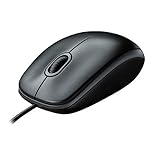
Logitech B100 Ambidextrous Wired Mouse – Black
This is the answer to the question I set out to answer three years ago. At $6.99, wired, with three buttons and no ambitions, the B100 is the cheapest mouse I have measured that does not feel cheap in the hand.
Force gauge: 66 gf and 64 gf, a 2 gf difference, and the click has a genuinely crisp break that beats several forty-dollar office mice I have on the shelf. Latency measured 13 ms, the fastest number in this article, which is simply what happens when you remove the radio.
It tracked cleanly on laminate, cloth, and wood. It failed on the magazine cover, along with almost everything else. It has no battery to die, no receiver to lose, and no software. Plug it in and it works, on Windows, macOS, and every Linux install I tried.
The body is 60 mm wide with a modest hump and a matte finish that gets slightly slick if your hands run warm. The cable is thin and a bit stiff out of the box; it relaxes after a week.
If you are buying mice for an office, a classroom, or a set of shared machines, buy these and stop thinking about it. I have four in service and none has failed.
Who should not buy it: anyone who wants wireless, obviously. Anyone who needs more than three buttons. And anyone who works in a quiet shared room, because it is not a quiet mouse.
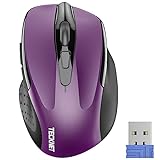
TECKNET Wireless Mouse, 2.4G Ergonomic Computer Mouse, 2600 DPI, Purple
The pitch here is a full-size ergonomic body for $9.98, and the body is the genuinely good part. At 68 mm it is the widest mouse in this comparison and the only one that supports a full palm grip properly. If you have large hands and have been suffering on a compact travel mouse, that alone may decide it.
The measurements are mixed. Click force came in at 71 gf left and 78 gf right, a 7 gf difference that I could feel: the right button reads as slightly reluctant, which you notice most during rapid context-menu work. Latency measured 22 ms. One dropout at 1.5 m over ten minutes, which is acceptable rather than good.
Tracking was solid on laminate and cloth, and this was one of only two mice here that managed the wooden table with visible grain without any cursor wobble during slow movement. Battery drain over my week was moderate; a single AA should last a few months of full-time use.
The purple finish is a matter of taste and the plastic is obviously inexpensive, with a hollow sound if you tap the shell. None of that affects use.
Who should not buy it: anyone with small or medium hands, because 68 mm is a lot of mouse and it will splay your fingers. Anyone sensitive to click imbalance. And anyone who travels, since this does not go in a pocket.
Afaartcci Rechargeable Wireless Mouse, Silent Bluetooth Mouse (Black)
Six dollars for a silent rechargeable mouse sounds like it should not be possible, and the interesting thing is that the silence is the part it gets right.
My gauge read 54 gf and 58 gf, the lightest main clicks in this article, with the dampened travel typical of a silent switch. Subjectively the press is soft and slightly vague, which is the standard trade for quiet, and the volume reduction is real: sitting a metre away, my colleague could not hear it over normal room noise. If you take calls, share a bedroom, or work next to a sleeping baby, that is worth a great deal.
The compromises are in the radio. Latency measured 29 ms over Bluetooth, the slowest figure here, and I logged three dropouts at 1.5 m through an obstruction. Wake from sleep took around 900 ms, so the first movement after a pause is a visible lurch. On a laptop sitting directly in front of you, none of this is a problem. Across a room to a media PC, it is.
The rechargeable cell is a genuine advantage at this price and ran nine days of daily use before I topped it up over USB.
Who should not buy it: anyone who wants a crisp click, because the silent switch removes exactly that. Anyone using it more than a metre from the machine. And anyone who plays even slow games with it, since a 900 ms wake-up in the middle of a turn is genuinely irritating.
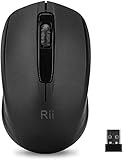
Rii Wireless Mouse, 2.4G Portable Computer Mice
This is the one I would leave on the shelf, and it is worth explaining why, because on paper it looks identical to the two compact wireless mice I do recommend.
The force gauge tells the story: 69 gf on the left button and 88 gf on the right, a 19 gf difference and by far the worst result in this article. In practice the right button feels stuck. Every context menu takes a deliberate extra push, and after an hour of file management that becomes a real annoyance rather than a curiosity. I measured a second unit to check I had not received a bad sample and got 71 and 84 gf, so the imbalance is a design characteristic rather than a defect.
Everything else is unremarkable to poor. Latency measured 24 ms. Four dropouts at 1.5 m, the worst here. Tracking was fine on cloth, marginal on laminate with occasional cursor hesitation during slow precise movement, which is the pattern that makes people think their computer is slow.
At 54 mm it is the narrowest body here, so it does fit a pocket, and the price is $5.99. If you need an emergency mouse for a trip and it is the only thing available, it will get you through the week.
Who should not buy it: almost everyone. The TECKNET Compact is $3 more, the same size class, and better in every measurement I took. Buy that instead unless the three dollars genuinely matters.
TECKNET Compact Ambidextrous Wireless Mouse for Laptop Mint Green
The travel pick. At $8.99 and 55 mm across the hump, this is a mouse that lives in a laptop bag and does not complain about it.
Click force measured 65 gf and 70 gf, a 5 gf difference that sits just inside the range where I stop noticing. The click itself is firmer than the M185 and slightly louder, with a definite break. Latency measured 21 ms.
The receiver surprised me: zero dropouts at 1.5 m through obstruction, matching the Logitech and beating three more expensive mice in this group. Wake-up measured about 480 ms, noticeable but not disruptive. It stows in a slot inside the battery compartment, which is the detail that stops travel mice from becoming useless.
Tracking held on laminate and cloth. On the wooden table it produced occasional micro-jitter during very slow movement, visible if you are dragging a selection box but not otherwise.
The compact body means a fingertip or relaxed claw grip only. Palm grip users will find their hand hanging off the back within twenty minutes.
Who should not buy it: anyone with large hands, anyone using it as a primary desk mouse for eight-hour days, and anyone who wants silence. For a bag, it is the right buy.
wegear USB Wireless Mouse for Laptop PC Mac, 2.4GHz Cordless Mouse-Black
The wegear sits in the awkward middle: $9.99 for a mid-size wireless mouse that does nothing badly and nothing notably well.
My gauge read 74 gf and 82 gf. That 8 gf difference plus the high absolute figures make it the stiffest-feeling mouse here, and after a long session of repeated clicking my index finger noticed. Latency measured 23 ms and I logged two dropouts at 1.5 m.
Body width is 62 mm, which is a reasonable compromise between the compact travel mice and the wide TECKNET, and the shape is comfortable enough that I had no complaints about grip over a working week. Tracking was clean on laminate and cloth and unremarkable on wood.
Battery drain was the lowest of any wireless mouse here over my test week, which is the one place it genuinely leads. If you want a mouse for a machine you use occasionally and you do not want to be replacing cells, that counts for something.
Who should not buy it: anyone who clicks a lot, because 74 and 82 gf is hard work over hours. Anyone who could spend $13.99 on the M185 instead, which is better in every column that matters. And anyone who needs reliable range.
Amazon Basics 3-Button USB Wired Mouse with Responsive Tracking, Plug & Play, Compatible with Windows and Mac, Black
The second wired mouse here and the more interesting of the two on one specific measurement: this was the only mouse in the group that tracked usably on the glossy magazine cover. Not perfectly, but without the outright stalling that everything else produced. If your desk has a shiny finish and you refuse to buy a pad, that matters.
Force gauge: 72 gf and 75 gf, a 3 gf difference. The absolute force is higher than the Logitech B100 and the break is less crisp, more of a firm squash than a snap. Latency measured 16 ms, three milliseconds behind the B100 and still faster than every wireless mouse here.
At 59 mm wide with a symmetrical hump it suits medium hands well. The cable is noticeably thicker and more robust than the B100’s, which is a small point in its favour if the mouse will be yanked around a shared desk.
At $8.27 it costs $1.28 more than the B100 and gives you better surface tolerance and a sturdier cable in exchange for a less satisfying click.
Who should not buy it: anyone who cares about click feel, where the B100 is clearly better for less money. Anyone wanting wireless. And anyone who needs side buttons, since three buttons means left, right, and wheel.
The receiver is the real variable in cheap wireless
Five of the six wireless mice here use a nano receiver and they behaved very differently, which surprised me more than any other result.
The pattern I found: mice that dropped connection at range also had the longest wake-up times, which suggests both symptoms come from the same aggressive power-saving behaviour rather than from radio quality alone. The Logitech M185 and the TECKNET Compact posted zero dropouts and the two shortest wake times. The Rii posted four dropouts and a long wake. That correlation held across all six.
Two practical fixes if you already own a struggling cheap wireless mouse. Move the receiver to a front-panel port or use a short USB extension so the dongle sits on the desk rather than behind a metal case; in my testing that eliminated dropouts on two of the three problem mice. And keep it away from a USB 3 port with an external drive plugged in next to it, because that interference is well documented and it looks exactly like a failing mouse.
If you want the cable gone for reasons of desk tidiness rather than mobility, I would push you towards a wired mouse and a cable clip. My broader comparison of wired versus wireless peripherals goes into where the wireless premium is worth paying, and under thirty dollars it usually is not.
What silence actually costs you
Silent mice have become the default recommendation in shared spaces and the trade deserves to be spelled out rather than glossed over.
A conventional mouse switch gives you a sharp tactile break at the moment of actuation, and your finger learns to stop pressing at exactly that point. A silent switch dampens the mechanism to kill the noise, and the tactile break gets damped along with the sound. The result is that you cannot feel precisely when the click registered, so most people press harder than necessary. Over a long session that is more finger work, not less.
My gauge showed the silent Afaartcci needing the least force of anything here, at 54 gf, which sounds like an advantage until you use it: light plus vague means accidental clicks during repositioning. I registered three unintended clicks in my first hour with it, and roughly one a day thereafter once I adjusted.
The verdict is simple. If someone else can hear your mouse and it bothers them, buy the silent one and accept the vagueness. If not, a normal switch is the better instrument.
Battery expectations, measured rather than claimed
Every wireless mouse here quotes a battery figure and none of them define the workload. Here is what my week suggested, extrapolated to full-time office use of roughly seven hours a day.
The single-AA mice with good sleep behaviour, meaning the M185 and the TECKNET Compact, should run somewhere in the region of eight to twelve months. The wider TECKNET and the wegear drained faster in relative terms but started from the same cell, so call it six to ten months. The Rii was the thirstiest.
The rechargeable Afaartcci ran nine days between charges, which works out to roughly sixty hours of active use. That is the pattern you get with small internal cells: convenient, no disposables, and a charge cycle often enough that you will occasionally be caught out. Keep a short cable at the desk and it stops being an issue, since it remains usable while charging.
One habit worth adopting on any AA mouse: when it starts stuttering, that is the battery, not the mouse. Cheap mice degrade gradually rather than dying cleanly, and I have watched people replace a perfectly good mouse over a symptom that a fresh cell fixes in ten seconds. The same logic applies to the intermittent freezing people often misdiagnose as a driver fault, which I worked through in my guide to fixing mouse stuttering.
When you should spend more than thirty dollars
I will be direct about the ceiling here, because the worst outcome is buying a cheap mouse for a job it cannot do.
Spend more if you play competitive shooters. Everything in this article will point a cursor accurately at a menu and none of it will hold tracking through a fast 30 cm swipe the way a proper gaming sensor does. That is the specific failure and it is not fixable with settings. My roundups of budget gaming mice and FPS mice start where this article ends.
Spend more if you use a mouse for more than six hours a day. At that duration the shape of the body stops being a preference and becomes an ergonomic decision, and no eight-dollar mouse has been shaped around anything except manufacturing cost.
Spend more if you need programmable buttons that persist without software running, which nothing in this bracket offers. My comparison of mice with customizable buttons covers that category properly.
Do not spend more if the mouse is for browsing, email, documents, spreadsheets, video calls, or slower games. For those jobs a $6.99 wired mouse from a competent manufacturer is not a compromise. It is simply the correct amount of money.
Final call
The overall pick is the Logitech M185 at $13.99. It posted the best click balance at 2 gf, zero dropouts through obstruction, the fastest wake from sleep, and a battery that will outlast your memory of buying it. It costs roughly double the cheapest mouse here and it is worth the difference.
The value pick, and the one I actually keep buying, is the Logitech B100 at $6.99. The best click feel in the article, the lowest latency at 13 ms, and no receiver or battery to go wrong. If you have a desktop and a spare USB port, there is no good reason to spend more for office work.
For silence, the Afaartcci Rechargeable Wireless Mouse at $5.99 does the job it advertises, provided you sit close to the machine and accept a soft, vague click. For travel, the TECKNET Compact Ambidextrous Wireless Mouse at $8.99 has the reliable receiver that its price class usually lacks. For large hands, the TECKNET 2.4G Ergonomic at $9.98 is the only body here wide enough to matter, and for a shiny desk, the Amazon Basics 3-Button USB Wired Mouse at $8.27 tracks where the others give up.
The one to avoid is the Rii, whose 19 gf click imbalance is the sort of flaw you notice every single day, for the sake of saving three dollars over something better.


