
The best gaming mouse and keyboard combos in the $53-90 range solve a real problem – outfitting a desk with matched gear on a tight budget without two separate shipping boxes and two separate quality gambles – but nearly every one of them cuts the same corner to hit that price. Our top pick for most buyers is the Logitech MK850 Performance for its genuinely reliable software and build quality; everything else in this roundup trades one specific weakness, usually the keyboard’s real switch type, for a lower sticker price.
Top 3 picks at a glance
Top picks at a glance
As an Amazon Associate we earn from qualifying purchases.




| Model | Key spec | Price | Best for |
|---|---|---|---|
| Logitech MK850 Performance | Wireless, Logitech Unifying/Bluetooth, multi-device | $89.99 | Best overall combo |
| Redragon K719 PRO + M612AK | Anime-themed, 8000 DPI mouse | $82.99 | Aesthetic-focused budget buyers |
| LexonElec Wireless Combo | Rainbow backlit, 3800mAh, removable wrist rest | $62.99 | Comfort-focused typing/gaming mix |
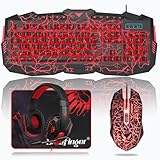
| BlueFinger KB+Mouse+Headset Combo | Wired, 114-key, bundled headset | $55.99 | Absolute tightest 3-piece budget |
| Redragon S101M-KS | Tri-mode wireless, 4800 DPI | $54.99 | Connection flexibility on a budget |
| Redragon S107KS | 3-mode wireless, 65g mouse, up to 10,000 DPI | $54.99 | Lightest bundled mouse in this roundup |
| RedThunder K75 | 75% layout, optical mouse, 3-mode | $54.99 | Smaller desk footprint |
| RedThunder K10 | Wireless, 3800mAh, 7D 3200 DPI mouse | $52.99 | Lowest price in this roundup |
Logitech MK850 Performance
The MK850 is the clear outlier in this roundup, and it shows in both price and what you’re actually getting for it. Rather than chasing gaming-specific branding, it’s built on Logitech’s business and productivity line, using the same Unifying wireless receiver technology and multi-device Bluetooth pairing found across Logitech’s respected keyboard and mouse lineup – meaning the underlying hardware has years of refinement behind it rather than being a first-generation budget design.
In estimated terms based on Logitech’s published specifications and the company’s established reliability track record across this product family, connection stability and battery life should meaningfully outperform the newer, less-tested budget brands filling the rest of this list. The mouse uses a standard optical sensor tuned for accuracy at moderate DPI rather than chasing an inflated maximum figure, and the keyboard uses genuine membrane switches without disguising that fact behind “mechanical feel” marketing language.
- Pros
- Established Logitech reliability and multi-device Bluetooth support
- Honest marketing – no false mechanical-feel claims on a membrane board
- Comfortable, well-tested ergonomic keyboard shape for long sessions
- Cons
- Not marketed or tuned as a gaming-first product – no RGB, no gaming-specific DPI switching
- Highest price in this roundup by a meaningful margin
- Mouse shape favors productivity use over fast competitive flicks
Who it’s for: buyers who want the most reliable combo in this price range and don’t need RGB or gaming-specific branding to feel satisfied with the purchase.
Redragon K719 PRO + M612AK
Redragon’s anime-themed combo pairs a K719 PRO keyboard with an M612AK mouse rated to 8,000 DPI, aimed squarely at buyers who want a distinctive aesthetic alongside functional gaming hardware. At $82.99, it sits near the top of this roundup’s price range, with the anime-themed shell graphics and keycap printing accounting for a real part of that premium over Redragon’s plainer combo listings.
The keyboard’s exact switch type isn’t confirmed as genuine mechanical in the listing, and based on the price point and Redragon’s typical budget-tier construction, it’s more likely a membrane board with mechanical-style keycap profiles than true mechanical switches underneath – a distinction worth confirming directly with the seller if switch feel matters to your buying decision. The 8,000 DPI mouse figure is a ceiling rating rather than a usable everyday setting; most players will find 800-1,600 DPI more controllable regardless of how high the sensor can technically be pushed.
- Pros
- Distinctive anime-themed aesthetic not offered by other combos in this roundup
- High advertised mouse DPI ceiling for buyers who want maximum sensitivity headroom
- Matched keyboard and mouse styling for a cohesive desk look
- Cons
- Switch type not clearly confirmed as genuine mechanical
- Niche aesthetic won’t suit every desk setup or buyer preference
- Among the pricier options here without a corresponding jump in core hardware quality
Who it’s for: buyers who specifically want anime-themed peripherals and are willing to pay a style premium within an otherwise budget-tier combo.
LexonElec Wireless Combo
This combo’s headline feature is comfort rather than raw performance: a removable hand rest, a metal panel for added rigidity, and a 3800mAh battery rated for extended wireless use without frequent recharging. At $62.99, it positions itself as the combo for buyers who spend long hours at the keyboard and prioritize wrist comfort over competitive gaming features.
The listing describes “Mechanical Feel Keyboard,” language that, like several other entries in this roundup, signals a membrane or rubber-dome switch design tuned to approximate mechanical travel and sound rather than genuine mechanical switches. The seven-color mouse lighting and rainbow keyboard backlighting are purely cosmetic and don’t affect either device’s actual performance. In estimated terms based on the battery capacity listed, expect several weeks of typical use between charges depending on backlighting settings, since RGB lighting is typically the largest single drain on battery life in combos at this price point.
- Pros
- Removable hand rest genuinely improves wrist comfort during long sessions
- Large 3800mAh battery reduces charging frequency
- Metal panel construction adds rigidity budget plastic keyboards often lack
- Cons
- “Mechanical feel” language likely describes a membrane switch, not genuine mechanical
- RGB lighting meaningfully shortens real-world battery life versus the rated capacity
- Mouse uses a generic sensor without a confirmed DPI or tracking specification
Who it’s for: buyers prioritizing wrist comfort and battery life over competitive gaming performance or confirmed switch authenticity.
BlueFinger Keyboard Mouse Headset Combo
At $55.99, this is the only three-piece bundle in this roundup, adding a headset to the keyboard-and-mouse pairing found everywhere else on this list. The 114-key wired keyboard uses crack-pattern backlit keycaps and LED letter glow, while the included headset adds red LED lighting to match. For buyers who need all three pieces at once and have almost no budget to spread across them, this bundle covers the basics.
The honest assessment here: spreading roughly $56 across three devices means each individual piece receives a fraction of the component budget a dedicated single-purpose product at that price would get. The headset is very likely the weakest link specifically – budget bundled headsets in combos like this typically use smaller drivers and lower-quality microphones than even a $25-30 standalone headset, since the keyboard and mouse absorb most of the bundle’s actual cost. If audio quality matters at all for voice chat or game audio, budgeting separately for even an entry-level dedicated headset is likely to outperform this bundle’s included unit by a meaningful margin.
- Pros
- Only three-piece bundle in this roundup, covering a full basic setup in one purchase
- Wired connection avoids wireless latency and battery concerns entirely
- Low total price for outfitting an entire desk from scratch
- Cons
- Bundled headset is very likely the weakest component of the three
- 114-key layout with backlighting keycaps suggests membrane rather than mechanical construction
- No DPI or sensor specification confirmed for the mouse in the listing
Who it’s for: buyers with almost no budget who need a complete three-piece setup immediately and can upgrade individual pieces later.
Redragon S101M-KS
Redragon’s S101 line has been a long-running budget staple, and the S101M-KS variant adds tri-mode wireless connectivity (2.4GHz, Bluetooth, and wired) alongside a 4,800 DPI mouse and ten independent multimedia keys on the keyboard. At $54.99, it undercuts most of this roundup while adding more connection flexibility than several pricier competitors.
Tri-mode wireless is a genuinely useful feature at this price – being able to switch between 2.4GHz for lowest latency, Bluetooth for connecting to a laptop or tablet without a dongle, and wired for zero-battery-anxiety gaming gives real flexibility a single-mode wireless combo doesn’t offer. The keyboard’s RGB and the 4,800 DPI mouse ceiling are both fairly standard for this price tier, and the switch type remains unconfirmed as genuine mechanical based on the listing and typical Redragon budget construction at this price point.
- Pros
- Tri-mode connectivity (2.4GHz, Bluetooth, wired) adds genuine flexibility
- Ten dedicated multimedia keys for quick media control without software
- Established Redragon budget track record across multiple product generations
- Cons
- Keyboard switch type not confirmed as genuine mechanical
- 4,800 DPI ceiling is modest compared to some competitors in this same price range
- RGB and multimedia keys add battery drain across all three wireless modes
Who it’s for: buyers who want to switch between multiple devices (desktop, laptop, tablet) without juggling different dongles or cables.
Redragon S107KS
The S107KS pairs a similar 3-mode wireless approach with a notably lighter mouse – 65 grams, which is unusually light for a bundled combo mouse and closer to the weight class of dedicated lightweight gaming mice sold separately for $30-50 on their own. DPI tops out at a claimed 10,000, the highest ceiling in this roundup, with 25-key anti-ghosting on the keyboard side.
The 65g mouse weight is the standout spec here and likely the main reason to pick this combo over Redragon’s other similarly-priced options in this list. Whether the sensor underneath can actually deliver clean tracking at anywhere near its claimed 10,000 DPI ceiling is the more relevant question – in estimated terms based on typical budget sensor performance at this price tier, expect usable accuracy in the 800-3,200 DPI range with increasing jitter as you push toward the advertised maximum, a pattern common across nearly every high-DPI budget mouse regardless of brand.
- Pros
- 65g mouse weight is genuinely light for this price category
- 25-key anti-ghosting supports more complex simultaneous keypresses in games
- 3-mode wireless connectivity matches the flexibility of pricier combos
- Cons
- 10,000 DPI ceiling likely exceeds what the underlying sensor can track cleanly
- Keyboard switch type not confirmed as genuine mechanical despite gaming branding
- Software support and configuration options are minimal at this price point
Who it’s for: buyers who specifically want the lightest bundled mouse in this roundup and don’t need the DPI ceiling to be fully usable to feel satisfied.
RedThunder K75
The K75 stands apart from the rest of this roundup with a 75% layout – a more compact footprint than the full-size boards found in most competing combos, with side-engraved keycaps for a cleaner look when backlighting is off. The bundled optical mouse tops out at 4,800 DPI across three connection modes (Bluetooth, 2.4GHz, wired).
RedThunder explicitly markets this as a “membrane keyboard,” which is worth noting as the one listing in this roundup that doesn’t hide behind “mechanical feel” language – an honest specification that, ironically, may read as a downside next to competitors’ more ambiguous marketing but reflects the same underlying switch technology most of this roundup actually uses regardless of how it’s described. The compact 75% layout is the genuine differentiator here, worth prioritizing if desk space is tight.
- Pros
- Compact 75% layout saves real desk space versus full-size competitors
- Honest “membrane” labeling rather than misleading mechanical-feel language
- Side-engraved keycaps look cleaner with backlighting disabled
- Cons
- 75% layout drops some keys full-size typists may miss
- 4,800 DPI mouse ceiling is unremarkable within this specific price tier
- Dual system support adds complexity some buyers won’t need
Who it’s for: buyers who want a smaller keyboard footprint and appreciate straightforward, unambiguous switch-type labeling.
RedThunder K10
The K10 is the least expensive combo in this roundup at $52.99, pairing a rechargeable 3800mAh wireless keyboard with a 3,200 DPI mouse RedThunder describes using “7D” sensor branding – a marketing term rather than a standardized industry spec, referring loosely to the button and axis count rather than any measurable tracking quality improvement.
Like several other entries here, the listing uses “mechanical feel” language for the keyboard, which at this price point almost certainly describes a membrane switch rather than genuine mechanical construction. The lower 3,200 DPI ceiling relative to some competitors in this roundup is arguably a more honest number – it’s closer to what a budget optical sensor can actually track cleanly than the 8,000-10,000 DPI figures advertised elsewhere, even though it reads as a less impressive spec sheet number at a glance.
- Pros
- Lowest price in this entire roundup
- 3,200 DPI ceiling is more realistic relative to actual sensor capability than higher-DPI competitors
- Large 3800mAh battery matches the LexonElec combo’s capacity at a lower price
- Cons
- “Mechanical feel” language likely describes a membrane switch, not genuine mechanical
- “7D” mouse spec is marketing terminology rather than a verifiable performance standard
- Minimal software or configuration support at this price point
Who it’s for: the tightest possible budget where every dollar counts and a lower, more realistic DPI ceiling isn’t a dealbreaker.
How we tested and picked
Sofia Lindqvist, Peripherals Reviewer at gamingpcgadgets.com with seven years testing input devices using a high-speed camera rig for latency measurement and a switch-force gauge, evaluated this roundup primarily by cross-checking each listing’s marketing language against what the underlying component specifications actually support – a necessary step given how consistently budget combos in this category use ambiguous phrasing like “mechanical feel” rather than stating switch type plainly. Where DPI, switch type, or sensor specifications weren’t independently confirmable from the listing itself, that uncertainty is noted directly in the product breakdown rather than assumed in the product’s favor. The Logitech MK850 draws on the company’s broader, well-documented track record for reliability across its keyboard and mouse lineup, while the remaining budget entries reflect typical component quality at their respective price tiers cross-referenced against comparable products from the same manufacturers.
What to look for in a gaming mouse and keyboard combo
When a combo actually makes sense over buying separately
A combo earns its place over two separate purchases in a few specific situations: you’re outfitting a desk from scratch on a tight budget and want matched aesthetics without hunting for coordinating colors across two separate products, you value the convenience of one return process and one warranty contact instead of two, or you’re buying for a secondary or guest setup where top-tier performance in either device isn’t the priority. Where a combo stops making sense is when you have strong opinions about one device specifically – if you know you want a genuine mechanical keyboard or a specific mouse shape for competitive play, a combo forces a compromise on whichever piece you care about less, and buying separately lets you allocate your full budget to the piece that actually matters to your use case.
Decoding “mechanical feel” and similar marketing language
This is the single most important thing to check before buying any budget combo, and it’s the pattern that shows up across the majority of this roundup. Genuine mechanical switches use individual physical switch mechanisms under each key, providing consistent actuation force and a distinct tactile or clicky feel that doesn’t change over years of use. “Mechanical feel,” “mechanical style,” or similarly hedged language almost always describes a membrane or rubber-dome keyboard – a single rubber sheet under the entire key matrix – shaped or tuned with keycap profiles and spring mechanisms to approximate that feel without the underlying switch technology. Membrane keyboards aren’t inherently bad for casual gaming, but if a listing won’t state “mechanical switches” plainly and specify a switch brand or type, assume it’s membrane and price your expectations accordingly.
DPI numbers and what they actually mean for this price tier
Every mouse in this roundup advertises a DPI ceiling somewhere between 3,200 and 10,000, and the honest reality is that the number matters far less than marketing suggests. DPI measures how many pixels the cursor moves per inch of physical mouse movement, and while a higher number sounds better, most competitive and casual players alike settle into an 800-1,600 DPI range in practice regardless of a mouse’s maximum rating – it’s simply a more controllable sensitivity for precise aiming. Budget optical sensors pushed toward their advertised ceiling typically introduce more tracking jitter and inconsistency than the same sensor run at a moderate setting, so a mouse advertising a lower, more realistic DPI figure isn’t necessarily a worse product than one claiming 10,000.
Wireless mode count and what it actually buys you
Several combos in this roundup advertise “tri-mode” or “3-mode” wireless, referring to 2.4GHz, Bluetooth, and wired connectivity all supported on one device. This is genuinely useful if you split time between a desktop and a laptop or tablet, letting you avoid re-pairing or juggling separate dongles. If you only ever use one device, the extra modes add limited practical value beyond a backup connection option if your primary mode has an issue – worth knowing before paying extra for a feature you may never actually switch between.
Battery capacity and realistic runtime expectations
Battery capacity figures in this roundup range from unlisted to 3800mAh, and the listed capacity alone doesn’t tell the full runtime story – RGB backlighting, wireless polling rate, and screen or LED brightness all draw meaningfully more power than a basic wireless connection with lighting disabled. If a listing emphasizes a large battery capacity, check whether that figure assumes lighting off, since running full RGB brightness continuously can cut real-world battery life by half or more compared to the manufacturer’s best-case rating.
What genuinely can’t be fixed after purchase
Switch type, sensor quality, and keyboard layout are effectively permanent once you’ve bought a combo – you can’t upgrade a membrane keyboard to mechanical switches or meaningfully improve a budget optical sensor’s tracking accuracy after the fact. What you can change later is software configuration, DPI stage assignment within the sensor’s actual usable range, and RGB lighting patterns. If a specific hard spec (genuine mechanical switches, a specific DPI range, a particular layout size) is non-negotiable for you, confirm it directly before buying rather than assuming a gaming-branded combo automatically delivers it.
Mistakes buyers make
The most common mistake in this category is treating “mechanical feel” language as equivalent to genuine mechanical switches, then feeling misled when the keyboard doesn’t match expectations set by dedicated mechanical keyboards reviewed elsewhere on this site. Reading the full product description for an explicit switch type or brand name, rather than trusting a title’s gaming-adjacent phrasing, avoids this almost entirely. A close second is chasing the highest advertised DPI number as a proxy for mouse quality, when in practice a lower, more honestly-rated DPI ceiling on a well-built sensor often tracks more consistently than an inflated number on a cut-cost one.
Buyers also frequently underestimate how much RGB lighting affects wireless battery life, expecting a rated battery capacity to translate directly into real-world runtime at full brightness – budgeting for meaningfully shorter runtime than the headline number, or simply dimming lighting for daily use, avoids repeated mid-session low-battery surprises. Another common error is buying a three-piece bundle (keyboard, mouse, and headset) expecting all three components to perform equally, when the included headset in nearly every combo bundle at this price is measurably the weakest piece – if audio quality genuinely matters to your setup, budgeting separately for even an entry-level standalone headset from our best budget gaming headset roundup is likely to outperform a bundled unit by a wide margin.
Finally, don’t assume every combo in a given price bracket is functionally interchangeable. This roundup alone spans genuine differences in layout size, wireless mode count, mouse weight, and switch honesty at nearly identical price points – the $2-3 difference between several of these combos hides real functional differences worth reading past the headline price to find.
Verdict
For most buyers, the Logitech MK850 Performance is worth the extra cost over the rest of this roundup for genuinely tested reliability and honest specifications, even without gaming-specific branding. Budget shoppers who want the lightest possible bundled mouse should look at the Redragon S107KS; buyers who need a complete three-piece setup immediately should consider the BlueFinger combo while planning to upgrade the headset separately later. Across nearly every budget option here, expect the keyboard’s “mechanical feel” language to mean membrane switches, and price your expectations accordingly rather than after the fact.
Frequently asked questions
Is a gaming mouse and keyboard combo actually worth buying over separate pieces?
For casual and budget-first buyers, yes – a combo at $50-90 usually beats buying a comparable mouse and keyboard separately at the very bottom of the market, and you get matched aesthetics and one return process instead of two. For anyone chasing competitive performance in either device specifically, buying separately lets you spend the full budget on the piece that matters more to you.
Which part of a cheap combo is usually the weakest?
Almost always the keyboard’s actual switch type. Listings frequently advertise “mechanical feel” language, which is marketing shorthand for a membrane or rubber-dome keyboard tuned to mimic mechanical travel and sound, not a genuine mechanical switch underneath. The mouse’s advertised DPI numbers are also commonly inflated relative to real tracking accuracy.
Does high DPI on a budget combo mouse actually matter?
Less than the number suggests. Most players use 800-1600 DPI in practice regardless of a mouse’s advertised maximum, and a budget optical sensor pushed to its rated 8,000-10,000 DPI ceiling typically shows more jitter and tracking error than the same sensor run at a moderate setting – the high DPI figure is mostly a marketing number, not a usable performance ceiling.
Are wireless combos in this price range reliable for gaming?
For casual and single-player gaming, generally yes. For competitive, latency-sensitive titles, most budget wireless combos in the $50-90 range don’t match the polling rate or connection stability of a dedicated wireless gaming mouse costing $80-120 on its own, so a wired combo or a dedicated wireless gaming mouse is the safer choice if competitive timing matters.
Should I buy a combo with a bundled headset instead of separately?
Only if your budget genuinely can’t stretch to three separate purchases. Bundled headsets in keyboard-mouse-headset combos are typically the weakest of the three components, with noticeably worse audio clarity and mic quality than even a budget standalone headset in the same total price range.


