
Top 3 picks at a glance
The Short Answer
If you are trying to decide how wide should rgb light bar be for monitor, match the bar to about 60 to 80 percent of your monitor’s viewable width, not the full frame. For most setups, that means a 15 to 17.7 inch bar for 24 to 27 inch monitors, and a 17.7 to 20 inch bar for 32 to 34 inch ultrawide or curved screens. A bar that is too short leaves dark edges and uneven bias lighting, while a bar that overhangs the sides creates glare and looks undersized for the desk. In 2026, most RGB monitor light bars are designed to sit centered on the top bezel and clamp without blocking the webcam, so width matters more for light coverage and aesthetics than for fit.
As a quick rule: for a 24 inch monitor, choose 15 to 15.75 inches wide. For a 27 inch monitor, choose 15.75 to 17.7 inches. For a 32 inch flat monitor or 34 inch curved ultrawide, choose 17.7 inches or wider, including foldable or split designs that extend to about 20 inches. If you use dual monitors, prioritize one bar per screen rather than one extra-wide bar trying to cover both.
As an Amazon Associate we earn from qualifying purchases at no extra cost to you. Product prices and availability are accurate as of the date shown and are subject to change.

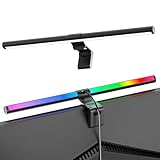


Standard Sizes
RGB monitor light bars are sold by overall housing width, which is slightly wider than the actual LED strip inside. Most models weigh between 0.6 and 1.2 pounds including the clamp, draw 5 to 10 watts over USB, and are powered by USB-A or USB-C at 5V. Prices in the current market typically range from about $16.99 for basic 15.75 inch models to $59.99 to $61.99 for larger curved or remote-controlled RGB versions with dual front and back lighting.
The table below shows the common width categories you will see when shopping, with both inches and centimeters, and which monitor sizes they pair best with.
| Category | Bar Width (inches) | Bar Width (cm) | Best For Monitor Size | Typical Weight |
|---|---|---|---|---|
| Compact | 12.5 – 14.0 in | 31.8 – 35.6 cm | 21.5 – 24 in flat monitors, small desks | 0.6 – 0.8 lb |
| Standard | 15.0 – 15.75 in | 38.1 – 40.0 cm | 24 – 27 in flat monitors | 0.7 – 0.9 lb |
| Large | 17.7 in | 45.0 cm | 27 – 32 in flat or 1800R-1500R curved | 0.9 – 1.1 lb |
| Ultrawide / Foldable | 17.7 – 20.0 in (extended) | 45.0 – 50.8 cm | 34 – 40 in ultrawide and super-ultrawide 21:9 / 32:9 | 1.0 – 1.2 lb |
Housing diameter is also worth checking if your monitor has a thick top bezel or a built-in webcam bump. Most bars are 0.9 to 1.2 inches in diameter and need at least 0.35 to 0.5 inches of flat bezel depth to sit securely. Curved-specific clamps add 0.6 to 0.9 inches of depth and use a weighted or gravity clip rather than adhesive, so they do not slide on 1000R to 1800R curves.
Wattage does not scale directly with width, but wider bars with both front task light and RGB backlight usually sit at the higher end of the range. Expect about 5W for a single-color front-light-only bar at 15.75 inches, and 7 to 10W for a dual-light RGB bar at 17.7 inches with full brightness and color effects active.
How to Measure Your Space
Do not rely on the advertised monitor class alone. A 27 inch monitor from one brand can be 24.1 inches wide with bezels while another is 24.6 inches wide. Measure first so you can see whether a 15 inch or 17.7 inch bar will give you that ideal 60 to 80 percent coverage.
- Measure viewable width, not diagonal. Place a tape measure across the front of the screen from the inside edge of the left bezel to the inside edge of the right bezel. Write it down in inches and centimeters. For example, a typical 27 inch 16:9 monitor measures about 23.5 inches or 59.7 cm viewable.
- Measure total top bezel width. Measure end to end across the top edge including the bezels and any camera housing. This tells you the absolute maximum bar length that will look flush. If this number is 24.2 inches, a 20 inch extended bar will still fit with room to spare.
- Check bezel depth and webcam clearance. Measure the flat area on top of the monitor from front to back. You need at least 0.4 inches or 1 cm of flat depth for most clamps. If a raised webcam sits in the center, measure how far it protrudes so you know whether you need an off-center mount or a notched clamp.
- Check curvature if applicable. For curved monitors, look up the R rating on the spec sheet, such as 1500R or 1800R. Bars labeled for flat monitors can wobble on tight curves. Choose a model explicitly rated for curved, flat and ultrawide fit if your curve is 1500R or tighter.
- Measure desk depth and viewing distance. Sit in your normal position and measure from your eyes to the screen. If you are closer than 22 inches or 56 cm, a very wide bar can feel too intense at full brightness. In that case, stay in the 15 to 15.75 inch range even on a 27 inch monitor and use stepless dimming instead of extra width.
- Calculate your target bar width. Multiply your viewable width by 0.6 and 0.8 to get your ideal range. For that 23.5 inch viewable 27 inch monitor, the range is 14.1 to 18.8 inches. That points you to either a 15.75 inch standard bar for a subtle look or a 17.7 inch bar for fuller edge-to-edge glow.
By Room or Use Case
Gaming Setup With 27 to 34 Inch Monitor
Gamers usually want strong RGB backlight wash on the wall plus a glare-free front light for keyboard visibility. For a 27 inch flat 165Hz panel, a 15.75 to 17.7 inch dual-light bar is the sweet spot. It covers most of the screen width without spilling light into your peripheral vision. For 32 inch or 34 inch curved ultrawide screens, step up to a 17.7 inch bar or a foldable design that extends to about 19 to 20 inches when open. Foldable housings, around 15 inches folded and 19.7 inches extended, let you keep the compact look for daily use and widen for immersive color modes or music sync. Keep wattage in mind if you power from the monitor USB port; choose 5 to 7W models for monitor-powered setups and 8 to 10W only if you have a dedicated USB wall adapter.
Home Office and Productivity Desk
For spreadsheets, video calls, and reading, even illumination matters more than RGB effects. On a 24 to 27 inch monitor in a home office, a 15 to 15.75 inch bar that sits centered provides uniform coverage without overhang. Look for 3 color temperature options around 3000K warm, 4000K neutral, and 6500K cool, with stepless dimming from about 10 to 100 percent. If your desk is 48 to 60 inches wide and you sit 24 to 30 inches from the screen, a 15.75 inch bar at 38 to 40 cm keeps the light concentrated on the desk surface, roughly a 24 to 28 inch wide pool of light at 20 inches depth. This reduces eye strain during long sessions and avoids washing out a second monitor if you use dual 24 inch displays.
Ultrawide and Curved Monitors 34 Inches and Up
Ultrawide monitors are wider than they look in photos, and a small bar leaves 3 to 4 inches of dark space on each side that makes bias lighting uneven. For a 34 inch 21:9 monitor with about 31.5 inches viewable width, the 60 to 80 percent target is 18.9 to 25.2 inches, but no single rigid bar that wide will mount cleanly on the bezel. The solution is a 17.7 inch primary bar paired with strong RGB back projection. The backlight bounces off the wall and visually fills the extra width, so the room glow looks continuous even though the housing stops short of the edges. For 39 to 40 inch super-ultrawide or 1000R aggressive curves, choose a curved-specific bar rated for 34 inches and up with a gravity clamp that grips the thicker top edge. These models typically measure 17.7 inches rigid or about 20 inches extended and weigh close to 1.1 pounds to stay stable.
Small Desk, Dorm, or Dual Monitor Array
If your desk is only 36 to 42 inches wide or you run two 24 inch monitors side by side, avoid the temptation to buy one extra-long bar to span both. A single bar centered over one monitor leaves the second screen underlit and creates a shadow line in the middle. Instead, use a 14 to 15 inch compact bar per monitor if space is tight, or 15.75 inch if you have at least 1.5 inches of clearance between monitors for the clamp arms. Compact bars at 12.5 to 14 inches and 31 to 36 cm are also better when the monitor sits close to a shelf or wall cabinet, since they leave 1 to 2 inches of clearance on each side for ventilation and do not interfere with monitor arms.
Common Sizing Mistakes
The most frequent mistake is matching bar width to monitor diagonal instead of viewable width. A 15 inch bar sounds small for a 27 inch monitor, but it is actually 64 percent of the viewable width and looks balanced. Buying a 20 inch bar for that same monitor creates 2 to 3 inches of overhang that catches the eye and can bump into monitor light sensors.
Another mistake is ignoring bezel thickness and curve. A bar that is technically the right length will tilt forward if the top bezel is rounded or less than 0.35 inches deep. This angles the asymmetric front light into your eyes instead of down onto the desk, causing the glare the bar is supposed to eliminate. Always confirm flat and curved compatibility and clamp depth before choosing width.
Shoppers also overlook power and dimming range when they chase width. A very wide bar at full brightness on a shallow 20 inch deep desk can be too intense for night work. If you cannot dim below about 10 percent or change color temperature, you will end up turning the bar off. A slightly narrower 15.75 inch bar with stepless dimming and 3000K to 6500K adjustment is more usable than a 17.7 inch bar with only on and off.
Finally, do not forget future monitor upgrades. If you plan to move from a 27 inch to a 34 inch ultrawide within a year, buying a 15 inch bar now means repurchasing later. In that situation, choose a 17.7 inch model with both flat and curved mounting options. It will look slightly large on the 27 inch today but will be the correct proportion after the upgrade, and it avoids waste.
FAQ
What width RGB light bar do I need for a 24 inch monitor?
For a 24 inch monitor with about 20.9 inches or 53.1 cm viewable width, choose 12.5 to 15.75 inches wide. A 15 inch bar gives about 72 percent coverage and is ideal if you want even front light for reading. A 15.75 inch bar at 40 cm gives a fuller wall glow if you use RGB modes often. Either will sit flush without overhanging the bezels.
Is a 17.7 inch bar too big for a 27 inch monitor?
No, 17.7 inches or 45 cm is usually the upper end of the ideal range for a 27 inch monitor. On a 27 inch screen with 23.5 inches viewable, 17.7 inches is about 75 percent coverage, which looks full but not oversized. It is a good choice if you have a deeper desk of 28 to 32 inches and want stronger bias lighting. If your desk is shallow or you sit close, a 15.75 inch bar will feel less intense and still provide complete task lighting.
Can one RGB light bar cover two monitors?
One bar is designed to light one screen and the desk directly in front of it. Even a 20 inch extended bar only covers about 40 to 50 percent of a dual 24 inch array that is roughly 42 inches wide total. For dual setups, use one bar per monitor, each sized to 60 to 80 percent of its own screen. This keeps brightness uniform and prevents a dark gap where the monitors meet. Expect to power each bar separately, so plan for two USB ports at 5W to 7W each.
Does bar width affect eye care and glare?
Width affects coverage uniformity, not the anti-glare optics themselves. Glare control comes from the asymmetric lens that projects light down at about 45 degrees away from the screen. A correctly sized bar, roughly 60 to 80 percent of viewable width, places that light pool evenly across the keyboard and desk without spilling onto the screen coating. A bar that is too narrow forces you to run it at maximum brightness to compensate, while a bar that is too wide can push light beyond the desk edge and reflect off glossy surfaces. Choose the right width and then use brightness and color temperature controls to tune comfort.
