
Most people buy a headset stand the same way: they see a photo, it costs less than lunch, and they hit “Add to Cart.” Then two weeks later the stand tips over every time they lift their headphones one-handed, or the base is so small it slides across the desk every time they bump the cable. The problem is almost never the price—it’s that buyers don’t know which measurements actually determine stability, and which numbers are marketing fluff. A stand that looks sturdy in a product photo can weigh six ounces and topple with a $300 pair of cans resting on it.
This guide walks through how to evaluate headset stand stability and base size with real numbers, so you can match a stand to the actual weight of your headphones instead of guessing. The examples referenced here—like the New Bee stand at $6.99, the Ahonnpely at $6.99, the Bliocefo wood-and-metal model at $9.99, and the utility-slot holder at $5.99—all sit in the budget tier, and they illustrate the trade-offs well: at this price range, base design and weight matter more than anything printed on the box.
As an Amazon Associate we earn from qualifying purchases at no extra cost to you.


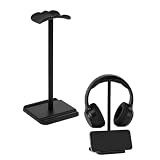
Top 3 picks at a glance
Decide These 3 Things First
Before comparing any products, answer these three questions. They narrow the field faster than any feature list.
1. How much do your headphones weigh? This is the single most important number. Most over-ear headphones weigh between 8 and 14 ounces (220–400 g). Lightweight wireless models like AirPods Max alternatives or on-ear sets run 6–9 ounces, while gaming headsets with boom mics and metal headbands often hit 12–16 ounces. A stand’s effective stability should be judged against your headphone’s weight, not against an abstract “holds all headsets” claim.
2. Where will it live, and how much desk space can you spare? A freestanding stand typically needs a footprint of 4 to 6 inches in diameter. If your desk is 48 inches wide and already crowded with a monitor arm and microphone boom, an under-desk hook or clamp mount might serve you better than any desktop stand, however attractive.
3. Will you grab the headphones one-handed, often? If you lift your headset dozens of times a day—remote workers and gamers usually do—you need a base-to-height ratio that resists tipping, not just a heavy base in isolation. We’ll cover the math below.
Base Size: The Numbers That Prevent Tipping
Stability is fundamentally about the relationship between the base diameter, the base weight, and how high the center of gravity sits once your headphones are on the stand. Here’s what to look for:
Base diameter: For headphones under 12 ounces, a base of 4 to 4.5 inches in diameter is workable. For heavier gaming headsets or headphones over 12 ounces, look for 5 to 6 inches. Below 3.5 inches, even a weighted base becomes tippy because the tipping moment—the force needed to rotate the stand over—scales directly with base radius.
Base weight: A stable desktop stand should weigh at least 8 ounces (roughly 230 g) on its own before headphones go on. The Bliocefo wooden-base model at $9.99, for example, uses a solid wood base specifically because wood adds mass that thin plastic can’t match. Budget all-plastic stands often weigh 4–6 ounces total, which is why they walk across the desk or tip when the cable pulls.
Height matters too: A taller stand (10–12 inches) looks elegant but raises the center of gravity. If you’re choosing a tall stand, insist on the wider, heavier base—roughly 5.5 to 6 inches and 12+ ounces. Shorter stands around 8–9 inches are more forgiving of compact bases.
A quick field test once it arrives: put your headphones on, then press lightly on the headband at a 20-degree angle. If the base lifts off the desk, it will fail in daily use.
Material: Plastic, Metal, and Wood Compared
ABS plastic: The standard for sub-$8 stands like the New Bee and the utility-slot model. Quality ABS is fine for headphones under 10 ounces and survives drops reasonably well. The downside is mass—plastic bases rely on wide geometry rather than weight, so check the listed weight carefully.
Metal (aluminum or steel): Adds 4–8 ounces of mass over comparable plastic designs and resists flex at the contact point. Look for stands where the vertical post is metal even if the base shell is plastic—that hybrid approach captures most of the benefit at a modest price.
Solid wood: The Bliocefo model represents this category—typically rubberwood, beech, or walnut bases around 1 to 1.2 inches thick. Wood bases commonly weigh 10–14 ounces, which is why they punch above their price in stability. Check that the wood is finished (sealed or oiled) so it doesn’t absorb desk moisture or scratch.
Contact padding: Whatever the body material, the headband rest should have silicone or rubber padding at least 0.08 inches (2 mm) thick. Bare plastic or bare metal contact points slowly crease headband padding on leather and faux-leather straps.
Construction Quality: Joints, Wobble, and Load Points
Two construction details separate stands that last from stands that loosen within months:
The base-to-post joint: On threaded stands, check that the post threads at least three full turns into the base. On press-fit or glued designs, a metal insert in the base is far better than plastic-into-plastic, which strips under repeated sideways force. This is the failure point on most cheap stands—one hard one-handed grab and the post starts leaning.
Load path: The headset’s weight should transfer straight down through the post into the base, not hang off a cantilevered arm. Hook-style hangers that extend 3 or more inches horizontally from the post put all the load off-axis; curved cradles that keep the earcups within 2 inches of the post centerline are inherently more stable.
Weight capacity: Any stand should handle at least 1.5 pounds (680 g), which covers essentially every consumer headphone. But treat capacity claims skeptically—a stand can “hold” 2 pounds while balancing perfectly still yet tip instantly in real use. Stability under motion matters more than static capacity.
Practical Features: Cable Management and Extra Utility
Beyond holding headphones, several design details improve daily usability:
Cable hooks or slots: A small notch or magnetic catch on the post keeps your headphone cable from sliding off the desk when the phones are lifted. On the utility-slot model, the extra slot doubles as a spot for cables or small accessories.
Multi-function designs: Some stands include a phone tray, watch cradle, or headset accessory shelf. These are genuinely useful, but only if the added geometry doesn’t raise the headphone rest height without widening the base—a common trade-off in under-$10 designs.
Surface protection: The underside should have a full-circle or multi-point rubber pad. Four small pads grip better on wood desks; a full soft ring performs better on glass or smooth laminate.
Price Tiers: What Each Dollar Buys You
Budget ($5–$10): This tier includes all the example products here—the New Bee, Ahonnpely, and utility-slot stands at $5.99–$6.99, and the Bliocefo wooden base at $9.99. Expect ABS plastic or simple wood-and-metal builds, weights of 5–13 ounces, and bases from 3.8 to 5 inches. The wooden-base option at the top of this tier often delivers the best stability per dollar because mass is cheap in wood and expensive in engineered plastic. Honest expectations: perfectly serviceable for headphones under 12 ounces; a coin flip for heavier gaming headsets.
Mid-range ($10–$30): You get aluminum construction, bases of 5.5–6.5 inches weighing 14–20 ounces, weighted steel plates inside the base shell, and better contact padding. This is the sweet spot for $150–$400 headphones.
Premium ($30–$70+): Machined aluminum or walnut, bases approaching 7 inches and 2 pounds, and design pedigree. You’re paying partly for aesthetics at this level—stability gains over a good mid-range stand are real but incremental.
Warranty and Seller Support
In this product category, warranty terms are modest but worth checking. Budget stands typically carry a 30- to 90-day return window; some brands offer 12- to 18-month limited warranties covering joint failure and finish defects. When buying at the $6–$10 level, prioritize listings from sellers with responsive support—even a $7 stand is annoying to replace if the base arrives cracked. Check whether replacement parts (a spare base screw, extra rubber pads) are offered; that’s a good proxy for a brand that stands behind sub-$10 hardware.
Delivery and Assembly
Most desktop stands ship in a small box under 1 pound and assemble in under five minutes, usually with a single threaded post that screws into the base by hand—no tools required. Wooden-base models sometimes ship with the base and post separated to prevent cracking in transit; expect to attach the post with a provided bolt and included Allen key. If a listing claims a stand “requires no assembly” but the post and base arrive as one piece in a oversized box, be wary of transit damage to the joint—the most fragile point on the whole product.
Spec Checklist
| Spec | Budget ($5–$10) | Mid ($10–$30) | Premium ($30–$70+) |
|---|---|---|---|
| Base diameter | 3.8–5 in | 5.5–6.5 in | 6–7+ in |
| Stand weight (empty) | 5–13 oz | 14–20 oz | 20–32 oz |
| Materials | ABS plastic, or wood base + metal post | Aluminum, steel-weighted base | Machined aluminum, solid walnut |
| Height | 8–11 in | 9.5–11.5 in | 10–12 in |
| Contact padding | Basic rubber strip (2 mm) | Silicone, 3 mm | Silicone/leather, 3–4 mm |
| Cable management | Notch or slot on some models | Hook or magnetic catch | Integrated routing channels |
| Best for headphones up to | 12 oz | 1 lb | 1.5 lb+ |
| Warranty | 30–90 days | 12–18 months | 2+ years |
Red Flags
Weight not listed anywhere in the listing. If a seller won’t tell you what the stand weighs, it’s usually light. Stability correlates with mass more than any other spec.
“Universal fit” with a base under 3.5 inches. That’s a stand designed to hold one specific lightweight earphone set, marketed to everyone.
Photos showing headphones hanging far off-axis. Product photos that show the headset dramatically extended past the post edge signal a cantilevered load path—expect tipping with heavier headphones.
Glued plastic joints with no metal insert. The post will loosen. There’s no version of plastic-glued-into-plastic that survives a year of daily one-handed grabs.
Capacity claims above 4 pounds. No consumer headphone comes close, and inflating the number suggests the seller hasn’t tested anything—they’re just writing copy.
No under-base padding shown. A bare base scratches desks and slides on smooth surfaces.
FAQ
How heavy should a headset stand base be?
Aim for at least 8 ounces (230 g) of stand weight for headphones under 12 ounces, and 14 ounces or more for heavier gaming headsets. Combined with a base diameter of 5 inches or more, that’s enough to resist tipping from normal one-handed lifts and cable tugs.
Do wooden bases really improve stability?
Yes, mostly through mass. A solid wood base 1 to 1.2 inches thick typically weighs 10–14 ounces—several times heavier than a comparable hollow plastic base. The Bliocefo-style wood-and-metal design at around $10 exists precisely because this combination delivers mid-range stability at budget-tier pricing.
Will a cheap stand damage my headphones?
Only at the contact point. If the headband rest lacks at least 2 mm of rubber or silicone padding, bare plastic can gradually compress or scuff leather and faux-leather headbands over months. Add a strip of self-adhesive silicone if your stand came without padding—it costs a couple of dollars.
Is a tall stand or short stand better for stability?
Shorter is inherently more stable because it keeps the center of gravity low. A stand 8–9 inches tall can get away with a 4-inch base; a 12-inch stand really wants a 5.5–6 inch base to match. If you love the look of tall stands, compensate with base weight, not just diameter.
If you’re shopping right now, the practical takeaway is simple: weigh your headphones, match them to a stand that’s at least as heavy as they are, and never buy a stand whose base diameter isn’t printed in the specs. Everything else—finish, brand, extras—is preference. By the time you’re refreshing your setup in 2026, the stand that survives will be the one you judged by these numbers, not the photo.


