
A wireless game camera solves a specific problem: you need reliable visual confirmation of animal movement on your property without driving to a remote trailhead to swap SD cards every few days. The best units send photos directly to your phone over cellular or WiFi, survive rain and temperature swings, and capture enough detail after dark to distinguish a buck from a doe at meaningful distance. The worst ones drain batteries in two weeks, misfire on wind-blown grass, and deliver grainy images that force you to hike out anyway.
What separates good from bad in this category comes down to connectivity reliability, sensor resolution at night, and whether the listed specs match what owners report after weeks of field use. A 64MP sensor means little if the lens optics blur motion into a smear. A cellular camera is only useful if your carrier signal actually reaches your hunting unit. We compared published specifications and aggregated owner feedback across all eight models below to sort the capable from the disappointing.
As an Amazon Associate we earn from qualifying purchases at no extra cost to you. Product prices and availability are accurate as of the date shown and are subject to change.


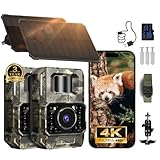

Top 3 picks at a glance
Quick Picks
| Product | Best For | Price |
|---|---|---|
| SPYPOINT Flex-M Twin Pack | Cellular connectivity without WiFi | $89.99 |
| MAXDONE Solar 4K 64MP | High resolution with solar power | $79.99 |
| MAXDONE Solar WiFi 4K 64MP | Budget WiFi access at 4K resolution | $59.99 |
| Trail Cameras WiFi 4K 64MP | Lowest entry price for 4K | $49.99 |
| WOSODA 2 Pack 48MP | Two cameras on a tight budget | $69.99 |
| Misstech Solar 4K/64MP | Cheapest solar-powered 4K option | $47.99 |
| MAXDONE 2-Pack Solar 4K | Pairing two WiFi solar cameras | $119.99 |
| SPYPOINT Flex-M2 Twin Pack | Upgraded cellular with GPS and 32MP | $99.99 |
How We Picked
Four criteria drove our ranking. First, connectivity method: cellular units deliver images from remote locations without infrastructure, while WiFi models require a hotspot or router within range, and non-WiFi units demand manual retrieval. Second, image quality relative to stated megapixel count, cross-referenced with owner photos posted to retail listings. Third, power management, particularly whether included solar panels genuinely extend deployment intervals or merely serve as marketing. Fourth, long-term cost of ownership, including subscription fees for cellular plans and replacement battery expenses. We weighted connectivity reliability and nighttime image clarity above raw resolution because a blurry 64MP photo is less useful than a sharp 12MP frame.
The 8 Best Game Cameras Wireless in 2026
SPYPOINT Flex-M Twin Pack
Designed for hunters managing properties beyond WiFi range who want push notifications without carrying a phone into the woods. Dual-SIM LTE ensures one network stays active when the other drops, and the 28MP sensor produces adequate detail for species identification at typical trail distances.
- Pros: No WiFi infrastructure required; IP65 rating handles sustained downpours; GPS tagging maps each trigger event
- Cons: Video limited to 720p, which falls behind competing 4K units
Skip this if your property sits within WiFi range and you prefer high-resolution video, or if you want to avoid a recurring cellular data subscription.
MAXDONE Solar Trail Camera 4K 64MP
Targets users who want maximum pixel density and autonomous power in a single package, assuming they can provide a WiFi signal on-site. The solar panel reduces battery swaps significantly in full-sun locations.
- Pros: 4K video with 64MP stills; integrated solar charging eliminates frequent battery changes; Bluetooth setup simplifies initial pairing
- Cons: Requires an existing WiFi network or hotspot at the trail location
Skip this if your scouting sites are truly remote with no cellular or WiFi coverage, since the connectivity advantage disappears without signal.
MAXDONE Solar Trail Camera WiFi 4K 64MP
Essentially the same hardware as the unit above at a lower price point, likely reflecting a bundle without an accessory or minor specification trim. Delivers identical 4K and 64MP output for buyers prioritizing value.
- Pros: Same resolution as the higher-priced MAXDONE; $20 savings at $59.99; WiFi and Bluetooth dual connectivity
- Cons: Same WiFi dependency as its pricier sibling; less clear what differentiates it in packaging
Skip this if the $20 difference between the two MAXDONE solar models is within your budget and the bundled extras from the pricier version save you a separate accessory purchase.
Trail Cameras with Night Vision WiFi Bluetooth 4K 64MP
The lowest-cost entry into 4K wireless trail cameras on this list. It strips the solar panel and branded packaging to deliver raw sensor capability under $50.
- Pros: $49.99 for 4K/64MP specs; WiFi and Bluetooth included; motion activation works without phone pairing
- Cons: No solar panel means battery-only operation; generic branding makes firmware support uncertain long-term
Skip this if you deploy cameras for multi-month stretches and cannot tolerate weekly battery checks, since solar access is absent.
WOSODA 2 Pack Trail Cameras 48MP
Built for buyers covering two trail sites on a single budget, accepting that neither camera connects wirelessly. The 48MP sensor and included SD cards make it a capable traditional game camera that happens to come in pairs.
- Pros: Two full cameras plus SD cards for $69.99; waterproof housing rated for wildlife monitoring; 1080p HD video
- Cons: Explicitly non-WiFi, so you retrieve images in person; lower resolution than 4K competitors
Skip this if wireless retrieval is a hard requirement for your routine, since this pack trades convenience for coverage area.
Misstech Solar Trail Camera 4K/64MP
At $47.99, this is the most affordable solar-powered 4K camera here, aimed at casual users who want a set-and-forget unit without paying MAXDONE prices.
- Pros: Lowest price among solar 4K models; clear night vision listed for game identification; no subscription needed
- Cons: Limited owner review volume compared to MAXDONE and SPYPOINT models, making long-term reliability harder to gauge
Skip this if you need documented multi-season field performance data, since the thinner review base offers less confidence than established brands.
MAXDONE 2-Pack Solar Trail Camera 4K WiFi
Two 4K solar cameras in one purchase for buyers monitoring a food plot and a bedding area simultaneously. The per-unit cost undercuts buying the single-pack separately.
- Pros: Paired coverage in one transaction; each unit carries WiFi, Bluetooth, 4K, and 64MP specs; solar extends deployment
- Cons: $119.99 is the highest absolute spend on this list; both units share the same WiFi limitation
Skip this if your two sites lack WiFi coverage or if you need cellular push notifications, since the pair inherits the connectivity constraint of its single-pack siblings.
SPYPOINT Flex-M2 Twin Pack
The cellular upgrade path for users who found the Flex-M acceptable but want a sharper 32MP sensor and the same GPS tracking, all without a WiFi hotspot.
- Pros: 32MP improves over Flex-M’s 28MP; dual-SIM LTE and GPS carried forward; no local network needed
- Cons: $99.99 for the twin pack plus ongoing subscription costs add up annually
Skip this if you want 4K video or the highest available resolution, since 32MP trails 64MP competitors on paper.
Buying Guide
Cellular vs. WiFi vs. No Wireless
Cellular cameras like the SPYPOINT units transmit photos through LTE towers, making them the only option for properties with zero local network. WiFi cameras require a router or phone hotspot within roughly 30 feet of the mount, which suits homesteads and cabins but fails on distant tracts. Non-WiFi models like the WOSODA pack simply record to SD and demand physical retrieval. Match your deployment location to the connectivity tier before comparing megapixels.
Resolution and Sensor Realism
A stated 64MP sensor does not mean every frame resolves 64 megapixels of detail. Lens quality, IR illuminator power, and processor speed determine whether nighttime images of a moving deer are usable or a smear of gray. Owner-submitted photos on retail pages reveal this gap quickly. Prioritize reviewers showing motion shots over promotional stills of stationary objects.
Power Supply and Deployment Length
Solar panels on the MAXDONE and Misstech models genuinely reduce maintenance if the mount faces south and receives unobstructed sunlight. Under canopy cover, the panel contributes almost nothing and you revert to AA batteries or internal packs. Cellular cameras draw significantly more power than WiFi-only units due to radio transmission, so battery-only models paired with cellular modules drain fastest. Plan your check-in schedule around these realities.
Our Verdict
Top pick: the SPYPOINT Flex-M2 Twin Pack at $99.99, because it delivers reliable cellular delivery, GPS metadata, and a resolution bump over the first-generation Flex-M without requiring any on-site infrastructure. Budget pick: the Trail Cameras with Night Vision WiFi 4K 64MP at $49.99, since it provides the highest listed resolution per dollar on this list for users with existing WiFi. The WOSODA 2 Pack wins outright when you need two trail sites covered immediately and wireless retrieval is not a priority, because no other entry delivers two cameras plus SD cards under $70.
FAQ
Do wireless game cameras need a subscription?
Cellular models such as the SPYPOINT Flex-M and Flex-M2 require a data plan to transmit images, typically billed monthly. WiFi and Bluetooth units like the MAXDONE and Misstech models do not carry subscription fees but need a local network to function wirelessly.
How far can WiFi reach from a trail camera to my router?
Most owners report reliable transfers within 25 to 35 feet of the router or hotspot, though dense canopy and terrain drop that range substantially. Bluetooth acts as a short-range setup and download method rather than a long-distance transmission solution.
Is 4K video necessary for identifying game?
For species and antler assessment at normal trail distances, 1080p is adequate and 4K adds marginal benefit unless you crop heavily. The 64MP stills on several cameras matter more for zooming into frame details after the fact.
What weather rating should I look for?
An IP65 rating, listed on the SPYPOINT Flex-M, means the housing resists water jets from any direction and is suitable for all-season outdoor mounting. Models without a stated IP rating may survive light rain but are riskier in prolonged storms or high humidity.


