When setting up a clean, ergonomic workstation, managing the clutter of cords under your desk is a top priority. If you are asking yourself, what size cable tray do i need for power strip organization, you are not alone. A poorly sized tray leads to dangling cords, jammed plugs, and potential safety hazards. Selecting the right dimensions ensures your power strips, bulky adapters, and heavy-duty cords are safely supported and completely hidden from view.
Our Top Picks
 Scanfield Under Desk Cable Management Tray2pcs Self Adhesive17 x 3.5 x 0.1 inches2.5 PoundsCheck on Amazon


Top 3 picks at a glance


The Short Answer
For a standard 6-outlet power strip (which typically measures 11 to 12 inches in length), you need a cable tray that is at least 16 to 17 inches long, 4 to 5 inches wide, and 3 to 4 inches deep. This extra physical clearance is crucial. It provides the necessary 4 to 5 inches of buffer space to accommodate exiting cables, bulky AC power adapters (often called “wall warts”), and the natural bending radius of heavy-duty power cords without crimping them.
As an Amazon Associate we earn from qualifying purchases at no extra cost to you.


If you use a larger 8-to-12-outlet surge protector, you will need an extended tray measuring 24 to 36 inches in length. Price-wise, basic wire basket organizers start around $10 to $15, while heavy-duty clamp-on steel models range from $20 to $40 depending on their weight capacity and mounting style.
Standard Sizes
Cable trays come in several standard sizes to match different desk configurations and power needs. Below is a breakdown of the standard sizes available on the market, along with their ideal power strip pairings:
| Tray Size Category | Length (in / cm) | Width (in / cm) | Depth (in / cm) | Best Suited For |
|---|---|---|---|---|
| Compact / Mini | 11–12 in / 28–30 cm | 3–3.5 in / 7.6–9 cm | 3 in / 7.6 cm | Small 3-to-4-outlet strips, phone chargers, and single-monitor setups. |
| Standard / Medium | 16–17 in / 40–43 cm | 4–4.5 in / 10–11.4 cm | 3.5–4 in / 9–10.2 cm | Standard 6-outlet power strips, dual monitors, and laptop docking stations. |
| Large / Extended | 24–30 in / 61–76 cm | 5 in / 12.7 cm | 4–4.5 in / 10.2–11.4 cm | Heavy-duty 8-to-10-outlet strips, multiple power bricks, and gaming rigs. |
| Extra-Large / Dual | 36–48 in / 91–122 cm | 5–6 in / 12.7–15.2 cm | 4.5–5 in / 11.4–12.7 cm | Large standing desks, home studio consoles, and dual-power strip setups. |
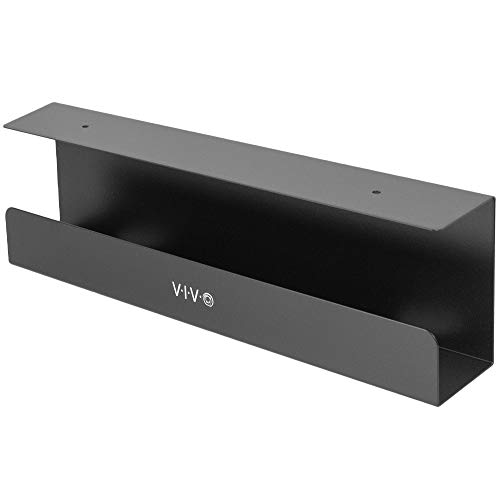
A 17-inch tray is widely considered the industry sweet spot. It is long enough to hold a standard 12-inch surge protector while leaving roughly 2.5 inches of clearance on either side for cables to exit. Many popular options, such as the VIVO Black 17 in Under Desk Cable Management Tray (DESK-AC06-1C) priced around $19, utilize this standard 17-inch length to balance capacity and under-desk real estate.
How to Measure Your Space
To avoid buying a tray that is too small for your gear or too large for your desk, follow these four simple measurement steps:
- Measure Your Power Strip’s Footprint: Use a tape measure to find the exact length, width, and height of your power strip. Do not just measure the housing; include the stiff strain-relief boot where the main power cord exits the strip. Add at least 4 inches to this total length to determine your minimum tray length.
- Calculate Vertical Clearance for Plugs: Plug your bulkiest AC adapters into the power strip and measure from the bottom of the strip to the highest point of the bent cable. This is your minimum required tray depth. Standard power bricks can easily stick up 3 to 4 inches, meaning you will need a tray with at least 4 inches of depth to keep them from pressing against the underside of your desk.
- Check for Under-Desk Obstructions: Look under your desk for support beams, crossbars, drawers, or grommet holes. Standing desks often have central motorized drive shafts or structural steel frames that run close to the desktop surface. Measure the open, flat wood space available to ensure your chosen tray can be screwed in or clamped on without hitting these obstacles.
- Evaluate Your Desk Lip for Mounting: If you do not want to drill holes into your desktop, you will likely opt for a clamp-on model like the VIVO Black Clamp-on 17 in Cable Management Tray (DESK-CM6L-B), which retails around $39. Measure your desk’s edge thickness (clamps usually support thicknesses from 0.4 to 2.3 inches) and ensure there is at least a 2-inch deep lip for the clamps to grip securely.
By Room or Use Case
Different environments demand different approaches to cable management. Choosing the right size tray depends heavily on what you plug in and where the desk is located.
Home Office & Standing Desks
Looking ahead to home office trends in 2026, clean and wireless-looking setups continue to dominate workspace design. For a standard sit-stand desk with a laptop, a docking station, and one or two monitors, a standard 17-inch tray is ideal. Because standing desks move up and down, your tray must securely hold the power strip so it does not shift during transitions. A screw-mounted tray like the VIVO 17-inch model (around $19) keeps everything rigid, while a no-screw, adhesive, or hanging system like the Scanfield Under Desk Cable Management Tray 2-Pack (around $31) offers modularity without damaging premium wood desktops.
Gaming Stations
Gaming setups are notorious for heavy power demands. With high-wattage power supplies (often 850W to 1200W), multiple gaming monitors, external speakers, and RGB lighting controllers, a single 6-outlet strip is rarely enough. Gamers usually need a heavy-duty 10-to-12-outlet surge protector. For this setup, you need a large 24-to-30-inch tray, or a dual-tray system. Using a 2-pack of 17-inch trays allows you to place them side-by-side, dedicating one tray to the power strip and heavy bricks, and the other to routing low-voltage data cables (HDMI, DisplayPort, USB) to prevent electromagnetic interference.
Living Room Entertainment Centers
In the living room, a cable tray mounted to the back of a TV console or media cabinet keeps dangerous cords away from toddlers and pets. Entertainment systems feature a mix of streaming boxes, gaming consoles, soundbars, and subwoofers. Because these devices are spread out horizontally, an extra-large 36-to-48-inch steel wire channel is highly recommended. This allows you to run cables from both ends of the console into a central, high-capacity power strip hidden directly behind the center of the TV.
Compact Workspaces & Writing Desks
If you work from a small writing desk or a kitchen nook, space is at a premium. A massive steel tray will look bulky and ruin the desk’s silhouette. For these minimalist setups, look for compact 11-to-12-inch wire baskets or simple cable sleeve bundles. A budget-friendly option like a Large Bundle Cord and Power Strip Organizer (often sold in multi-pairs or simple basket styles for around $9) provides just enough room to tuck away a small 3-outlet strip and a laptop charger, keeping the floor completely clear.
Common Sizing Mistakes
Avoid these frequent pitfalls when selecting your cable tray size:
- Buying a Tray That Matches the Power Strip Exactly: If you buy a 12-inch tray for a 12-inch power strip, you will have no room to plug in the main power cord, which requires a gentle bend. Always size up by at least 4 inches.
- Ignoring the “Bend Radius” of Heavy-Duty Cords: Thick 14 AWG power cables cannot bend at sharp 90-degree angles without damaging the internal copper wiring. Ensure your tray has enough width (at least 4 inches) to allow cables to curve naturally as they exit the power strip.
- Forgetting to Factor in Height for “Wall Warts”: Many smart home devices and external hard drives use bulky square adapters. If your tray is only 2.5 inches deep, these adapters will stick up past the rim of the tray and press against the bottom of your desk, preventing the tray from mounting flush or causing the plugs to bend dangerously.
- Overloading the Weight Limit: Cheap, thin plastic or wire mesh trays can sag under the weight of a heavy metal surge protector and three or four copper power bricks. Check the weight rating of your tray; quality steel models can easily support 11 to 15 pounds, whereas flimsy adhesive models may fail if loaded past 5 pounds.
FAQ
Can I use multiple smaller cable trays instead of one large one?
Yes, using multiple smaller trays is often highly recommended. For example, installing two 17-inch trays side-by-side instead of one single 36-inch tray gives you more flexibility. It allows you to leave a gap in the middle to route monitor cables down directly, and makes it easier to work around under-desk support beams or grommet holes.
How much weight can a standard under-desk cable tray hold?
A standard screw-mounted or clamp-on steel cable tray typically supports between 10 and 20 pounds (4.5 to 9 kg). High-quality steel clamps, like those on the VIVO DESK-CM6L-B, provide excellent structural rigidity. Conversely, adhesive-mounted trays are usually limited to 3 to 5 pounds and are better suited for lightweight cords rather than heavy metal surge protectors.
Should I choose a clamp-on or screw-mounted cable tray?
Choose a clamp-on tray if you have a high-quality wood, glass, or metal-framed desk and want to avoid drilling permanent holes. Clamps also make it easy to reposition the tray later. Choose a screw-mounted tray if you want a flush, completely hidden look under the desk, or if your desk has a beveled edge that cannot accommodate standard C-clamps.
How do I prevent my power strip from overheating inside a cable tray?
To prevent heat buildup, choose a tray with an open-wire mesh design or ventilation slots rather than a solid plastic box. Ensure you do not overstuff the tray with excess cable slack, which blocks airflow. Power strips running high-draw appliances (like gaming PCs or space heaters) require constant ambient air circulation to dissipate heat safely.
Related guides
- Best Mini-LED Monitor: Five Listings From a Renewed KTC to a 5K LG, Compared by Pixels and Ports (2026)
- Curved vs Flat Monitor: Which to Choose for Your Desk
- 1440p vs 4K Monitor: Which Should You Choose?
- Best Curved Monitor: Seven 24 to 34 Inch Picks Compared by Curve Radius, Resolution and Inputs (2026)