
Good lighting flatters you on camera far more than megapixels do, and the two desk options people weigh are a ring light and a key light (a rectangular LED panel). They light your face differently, cast different catchlights in your eyes, and suit different desks. Here is how to choose for calls and streams.
As an Amazon Associate we earn from qualifying purchases at no extra cost to you.

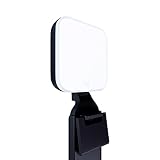


Top 3 picks at a glance
How each light shapes your face
A ring light is a circular LED that surrounds the camera, throwing flat, even, shadowless light straight at you. That evenness hides blemishes and is beginner-proof, but it can look a little clinical and leaves a telltale circular reflection in glasses and eyes. A key light is a flat panel placed off to one side and slightly above, creating soft directional light with gentle shadow that adds depth and a more cinematic, three-dimensional look.
| Factor | Ring light | Key light (panel) |
|---|---|---|
| Look | Flat, even | Soft, dimensional |
| Glasses glare | Ring reflection likely | Easier to avoid |
| Placement | Around/behind camera | Off to one side, above |
| Desk footprint | Small clamp or stand | Needs side space or arm |
| Best brightness | Adjustable, ~10-18 W | Adjustable, 1000-1600 lm |
| Typical cost | $20-60 | $60-130 |
Ring light strengths and weaknesses
Ring lights are cheap, compact, and hard to get wrong: mount one around your webcam and your face is evenly lit in seconds. They shine for makeup, close-up talking-head calls, and small desks. The downsides are the flat, slightly artificial look and the circular catchlight, which is distracting on anyone wearing glasses.
Key light strengths and weaknesses
A key light panel with a diffuser produces the softer, more professional look most streamers prefer, with shadow that sculpts your features. It also sits off-axis, so glasses wearers avoid the ring reflection. The trade-offs are higher cost, a larger footprint, and a short learning curve to position it at roughly 45 degrees to one side and above eye level.
Which to buy for your desk
Choose a ring light if you want the simplest, cheapest, most foolproof lighting, you take mostly close calls, and desk space is tight. Choose a key light if you wear glasses, you stream or record and want a polished dimensional look, and you have room to place a panel to the side, ideally on a clamp arm to save desktop space. Many enthusiasts start with a ring light and graduate to a key light (or add a second panel as fill) as their setup matures.
Color temperature and control matter more than raw power
Whichever you buy, two features do the heavy lifting: adjustable brightness and adjustable color temperature. Aim for a neutral white around 4000 to 5000 K for most rooms; going too warm (below 3000 K) tints you orange, and too cool (above 6000 K) looks clinical and blue. If you work near a window, being able to shift the light warmer or cooler to match the daylight prevents the split-color look where half your face is lit by sun and half by LED. A diffuser, whether the frosted front of a ring or a fabric panel over a key light, softens harsh shadows and calms the catchlight in your eyes. Finally, mount the light on its own small stand or clamp arm rather than resting it on the desk, so a bump does not swing your lighting mid-call.
FAQ: Which is better if I wear glasses?
A key light. Because it sits off to the side rather than ringing the lens, you can angle it to keep reflections out of your lenses. A ring light almost always leaves a bright circular reflection in glasses on a straight-on call.
FAQ: How bright should a desk light be for video calls?
Enough to be your dominant light source without squinting. A dimmable ring around 10 to 18 watts or a key panel around 1000 to 1600 lumens, softened with a diffuser and set to a neutral 4000 to 5000 K, lights most desks well. Always keep your face brighter than the background.
Bottom line
Ring lights win on price, size, and simplicity for straight-on calls; key lights win on a natural dimensional look and glasses-friendly placement for streaming and recording. Pick the ring for foolproof convenience or the key panel for a more professional result, and in both cases position the light in front of you, brighter than whatever is behind.


