
The Short Answer
Yes, a monitor arm is worth it for ergonomics if your monitor’s built-in stand won’t let you raise the screen so the top edge sits at or just below eye level. That’s the one condition that matters most. If your stand already achieves that height — and lets you push the screen roughly 20 to 30 inches from your eyes — an arm adds convenience, not much ergonomic benefit. For everyone else, and that’s most people using stock stands, a monitor arm is one of the cheapest ergonomic upgrades you can make. Decent models start around $25 to $40, which is a fraction of what you’d pay for an ergonomic chair or sit-stand desk.
What You Actually Get
A monitor arm replaces your monitor’s stock stand with an adjustable pole-and-gas-spring mount that clamps to the back edge of your desk. You get three kinds of movement a fixed stand can’t offer: height adjustment (typically 4 to 15 inches of vertical travel), depth adjustment (push the screen forward to center it over your desk rather than sitting in the footprint of its stand), and tilt or rotation (most arms tilt ±45 to ±90 degrees and rotate from landscape to portrait).
As an Amazon Associate we earn from qualifying purchases at no extra cost to you.

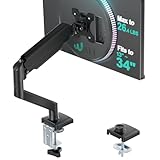
The ergonomic payoff comes from proper positioning. Ergonomists generally recommend the top of your screen sits at or slightly below eye level, about an arm’s length away, tilted back 10 to 20 degrees. Most stock stands max out with the screen only 2 to 4 inches above the desk — far too low if you’re over 5’8″ or so. An arm fixes that instantly. It also frees up the desk space the stand’s base occupied, usually 8 to 10 inches by 7 to 9 inches, which you can reclaim for a keyboard tray, notebook, or simply more surface area.
Installation is simpler than most people expect. Take the ErGear Single Monitor Arm ($26.99) as a typical example: it clamps to desks up to about 2.4 inches thick (grommet mounting is also included), supports 13- to 34-inch screens up to 19.8 pounds, and uses a tool-free VESA plate that clicks onto the back of your monitor. Most people finish the swap in 15 to 25 minutes. The WALI Adjustable Single Monitor Arm, also $26.99, covers similar territory — 13- to 34-inch screens up to 26.4 pounds — with a heavier weight capacity if you’ve got a beefier display.
Check two specs before buying anything: your monitor’s VESA pattern (75x75mm or 100x100mm on nearly all modern displays) and its weight without the stand. A 27-inch monitor typically weighs 9 to 13 pounds bare, well within both arms’ limits. Ultrawide 34-inch curved panels run heavier, so verify capacity.
Pros
- Genuine height adjustment. Gas-spring arms move smoothly through a 10-plus-inch vertical range, so you can set the screen exactly at eye level — the single most impactful monitor ergonomic fix.
- Better viewing distance and angle. Push the screen farther back and tilt it to reduce neck strain, then readjust in seconds whenever you change seating posture.
- Frees up desk space. The stand’s footprint disappears, giving you back roughly 70 to 90 square inches of surface.
- Built-in cable management. Both the ErGear and WALI arms include channels or clips to route cables along the arm, so raising and lowering the screen doesn’t yank your cords.
- Landscape-to-portrait rotation. Useful for coding, writing, or reading long documents without scrolling.
- Two-monitor readiness. Many single arms are cross-compatible, so adding a second screen later is a small upgrade rather than a new setup.
- Very low cost of entry. At $26.99 for both the ErGear and WALI models, this is among the cheapest ergonomic improvements available.
Cons
- Desk quality matters. Arms clamp onto the desk edge; particleboard desks under about 3/4 inch thick, or desks with weak backs, can flex or crack under leverage. Glass desks generally won’t work with clamps.
- Bounce and wobble. Cheap arms can shake noticeably when you type on a standing desk or nudge the desk. Gas-spring tension needs tuning to your monitor’s weight.
- Installation still takes effort. You’ll unscrew the stock stand, mount the VESA plate, and route cables — plan for 20 to 30 minutes, and a second pair of hands helps with large monitors.
- Weight limits. Exceed the rated capacity (19.8 lbs on the ErGear, 26.4 lbs on the WALI) and the arm will sag or fail to hold height.
- Recessed or proprietary VESA mounts. Some slim monitors (certain Apple, Samsung, and portable displays) need an adapter or can’t be arm-mounted at all.
- Aesthetics aren’t for everyone. The pole and clamp are visible even with cable management.
Who Should Buy It
You should buy a monitor arm if any of these describe you: your monitor stand doesn’t raise the screen to eye level; your neck aches after long work sessions; your desk is cluttered and the stand’s base is in the way; you alternate between sitting and standing (an arm keeps the screen at the right height in both positions); or you use a large desk and want the screen centered rather than pushed back by its stand. Budget buyers are well served here — at $26.99, the ErGear and WALI arms cost less than most ergonomic mice.
Who Should Skip It
Skip it if your current stand already positions the screen correctly and you never adjust it; if your desk is glass, thin, or otherwise unsuitable for clamping (consider a freestanding monitor stand instead); if your monitor has a fixed, non-removable stand or lacks a VESA mount; or if you rarely sit at the desk and the adjustment won’t get used. Also skip it if you plan to mount a monitor weighing more than the arm’s rated capacity — a heavy-duty arm (or a wall mount) is the better purchase.
Cheaper Alternatives
| Option | Cost | Trade-off |
|---|---|---|
| Monitor riser stand (wood or metal) | $15–$35 | Adds fixed 3–5 inches of height; no tilt, depth, or fine adjustment; keeps the stand’s footprint |
| Stack of books or a sturdy box | $0 | Free and effective for height, but looks rough and offers zero adjustability or stability |
| Monitor stand with adjustable height (e.g., column-style riser) | $25–$50 | Better adjustability than a riser but still bulky; can’t do portrait rotation |
| Replacement monitor with height-adjustable stand | $150+ | Cleanest look and built-in ergonomics, but far more expensive than any arm |
| VESA wall mount | $20–$60 | Frees all desk space and never wobbles, but is permanent, requires drilling, and can’t move with a standing desk |
For the price of a riser, an arm simply does more — which is why the arm wins the cost-to-benefit comparison in nearly every case. Prices for quality single arms have stayed flat through 2026, and the sub-$30 tier from brands like ErGear and WALI covers most 13- to 34-inch monitors adequately.
FAQ
Will a monitor arm actually reduce neck pain?
It can, if neck pain comes from looking down at a low screen — the most common cause. Raising the top of the monitor to eye level reduces the constant downward head tilt that strains the cervical spine. If your pain stems from chair height, desk height, or posture habits, the arm alone won’t solve it, but proper screen height is still a necessary part of the fix.
Will a monitor arm fit my desk?
Most clamp-style arms fit desks 0.4 to 2.4 inches thick with at least 2 inches of clearance behind the desk edge. Measure both before buying. Glass desks, desks with thick back trim, or desks with cable troughs running along the rear edge may need a grommet mount (if your desk has a hole) or a freestanding base instead.
Do all monitors work with monitor arms?
Nearly all monitors with a 75x75mm or 100x100mm VESA mount do. Check your monitor’s manual or the back panel for four threaded holes. Some ultra-thin and all-in-one displays lack VESA mounts or hide them behind fixed stands; adapters exist for a few models but add cost and hassle. Also confirm your monitor’s bare weight is under the arm’s rating — 19.8 lbs on the ErGear, 26.4 lbs on the WALI.
Are cheap monitor arms sturdy enough, or should I spend more?
For a single monitor under 20 pounds on a solid desk, budget arms in the $25 to $40 range are generally sturdy enough for everyday use. Expect a little more bounce on standing desks and slightly stiffer joints than premium arms offer. If you’re mounting a 34-inch ultrawide, a dual-monitor setup, or anything over 26 pounds, step up to an arm rated for that load rather than gambling on the budget tier.


