
There is a distinct, stomach-churning sound that every premium workspace enthusiast dreads: the slow, metallic groan of a cheap monitor arm yielding to a heavy ultrawide screen. You spend upwards of $1,000 on a breathtaking 49-inch curved monitor, only to watch it slowly tilt face-down toward your desk like a wilted flower because you tried to save $30 on the mount.
When dealing with massive displays, standard buying advice fails. Most consumer monitor mounts are designed for flat, lightweight 27-inch screens. When you clamp a massive, aggressively curved screen to these standard arms, the physics change. The center of gravity shifts forward, the leverage on the tilt joint multiplies, and cheap tension springs simply collapse. To keep your investment safe and your sightlines ergonomic, you must look past basic marketing claims and focus on the cold, hard physics of desk mounting.
As an Amazon Associate we earn from qualifying purchases at no extra cost to you.
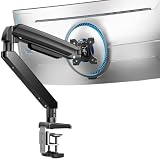


Top 3 picks at a glance
Decide These 3 Things First
Before you enter your credit card information, you must evaluate your current desk setup. A heavy-duty monitor arm does not exist in a vacuum; it is part of a structural system that includes your desktop and your wall clearance.
- Your Desk Material: This is the most common failure point. Heavy-duty arms clamp a massive amount of weight onto a tiny surface area. If your desk is made of hollow-core MDF, particleboard, or glass, a heavy ultrawide setup can literally crush or crack the desktop. Solid wood, thick plywood, or metal-framed desks are highly recommended. If you must use MDF, you will need to purchase a steel reinforcement plate to distribute the clamping force.
- The Net Weight (Without the Stand): Monitor manufacturers list the “product weight with stand.” You need to find the “weight without stand” (often listed as VESA-mount weight). This is the actual load the arm will support. For a typical 49-inch ultrawide, this weight ranges from 25 to 40 pounds.
- Your Depth Clearance: Heavy-duty articulating arms require physical space behind the desk to fold back properly. If your desk is pushed flush against a wall, you may have to pull it forward 2 to 6 inches to achieve your desired screen depth, or opt for a post-style mount that offers less articulation but sits closer to the back edge.
Decide Your Size and Weight Capacity
Do not buy a monitor arm based solely on the screen size rating. A box that says “supports up to 49-inch screens” is meaningless if your specific monitor exceeds the weight limit or has an extreme curve.
For heavy ultrawides, weight capacity is the primary safety metric. Standard heavy-duty mounts usually support up to 33 pounds (like the VIVO Premium Aluminum mount), while ultra-heavy-duty options support up to 44 pounds (like the HUANUO TitanLift or WALI Heavy Duty mounts). Always leave a safety buffer of at least 10% to 15%. If your monitor weighs 31 pounds without the stand, do not buy a mount maxing out at 33 pounds; aim for one rated for 37.4 pounds (like the ErGear Heavy Duty mount) or higher to prevent long-term spring fatigue.
Evaluate Material and Joint Construction
As we look ahead to workspace trends in 2026, the materials used in monitor arm construction have become more sophisticated, yet the fundamental laws of physics remain. You want to look for die-cast aluminum or heavy-gauge steel. Avoid any arm that uses plastic in its load-bearing joints, especially the VESA bracket and the tilt mechanism.
The tilt joint is the single most critical component for an ultrawide monitor. Because curved screens (especially deep 1000R curves) sit several inches forward from the VESA plate, they exert immense rotational torque on the tilt joint. If this joint is secured by a simple friction screw, the monitor will inevitably droop downward. Look for arms with reinforced tilt heads, heavy-duty tilt bolts, or specialized mechanical tilt locks that can handle the forward-shifting center of gravity.
Optimize for Comfort and Ergonomic Performance
A great monitor arm should move effortlessly when you want it to, and stay perfectly still when you don’t. This balance is dictated by the internal counterbalance mechanism: gas spring (pneumatic) versus mechanical spring.
- Gas Spring (Pneumatic): These arms use a pressurized gas cylinder to offset the monitor’s weight. They offer incredibly smooth, fluid, one-handed adjustments. However, gas cylinders can slowly lose pressure over several years of supporting a maximum load.
- Mechanical Spring: These use heavy coiled steel springs. While they can require a bit more physical effort to adjust initially, they are incredibly durable, do not degrade over time, and are highly reliable for holding maximum weight loads at stable heights.
For proper ergonomics, ensure the arm offers at least 10 to 20 inches of height adjustment, can extend forward up to 24 inches, and offers a tilt range of at least +15° to -15°. If you like to stand at your desk, make sure the maximum height of the arm allows the top third of your ultrawide screen to remain at eye level when you are standing upright.
Analyze the Price Tiers
The market for heavy-duty monitor arms is divided into distinct price brackets, and what you pay directly correlates with material tolerances and joint longevity.
- Budget ($35 to $60): These are typically steel-constructed, basic spring-tension arms like the ErGear or WALI models. They are incredibly strong and get the job done, but adjustments can feel stiff, and they often require two hands to position safely. They are excellent if you plan to set your monitor in one place and rarely move it.
- Mid-Range ($70 to $130): This tier features polished aluminum constructions, smoother gas spring cylinders, and dual C-clamp bases (such as the HUANUO TitanLift or VIVO Premium models). They offer a great balance of aesthetic appeal, smooth articulation, and robust tilt mechanisms designed specifically for curved displays.
- Premium ($150 to $350+): These are commercial-grade mounts featuring highly engineered mechanical spring systems and heavy-duty pivot joints. They offer effortless, one-finger adjustments and are built to support the absolute heaviest 1000R curved screens on the market without a millimeter of sag over a decade of use.
Check the Mounting and Assembly Logistics
Installing a monitor arm for a 40-pound display is a two-person job. Before you begin, examine how the base attaches to your desk. There are two primary options:
Dual C-Clamp: This is the most secure option for heavy ultrawides. Instead of a single small clamp, a dual C-clamp uses a wider metal plate with two separate clamping screws to distribute the physical weight across a wider section of your desktop. Ensure your desk lip is at least 2.5 to 3 inches deep to accommodate the clamp bracket.
Grommet Mount: This method bolts the arm directly through a hole in your desktop (usually 0.4 to 2.5 inches in diameter). This is structurally the strongest mounting method because it prevents the arm from slipping or tipping forward, but it requires drilling a hole if your desk doesn’t have a pre-existing cable grommet.
Spec Checklist
Use this quick-reference table to compare what you should expect across different budget categories when shopping for a heavy-duty ultrawide monitor arm.
| Specification | Budget Tier ($35 – $60) | Mid-Range Tier ($70 – $130) | Premium Tier ($150 – $350+) |
|---|---|---|---|
| Weight Capacity | 33 to 37.4 lbs | 33 to 44 lbs | 40 to 44+ lbs (with heavy-duty tilt) |
| Primary Material | Heavy-gauge Steel | Die-cast Aluminum & Steel | Polished Aircraft-grade Aluminum |
| Counterbalance | Mechanical Spring / Friction | Gas Spring (Pneumatic) | Premium Mechanical Spring |
| Base Mount Type | Single or Dual C-Clamp | Heavy-duty Dual C-Clamp | Reinforced Single/Dual Bolt Grommet & Clamp |
| Tilt Joint Design | Standard Hex Bolt Friction | Reinforced Tension Plate | Heavy-Duty Pivot Lock (1000R compatible) |
Red Flags
When shopping, look out for these warning signs that indicate a monitor arm is not fit for a heavy ultrawide:
- Single, Narrow C-Clamp Bases: If the base clamp is less than 3 inches wide and only has one small tightening screw, it will put immense pressure on a tiny section of your desk, risking structural damage and instability.
- Ball-and-Socket Tilt Joints: Avoid arms that use a ball-joint to control screen tilt. While highly adjustable, these joints lack the mechanical leverage required to hold a heavy, curved screen upright, leading to instant monitor sag.
- Vague Weight Ratings: If a listing boasts “supports up to 49 inches” but buries the weight limit in the fine print, or lists a maximum capacity under 30 pounds, it is not designed for modern, heavy ultrawide screens.
FAQ
Can I use a standard monitor arm for a curved 49-inch ultrawide?
No. Standard monitor arms are built for flat screens with a centered weight distribution. Curved ultrawide screens have a center of gravity that sits several inches forward, which multiplies the downward rotational force (torque) on the tilt joint. Standard arms will immediately droop, even if the monitor’s weight is technically under the arm’s stated limit.
What is the difference between a gas spring and a mechanical spring?
Gas spring arms use compressed gas cylinders to provide smooth, effortless, fluid motion, which is ideal if you adjust your monitor height frequently throughout the day. Mechanical spring arms use heavy coiled steel springs; they require slightly more effort to adjust but are highly durable and hold heavy weight loads consistently over many years without losing tension.
Do I need a reinforcement plate for my desk?
If your desk is made of solid hardwood (like oak, walnut, or butcher block) or thick plywood, you do not need a reinforcement plate. However, if your desk is made of MDF, particleboard, or has a hollow honeycomb core (like many budget flat-pack desks), a reinforcement plate is highly recommended to distribute the clamping pressure and prevent the wood from crushing.
How does the curve radius (like 1000R) affect the arm’s weight capacity?
The “R” rating refers to the curve radius; a 1000R curve is much deeper and more aggressive than an older 1800R curve. The deeper the curve, the further forward the monitor’s center of gravity shifts away from the VESA mount. This forward shift acts as a lever, making a 30-pound monitor exert the physical force of a 40-pound monitor on the tilt joint. Always look for arms that explicitly state compatibility with 1000R curved screens.


