
A 16-inch MacBook Pro is a powerful machine, but its low, flat profile on a desk is a fast track to neck strain, hunched shoulders, and poor airflow. Even with its large Liquid Retina XDR display, typing for hours while looking down forces your spine out of alignment, and the aluminum chassis can trap heat against a desk surface during sustained creative work or video calls.
A good laptop stand solves both problems by elevating the screen to eye level and opening up ventilation underneath. For the larger 16-inch model, stability and footprint matter more than with a 13-inch Air. We focused on stands that can securely support its weight and width without wobbling, while still fitting a typical home office desk. In 2026, with hybrid work still the norm, these risers and holders have become essential desk accessories for posture correction and a cleaner workspace.
As an Amazon Associate we earn from qualifying purchases at no extra cost to you.





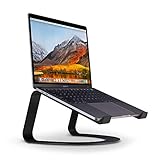


Our Top Picks
 Nulaxy Full Aluminum Laptop Stand1 Count (Pack of 1)11.5 x 8.3 x 2.3 inches1.8 poundsCheck on Amazon


Top 3 picks at a glance
Quick Picks
| Product | Best for | Price |
|---|---|---|
| Nulaxy Ergonomic Adjustable Laptop Stand for Desk, Dual Foldable Computer Riser with Advanced Heat-Vent, Heavy-Duty Portable Notebook Holder for Posture Correction, Compatible with Mac 10-16″ Laptops | Best Budget Foldable | Check on Amazon |
| LOXP Adjustable Laptop Stand, Computer Stand with 360 Rotating Base | Best for 360-Degree Rotation | Check on Amazon |
| Lamicall Aluminum Laptop Stand for Desk for MacBook Air Pro Neo 10-17.3” | Best Fixed Aluminum Riser | Check on Amazon |
| Nulaxy Full Aluminum Laptop Stand, Stable Support to 22 lbs, Open Cooling | Best Ultralight Value | Check on Amazon |
| Laptop Stand for desk(360°Rotating),Aluminum laptop Riser for 10-16″Laptops | Best Snug-Fit Rotating Riser | Check on Amazon |
| Twelve South Curve Cooling Laptop Stand | Best Design-Focused Fixed Riser | Check on Amazon |
| tounee Telescopic Laptop Stand for Desk with 360° Swivel Base, Sit to Stand, Height Adjustable, Portable Riser Holder for Good Posture, Compatible with MacBook Pro, All Laptops 10-17″-Gray | Best for Sit-to-Stand Desks | Check on Amazon |
| Bestand Laptop Stand Aluminum Cooling Computer Stand Holder for Apple MacBook Air Pro 11-16″ Laptops (Gray) | Best Open Cooling Design | Check on Amazon |
How We Compared
We prioritized stands that are explicitly compatible with the 16-inch MacBook Pro, which measures 14.01 inches wide and weighs about 4.7 pounds for the M3 Pro/Max models. Stability under load was the first filter, followed by adjustability, cooling design, and desk footprint. We compared fixed-height aluminum risers against folding and telescopic designs to cover different work styles, from permanent desk setups to portable and sit-to-stand use.
Price range was also a key factor, spanning budget, mid-range and premium options to identify value at every tier. We evaluated stated weight capacity, materials, hinge quality, and ventilation features like open backs and heat-vent cutouts, while avoiding unverified performance claims. Ergonomics guided our final rankings, favoring options that raise the screen 6 to 10 inches to bring the display closer to eye level when paired with an external keyboard and mouse.
The Best Picks
1. Nulaxy Ergonomic Adjustable Laptop Stand for Desk, Dual Foldable Computer Riser with Advanced Heat-Vent, Heavy-Duty Portable Notebook Holder for Posture Correction, Compatible with Mac 10-16″ Laptops
This dual-foldable riser is ideal for anyone who wants an affordable, adjustable stand that travels well and handles the full width of a 16-inch MacBook Pro. Its folding design collapses flat for a backpack, and the heat-vent structure keeps airflow moving during long work sessions. As a budget pick, it is one of the lowest-priced options that still offers height and angle adjustment for posture correction.
- Pros: Highly portable dual-foldable build; adjustable angles help reduce neck strain
- Pros: Advanced heat-vent design promotes cooling without a fan
- Con: Foldable joints can feel less rigid than a solid aluminum riser at full extension
When to skip: If you need a completely wobble-free, single-piece aluminum stand for a permanent desk setup, choose a fixed-weight alternative.
2. LOXP Adjustable Laptop Stand, Computer Stand with 360 Rotating Base
Built for collaboration and flexible viewing, this stand is best for users who frequently share their screen or switch between typing and presenting. The 360-degree rotating base lets you turn the 16-inch MacBook Pro smoothly without lifting the machine, which is useful in meetings or at a kitchen island. It adds rotation without pushing into the premium tier.
- Pros: 360-degree swivel makes screen sharing effortless
- Pros: Adjustable height helps align the large 16-inch display with eye level
- Con: Rotating base adds footprint diameter, requiring more desk clearance
When to skip: If your desk is narrow or crowded, a compact fixed stand will save space.
3. Lamicall Aluminum Laptop Stand for Desk for MacBook Air Pro Neo 10-17.3”
This Lamicall model is a solid choice for users who want a stable, minimalist riser that will hold a 16-inch MacBook Pro plus larger 17.3-inch notebooks. The one-piece aluminum construction resists flex and provides a clean, elevated platform that improves ergonomics and hides cables underneath. As a mid-range pick, it balances build quality and cost for a dedicated home office desk.
- Pros: Wide compatibility from 10 to 17.3 inches accommodates the 16-inch Pro with room to spare
- Pros: Single-piece aluminum design offers excellent stability for daily typing with an external keyboard
- Con: Fixed height and angle offer less customization than adjustable folding stands
When to skip: If you need variable height for alternating sitting and standing, consider a telescopic model.
4. Nulaxy Full Aluminum Laptop Stand, Stable Support to 22 lbs, Open Cooling
For shoppers prioritizing value and thermals, this full aluminum stand stands out. It is rated to support up to 22 lbs, which is more than four times the weight of a 16-inch MacBook Pro, so there is no concern about sag or instability. The open design maximizes air circulation around the chassis. It is one of the most affordable aluminum options in this roundup.
- Pros: 22-lb weight capacity ensures rock-solid support for the 16-inch model
- Pros: Open cooling structure reduces heat buildup during intensive tasks
- Con: Lightweight aluminum can slide on slick desks without a non-slip mat
When to skip: If you need height adjustment or rotation, this fixed-profile cooler is too basic.
5. Laptop Stand for desk(360°Rotating),Aluminum laptop Riser for 10-16″Laptops
Designed specifically for laptops up to 16 inches, this aluminum riser is a precise fit for the MacBook Pro 16 without excess overhang. The 360-degree rotation is paired with a sturdy aluminum base that keeps the machine centered while turning. It sits in the mid-range for users who want rotation plus a more tailored, snug platform.
- Pros: Tailored 10-16 inch fit centers the MacBook Pro 16 securely
- Pros: Aluminum riser with 360-degree rotation combines stability and flexibility
- Con: Upper limit of 16 inches leaves no margin if you also use a larger secondary laptop
When to skip: If you regularly switch between a 16-inch Pro and a 17-inch workstation, choose a 17.3-inch compatible stand.
6. Twelve South Curve Cooling Laptop Stand
The Twelve South Curve is a long-running MacBook favorite for buyers who want a fixed riser that looks like part of the desk. Its single curved aluminum frame holds the laptop by the edges, so the bottom panel is open to the air, and it lifts the screen about 6.5 inches, a comfortable height for most users at a standard 29 to 30-inch desk when paired with an external keyboard. The 16-inch MacBook Pro sits securely on its silicone-padded arms. It costs more than the budget aluminum risers here, so it suits buyers who value the matte finish and open-air design.
- Pros: Open-air design leaves the bottom panel uncovered for cooling
- Pros: Durable aluminum build with silicone pads to prevent slipping and scratching
- Con: Non-adjustable angle may not suit very tall users who need higher elevation
When to skip: If you need telescoping height or swivel, this static riser will not adjust enough.
7. tounee Telescopic Laptop Stand for Desk with 360° Swivel Base, Sit to Stand, Height Adjustable, Portable Riser Holder for Good Posture, Compatible with MacBook Pro, All Laptops 10-17″-Gray
This is the pick for ergonomic flexibility. The telescopic column adjusts height for sit-to-stand workflows, and the 360-degree swivel base allows easy repositioning throughout the day. It is one of the few stands here designed to function as a true sit-to-stand riser for a 16-inch MacBook Pro while remaining compatible with laptops from 10 to 17 inches. It sits in the premium tier for users who change posture often.
- Pros: Telescopic height adjustment supports healthy sit-to-stand transitions
- Pros: 360-degree swivel base plus broad 10-17 inch compatibility
- Con: Costs more than most risers here, and the larger vertical column requires stable desk placement
When to skip: If you work at a fixed seated desk and want the smallest footprint, a low-profile riser is more efficient.
8. Bestand Laptop Stand Aluminum Cooling Computer Stand Holder for Apple MacBook Air Pro 11-16″ Laptops (Gray)
The Bestand stand is built for cooling and clean aesthetics on an Apple-focused desk. Its aluminum holder elevates the MacBook Pro 16 to improve viewing angle while the open underside dissipates heat without blocking vents. Sized for 11 to 16-inch Apple laptops, it frames the 16-inch model neatly. It is a mid-range choice for users who value thermal design and color-matched finish.
- Pros: Aluminum cooling holder helps maintain airflow during long renders and calls
- Pros: Compact holder design frees up desk space underneath for a keyboard or notebook
- Con: Limited to 16 inches maximum, less versatile for larger laptops
When to skip: If you need rotation or adjustable height, this fixed cooling stand lacks those features.
More Stands Worth Considering for a 16-Inch MacBook Pro
The eight picks above focus on value aluminum risers and rotating stands. Editorial MacBook stand guides also keep coming back to a few designs this list was missing: a classic one-piece riser with a long track record, a premium adjustable stand that raises the webcam for video calls, a vertical stand for clamshell mode, a taller telescopic riser, and a foldable riser that reaches higher than our current foldable pick. These five fill those gaps.
Rain Design mStand Laptop Stand
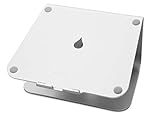
The mStand has been one of the most recommended MacBook stands for well over a decade, and it still shows up in nearly every editorial roundup. It is a single solid piece of aluminum with no hinges or joints, so there is nothing to loosen, creak, or wobble when you type on an external keyboard.
Rain Design’s specs: about 10 inches wide, 7.5 inches deep, and 5.9 inches tall at the back, weighing about 3 pounds. The stand raises the laptop roughly 3 inches at the front and 6 inches at the rear, tilting the screen toward you. Rubber pads keep the MacBook from touching the aluminum, and a 2-inch hole at the back keeps the charging cable tidy. It works with laptops less than about 10.4 inches deep, which covers the 16-inch MacBook Pro, and it comes in finishes that match Apple’s silver, space gray, midnight, and starlight colors.
Who it is for: anyone with a permanent desk setup who wants a stand that matches the MacBook and will last for years.
Strengths: one-piece rigidity; aluminum body helps draw heat away from the base; heavy enough that it does not slide; clean cable routing.
Drawbacks: fixed height and angle; around 6 inches of lift may be too low for tall users without a monitor arm or desk riser; heavy and bulky for travel. Rain Design does not publish a maximum load. It sits in the mid-range tier.
How it compares: it plays the same role as our Lamicall and Twelve South Curve fixed risers but with a heavier, solid build and a long reputation. If you want rotation, the mStand360 version adds a swivel base.
Twelve South Curve Flex Adjustable Laptop Stand

The Curve Flex is the premium adjustable pick, and it is especially good on a 16-inch MacBook Pro used for video calls. Its arm unfolds to raise the laptop well above typical risers, which brings the built-in camera close to eye level instead of looking up your nose.
Twelve South’s specs: folds to about 1.2 inches thick and opens to about 10.8 inches tall. With a 16-inch MacBook Pro on it, Twelve South says the top of the screen, and the webcam, sits about 22 inches above the desk. It adjusts from a flat typing wedge to full height, with the keyboard angle ranging from 0 to 45 degrees. It weighs about 1.75 pounds, supports laptops at least 8.66 inches wide and up to 7 pounds, and comes with a padded travel sleeve.
Who it is for: remote workers who spend hours on video calls, taller users, and anyone who wants one adjustable stand for home and travel.
Strengths: by far the highest lift of the fixed-base stands here; infinitely adjustable height and angle; folds flat with a sleeve included; well-finished aluminum.
Drawbacks: premium pricing; at full height the laptop keyboard is unusable, so you need an external keyboard and mouse; a tall, cantilevered design has more bounce than a solid riser if you bump the desk.
How it compares: it covers the height that our tounee telescopic pick offers, without a tall column and swivel base. Choose the tounee for sit-to-stand use and rotation; choose the Curve Flex for a cleaner look and travel.
Twelve South BookArc Flex Vertical Laptop Stand

Not every MacBook Pro needs to be raised. If you run your 16-inch in clamshell mode with the lid closed, connected to an external monitor, keyboard, and mouse, a vertical stand frees up the most desk space. The BookArc Flex holds the laptop upright like a book, taking up a footprint of only about 3.6 by 8.4 inches.
Twelve South’s specs: aluminum with silicone pads, weighing about half a pound. Its flexible arcs close around the laptop under its own weight, so there are no inserts to swap between laptop sizes. Twelve South lists compatibility with MacBook Air and MacBook Pro, including the 16-inch, and laptops up to 1 inch thick; the 16-inch MacBook Pro is around two-thirds of an inch thick.
Who it is for: people who dock their MacBook Pro to a large monitor and want the cleanest, smallest desk footprint.
Strengths: tiny footprint; automatic fit with no inserts; keeps the laptop off the desk and away from spills.
Drawbacks: does nothing for the laptop’s own screen ergonomics; Twelve South notes the laptop should be set in straight, and it suggests a different stand style for desks that get bumped often. Ports end up pointing up or down depending on orientation, so plan cable routing. It sits in the budget to mid-range tier.
How it compares: it is a different category from every riser on this list. Pick it only if the MacBook’s built-in screen is not part of your daily workflow.
Nulaxy LS18 Telescopic 360 Rotating Aluminum Laptop Stand

This Nulaxy model is a taller, sturdier alternative to our tounee sit-to-stand pick. It combines a telescopic column, a rotating base, and an adjustable tilt in one all-metal stand.
From Nulaxy’s listing: the column extends up to about 18 inches, which is enough to use the laptop standing at many desks; the platform rotates 360 degrees for screen sharing; it holds up to 22 pounds; it fits laptops from 10 to 17 inches; and it includes a heat-vent platform. It folds down when not in use.
Who it is for: people who alternate between sitting and standing without a standing desk, and people who share their screen across a table.
Strengths: high lift for standing use; 22-pound capacity gives plenty of margin over a roughly 4.7-pound MacBook Pro; rotation and tilt in one stand.
Drawbacks: at full extension, any telescopic stand has more movement than a low riser; the base needs a sturdy desk and is heavier than a simple riser, so it is not a travel stand. It sits in the mid-range tier.
How it compares: it directly competes with the tounee. The Nulaxy has a higher stated capacity; compare current pricing and pick whichever base fits your desk better.
RIWUCT Aluminum Alloy Foldable Laptop Stand
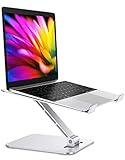
The RIWUCT is a foldable aluminum riser that several recent guides name for the 16-inch MacBook Pro. It is a simple upgrade over our #1 Nulaxy foldable pick for people who want a little more height.
From the listing: it raises the laptop up to about 7.48 inches, adjusts in height and tilt, and folds flat for storage. The laptop rests on two holder arms rather than a flat plate, which leaves space for air to flow underneath. Non-slip strips on the arms and four silicone pads on the base keep the stand and laptop from sliding. It fits laptops from 10 to 16 inches, including the 16-inch MacBook Pro, and it is rated to hold up to 8.8 pounds.
Who it is for: people who want an adjustable, portable stand at a budget price that can still lift a 16-inch MacBook Pro to a comfortable height.
Strengths: more lift than most foldable risers; open-arm design for airflow; folds for a laptop bag.
Drawbacks: the 8.8-pound rating is lower than the 22-pound rated Nulaxy stands, though still well above the MacBook Pro’s weight; the front lip can press against your wrists if you type on the built-in keyboard; reviewers note the hinges start out stiff.
How it compares: pick it over the Nulaxy foldable if you need a bit more height; pick the Nulaxy Full Aluminum if you want a fixed, heavier-duty riser.
Buying Guide
Stability and Size for a 16-Inch MacBook Pro
The 16-inch MacBook Pro is wider and heavier than smaller MacBooks, so prioritize stands rated well above 5 pounds and at least 14 inches wide. Fixed aluminum risers typically feel the most stable, while foldable and telescopic stands trade some rigidity for adjustability. Check whether the stand lists compatibility up to 16 inches exactly or up to 17.3 inches if you own multiple machines. For daily use with an external keyboard and mouse, a weight capacity of 15 to 22 lbs provides a comfortable margin and reduces vibration while typing.
Ergonomics and Adjustability
Look for a lift of 6 to 10 inches to bring the top of the display near eye level when you are seated upright. Adjustable angle stands let you fine-tune the tilt to reduce glare, while telescopic stands are better for sit-to-stand desks where you alternate between seated and standing heights. If you share your screen often, a 360-degree rotating base saves you from dragging the laptop across the desk. Remember that any stand that raises the screen will require a separate keyboard and mouse for comfortable typing.
Cooling, Material, and Portability
Aluminum dissipates heat better than plastic and matches the MacBook finish, while open or vented designs improve airflow around the bottom panel where heat builds up. Rubber or silicone pads are essential to prevent sliding and to protect the desk and laptop. If you move between rooms or travel, a dual-foldable stand that collapses to under an inch thick is far more portable than a one-piece riser. Expect basic foldable or lightweight aluminum models in the budget tier, with rotating and telescopic designs in the mid-range and premium tiers.
Comparison Table: The Additional Picks
| Product | Type | Lift / height | Adjustable | Portable | Price tier |
|---|---|---|---|---|---|
| Rain Design mStand | One-piece riser | About 6 in at rear | No | No | Mid-range |
| Twelve South Curve Flex | Folding adjustable arm | Up to about 10.8 in stand height | Height and angle | Yes, sleeve included | Premium |
| Twelve South BookArc Flex | Vertical (clamshell) | Not a riser | Self-adjusting width | Yes | Budget to mid-range |
| Nulaxy LS18 Telescopic | Telescopic, rotating | Column up to about 18 in | Height, tilt, 360 rotation | No | Mid-range |
| RIWUCT Foldable | Foldable riser | Up to about 7.5 in | Height and tilt | Yes | Budget |
More Things to Know Before You Buy
16-Inch MacBook Pro Size and Weight Facts
Recent 16-inch MacBook Pro models are about 14 inches wide, 9.8 inches deep, and roughly two-thirds of an inch thick, and they weigh around 4.7 to 4.8 pounds depending on the chip. Depth is the number most buyers forget: a stand’s platform should be deep enough that the rear of the laptop is supported and the front lip does not sit under the keyboard. Check stated depth limits, such as the mStand’s roughly 10.4-inch maximum, against your laptop.
Webcam Height for Video Calls
The MacBook Pro’s camera sits in the notch at the top of the screen. Raising the screen to eye level also puts the camera at eye level, which avoids the unflattering upward angle you get on a flat desk. Tall stands such as the Curve Flex and telescopic models do this best. If you mostly use an external monitor with its own webcam, a lower riser is enough.
Clamshell Mode vs. Open Use
If you always connect a large external display and never use the MacBook’s own screen, a vertical stand saves the most space. If you use the MacBook as a second screen beside a monitor, raise it on a riser to match the monitor’s height. Apple silicon MacBook Pros support clamshell mode when connected to power, an external display, and an external keyboard and pointing device.
Heat and Performance
The 16-inch MacBook Pro takes in and exhausts air through vents along its sides and rear, and its bottom panel also sheds heat. Any stand that lifts the laptop off the desk helps, and open designs that touch only the edges do the most. Avoid placing the laptop on soft surfaces or wrapping the stand’s arms around the side vents.
Typing Position
Once the screen is at eye level, the built-in keyboard is too high for comfortable typing. Budget for an external keyboard and mouse or trackpad. If you sometimes type directly on the laptop, choose an adjustable stand you can lower to a gentle wedge.
How to Set Up Your MacBook Pro Stand
- Sit in your usual position with your back against the chair and feet flat on the floor.
- Raise the screen until the top edge sits at or slightly below eye level. For most people at a standard 29- to 30-inch desk, that means 6 to 8 inches of lift when seated.
- Set distance so the screen is roughly an arm’s length away. The 16-inch display is large enough to sit a little farther back than smaller laptops.
- Tilt the screen back slightly, about 10 to 20 degrees, to reduce glare from overhead lights.
- Place the keyboard and trackpad so your elbows rest at about 90 degrees with relaxed shoulders.
- Route cables through the stand’s cable hole or along its rear so the charger and display cables do not pull on the laptop.
- Check stability by typing normally for a minute. If the screen bounces, lower the height a notch or add a non-slip mat under the base.
Which Stand Fits Your MacBook Pro Setup
- Permanent home office with external keyboard: a one-piece riser such as the Rain Design mStand, the Lamicall, or the Nulaxy Full Aluminum. They are the steadiest options and need no adjusting once placed.
- MacBook beside an external monitor: an adjustable stand you can raise until the MacBook screen lines up with the monitor, such as the Curve Flex, the RIWUCT, or the Nulaxy foldable.
- Clamshell mode with a large monitor: the BookArc Flex vertical stand, which keeps the closed laptop off the desk in a tiny footprint.
- Sit-to-stand without a standing desk: a telescopic stand such as the tounee or the Nulaxy LS18, which can lift the screen high enough for standing work.
- Frequent video calls: the Curve Flex or a telescopic stand, so the camera reaches eye level.
- Working between home, office, and travel: a foldable stand that fits in a laptop sleeve, such as the Nulaxy foldable, the RIWUCT, or the Curve Flex with its included sleeve.
- Shared screens and meetings: a rotating base, such as the LOXP, the 360-degree aluminum riser, or the Nulaxy LS18, so you can turn the screen toward others without lifting the laptop.
Common Mistakes to Avoid
- Raising the screen without an external keyboard. Typing on a raised laptop strains wrists and shoulders more than typing flat. Add a keyboard and mouse or trackpad.
- Choosing by screen size alone. Check platform depth and the front lip position; a lip under the keyboard or trackpad makes typing on the laptop awkward.
- Covering vents. Stands with wide side arms can sit against the side intakes on the 16-inch. Center the laptop and keep its sides clear.
- Maxing out the height on a light desk. Telescopic and foldable stands bounce more at full extension. Use the lowest height that gets the screen to eye level.
- Skipping the pads check. Make sure rubber or silicone pads cover every contact point, and clean grit off them occasionally to protect the aluminum finish.
Our Verdict
For most 16-inch MacBook Pro owners, the Nulaxy Ergonomic Adjustable Laptop Stand is the top pick: a budget dual-foldable riser with height and angle adjustment, a heat-vent design and a flat-folding frame that travels well. If you want a fixed riser for a permanent desk, the Nulaxy Full Aluminum Laptop Stand with its 22-lb capacity and open cooling is hard to beat. Users who need rotation should consider the LOXP Adjustable Laptop Stand or the 10-16 inch Aluminum Riser for a tighter fit, while anyone building a sit-to-stand setup will get the most benefit from the premium tounee Telescopic Laptop Stand.
FAQ
Will these stands fit a 16-inch MacBook Pro with a case?
Most of these stands list compatibility as 10-16 inches or 10-17.3 inches measured by laptop width, so a slim hardshell case usually still fits. Bulkier cases or sleeves can add 0.1 to 0.2 inches of width and may make a snug 16-inch platform feel tight. If you always use a case, consider a stand rated to 17.3 inches for extra clearance.
What height is best for reducing neck strain?
For a 16-inch MacBook Pro on a standard 29 to 30-inch desk, raising the screen so the top bezel is at or just below eye level is ideal. That typically means 6 to 8 inches of lift when seated and 10 inches or more when standing. Pair the stand with an external keyboard and mouse so your elbows can stay at about a 90-degree angle while the screen stays elevated.
Do I need a rotating base?
Rotation is not essential for solo work, but it is valuable if you frequently show your screen to others, collaborate across a table, or rotate between portrait and landscape reference materials. Fixed risers have a smaller footprint and fewer moving parts, so they tend to feel more solid. Choose rotation if sharing and repositioning outweigh absolute rigidity.
Will an aluminum stand scratch my MacBook Pro?
Quality aluminum stands include silicone or rubber pads on the arms and base to prevent metal-to-metal contact. Those pads also stop the laptop from sliding and dampen vibration. Before first use, check that pads are present on all contact points and clean both the stand and laptop bottom to avoid trapping grit that could cause micro-scratches.
Is a vertical stand bad for a MacBook Pro’s cooling?
No. In clamshell mode the MacBook Pro still moves air through its side and rear vents, and standing upright gives those vents open air on both sides. Keep the hinge side clear and do not push the laptop flush against a wall.
Can I use the MacBook Pro closed on a stand?
Yes. With the laptop connected to power, an external display, and an external keyboard and mouse or trackpad, you can close the lid and keep working on the external screen. A vertical stand is the most space-efficient way to do this.
How high should the stand raise a 16-inch MacBook Pro for video calls?
High enough that the camera at the top of the screen is at or just below eye level. Low risers usually get the screen close; tall stands like the Curve Flex or a telescopic riser get the camera fully level for seated calls.
Are foldable stands stable enough for the 16-inch model?
Good foldable stands are rated well above the MacBook Pro’s roughly 4.7 pounds, so weight is not the problem. Stability depends on height: foldable stands have more bounce at full extension. If you type hard on an external keyboard, a one-piece riser or a lower setting feels steadier.
Should I choose a stand rated for 16 inches or 17.3 inches?
A 16-inch rating fits the MacBook Pro 16 snugly. A 17.3-inch rating gives extra room if you use a case or share the stand with a larger laptop. What matters most is platform depth and that the front lip sits below the laptop’s edge, not under the keyboard.


