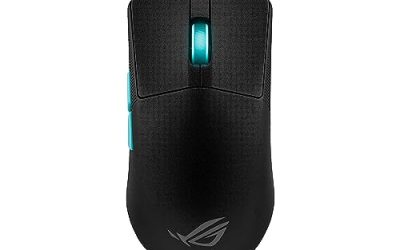
Choosing a gaming mouse by sensor specifications alone misses the decision that affects every click, flick, and long session: whether the shell actually fits your hand. A mouse that is too long pushes your fingers past the main buttons, one that is too narrow forces a tense pinch, and one that is too tall can tilt your wrist into an uncomfortable angle. Size changes how accurately you stop the cursor, how relaxed your forearm stays, and how consistent your aim feels.
This guide is for players who bought a well-reviewed mouse and found it oddly tiring, new buyers measuring for the first time, and anyone switching grip styles. It walks through a simple hand measurement, explains palm, claw, and fingertip grips in plain terms, and matches those numbers to small, medium, and large mouse categories. You only need a ruler or tape measure and a few minutes of honest observation about how you naturally hold a mouse during real play.
As an Amazon Associate we earn from qualifying purchases
How to Choose
Size selection works best as a sequence rather than a single number. Start with your hand, because hand length and width set the outer boundaries that no grip adjustment can fully overcome. Next, identify your natural grip, because two players with identical hands often need different shell lengths depending on how much of the palm makes contact. Then compare ratios instead of chasing an exact millimetre match, since manufacturers round dimensions and shape curves matter as much as the listed length. Finally, look at where the hump sits and how the sides taper. Working through those four steps in order prevents the common problem of falling for a specification sheet and only later discovering that the shape fights your hand on every swipe.
It also helps to measure and decide before you look at specific models. Once a particular design catches your eye, it is easy to rationalise a poor fit and assume you will adapt. Hands do adapt to a degree, and a short adjustment period is normal, but persistent pinching, fingertip overreach, or wrist ache after ordinary sessions usually signals a size mismatch rather than a lack of practice. Treat the categories in this guide as starting ranges, not rigid laws. They narrow a large market down to a manageable shortlist of shapes that deserve your attention, and they give you a clear reason to rule out mice that sit far outside your range, however impressive their other features may appear.
Measure Your Hand Length and Width First
Place your dominant hand flat on a table with fingers together and relaxed, not stretched. Measure length from the tip of your middle finger straight down to the first crease at the base of your palm, where the hand meets the wrist. Then measure width across the knuckles of your four fingers, excluding the thumb, at the widest point. Write both numbers down in centimetres and millimetres. As a broad guide, hands under about 17 centimetres long are usually small, hands from roughly 17 to 20 centimetres are medium, and hands above about 20 centimetres are large. Repeat each measurement once to confirm it, because a few millimetres of error can shift a borderline result.
Identify Your Natural Grip Style
Grip style describes how your hand contacts the shell during play. In a palm grip, most of the palm and fingers rest along the mouse, favouring longer, fuller shapes that support the whole hand. In a claw grip, the palm base touches the rear while the fingers arch and contact the buttons with their tips, which suits a medium length with a defined rear hump. In a fingertip grip, the palm does not touch the mouse at all and control comes from the fingers alone, favouring shorter, lower shapes. Watch your hand during an ordinary game rather than posing it, because your relaxed, unthinking grip is the one your size choice must serve.
Use Size Ratios Instead of Exact Matches
Listed mouse dimensions are a starting point, not a guarantee of fit, so ratios give a more useful comparison. A common conservative approach is to compare mouse length with hand length. For a palm grip, a mouse length near 60 to 65 percent of hand length often feels supportive without forcing overreach. For claw and fingertip grips, a shorter ratio, nearer 55 to 60 percent, usually leaves room for the fingers to arch or steer. Width matters too: the mouse grip width should let your thumb and ring finger rest without squeezing inward or spreading wide. If a mouse falls well outside these ranges for your grip, treat that as a warning sign worth taking seriously.
Check Shape, Hump Position, and Side Taper
Two mice with identical length and width can feel completely different because of shape. The hump is the highest point of the shell, and its position changes everything. A rear hump fills the palm and supports claw and relaxed grips, a centre hump gives fingertip and claw players a pivot point under the middle of the hand, and a low, gradual hump suits palm users who want even contact. Also check height at the peak, since a tall shell can lift the wrist, and examine the sides: gently curved sides are easier to lift during resets, while flat or sharply angled sides can dig into the thumb. Length gives the category, but hump and taper decide comfort.
Which One Fits Your Situation
Situation matters because the same hand can need different sizes depending on the games played and the length of a typical session. A player who makes large, low-sensitivity swipes needs room to reset the mouse without the heel of the palm dragging or the fingers running out of shell. A player who makes small, frequent corrections needs a shell the fingers can reposition quickly without moving the whole arm. Use the scenarios below to sanity-check the category your measurements suggested. If your measured category and your situation point in opposite directions, the situation usually reveals a grip habit you had not noticed, so re-check how you actually hold the mouse before deciding.
Desk space and mousepad size play a quieter role as well. A large mouse on a small pad can feel restrictive not because the shell is wrong but because there is no room to use it, while a small mouse on a wide pad gives fingertip players freedom they may not need. Session length matters too. Discomfort that appears only after two or three hours often relates to height and support rather than length, so a slightly fuller shape in the same category can help. Consider these factors as fine-tuning once the basic category is set, not as reasons to jump two sizes away from what your hand measurements indicate.
Small Hands Using a Palm Grip
If your hand measures under about 17 centimetres and you rest your whole palm on the mouse, stay in the small category rather than stretching onto a medium shell. A small mouse with a supportive rear hump lets your fingers reach the main buttons without extending and keeps your wrist neutral. Avoid tall small mice, because height can matter more than length at this size. A low, full shape usually feels more stable and reduces side squeezing.
Medium Hands Using a Claw Grip
Medium hands, roughly 17 to 20 centimetres long, paired with a claw grip are the most flexible combination, and most medium mice are designed with this pairing in mind. Choose a medium shell with a noticeable rear or centre hump so the base of your palm has a clear contact point while your fingers stay arched. Length near the middle of the medium range gives your fingertips room to pull the mouse back for vertical adjustments.
Large Hands Tired of Cramped Shells
Players with hands above about 20 centimetres often end up on medium mice simply because they are common, then compensate by curling their fingers tightly or letting their palm drag. A large-category mouse, longer and wider, lets the fingers lie flatter and gives the thumb a natural resting position instead of a constant pinch. For a palm grip, prioritise length and a gradual hump. For relaxed claw, choose a rear hump without excessive width.
Fingertip Players Who Want Quick Corrections
Fingertip grip removes palm contact entirely, so size rules shift downward. Even players with medium or large hands often prefer a small or shorter medium mouse, because control comes from pushing and pulling the shell with the fingers. A lower height helps, since a tall hump can collide with the palm you are trying to keep clear. Look for secure side curves so the mouse does not slip during rapid micro-adjustments, and build session length gradually.
Common Mistakes
Most sizing mistakes are understandable. Product pages list length, width, and height as plain numbers, which invites direct comparison even though shape changes how those numbers feel. Marketing also pushes players toward whatever shape is fashionable, and it is easy to assume that a popular design must suit everyone. The errors below come up repeatedly, and each one is avoidable with the measurements and grip observations covered above. If you recognise one of them in a past purchase, that recognition is useful information rather than a failure: it tells you which variable to change next time instead of simply buying a different mouse at random and hoping the result improves.
- Guessing hand size instead of measuring. Describing your hand as average tells you almost nothing, because hand length varies widely among adults of similar height. A two-minute measurement with a ruler gives a concrete number you can compare against mouse dimensions and size categories. Without it, every later decision in the process rests on a guess, and borderline cases, which are the ones where size matters most, become coin flips. Measure both length and width, write the numbers down, and keep them for future purchases, since your hand size is stable information you only need to gather once.
- Copying a professional player’s mouse. Professional players choose shapes around their own hands, grips, sensitivity settings, and years of habit, none of which transfer to you automatically. A small fingertip mouse that suits a player with small hands can feel uncontrollable for a palm player with large hands, even at the highest level of build quality. It is reasonable to note which categories professionals with hands similar to yours tend to use, but treat that as a loose reference point. Your measurement and your grip should make the final decision, not a tournament broadcast or a highlight clip.
- Judging fit in the first five minutes. A new size often feels strange simply because it is different from the shape your hand has memorised. Gripping a mouse briefly in a shop, or using one for a single short session, mostly measures familiarity rather than fit. Give a new size several sessions across a few days before deciding, while still paying attention to genuine warning signs such as numbness, sharp wrist pain, or persistent finger strain. Mild unfamiliarity usually fades. Recurring ache in the same spot usually does not, and it deserves to be taken seriously rather than pushed through.
- Looking only at length and ignoring width and height. Length is the number most guides emphasise, so buyers often match it carefully and ignore the other two dimensions. Width decides whether your thumb and ring finger pinch or splay, and height decides how much the shell lifts and angles your wrist. A mouse can be the correct length and still feel wrong all evening because it is too narrow for your hand width or too tall for your grip. Compare all three dimensions against your measurements and grip, and remember that grip width, measured where your fingers actually rest, matters more than the widest point of the shell.
- Assuming one size must suit every game and grip. Some players genuinely change grip between genres, resting their palm during slow strategy games and shifting to claw or fingertip control in fast shooters. A single mouse can handle that if it sits in the middle of your range, but expecting one shell to be perfect for two very different grips often leads to a compromise that serves neither well. Be honest about which game type dominates your time and size primarily for that grip. Occasional sessions in another genre will still feel acceptable on a mouse chosen for your main style of play.
Frequently Asked Questions
Answers to sizing questions tend to be ranges rather than single numbers, because hands, grips, and shell shapes interact. The responses below give conservative starting points that suit most players, along with the reasoning behind them, so you can adjust sensibly when your own measurements fall between categories. If a question here matches your situation exactly, use the suggested range as your shortlist boundary and then compare hump position and width within it. When two answers seem to conflict, return to the basic sequence: hand measurement first, grip second, and shape details third. That order resolves most apparent contradictions without needing any additional information or equipment beyond the ruler you already used.
How do I measure my hand for a gaming mouse?
Measure length from the tip of your middle finger to the first crease where your palm meets your wrist, with your hand flat and relaxed. Then measure width across the knuckles of your four fingers, excluding the thumb. Length places you in a small, medium, or large category, and width shows whether a shell will feel pinched or spacious.
What mouse size suits a 19 centimetre hand?
A 19 centimetre hand falls in the medium category, so most medium mice are the natural starting point. Palm players usually do well with a fuller medium shell, while claw and fingertip players often prefer a medium mouse toward the shorter end of the range. Check width too, because a broad palm may suit a wider medium shape better.
Should a claw grip use a smaller mouse?
Usually a claw grip suits a mouse at the shorter end of your size category rather than a full category smaller. The arched fingers need room to contact the buttons and pull the mouse backward, and a defined hump gives the palm base its contact point. Dropping an entire size can leave the palm unsupported and force an exaggerated arch that tires the fingers.
Is a bigger mouse better for long sessions?
Not automatically. A larger mouse can support a palm grip and spread contact across the hand, which many players find comfortable over long sessions. However, an oversized shell forces finger overreach and increases wrist movement, creating its own fatigue. Comfort comes from a size matching your hand and grip, with a height that keeps your wrist neutral.
Related guides
More from Amazon
Programs that pair well with the guide above. Offers and eligibility are set by Amazon and may change.
Free shipping on eligible items, Prime Video and more. Eligible new members can start with a free trial.
Start a Prime free trialAd-free music streaming. Eligible new subscribers can start with a free trial.
Try Music Unlimited freeA Prime membership for ages 18-24 with a trial period. Eligibility is set by Amazon.
See Prime for Young AdultsAudiobooks and podcasts to listen to on the go. Eligible new members can start with a free trial.
Try Audible freeAs an Amazon Associate we earn from qualifying purchases.