
Every PC builder eventually hits the same wall: the case is assembled, the components are in place, and then you look behind the motherboard tray and see a tangled mess of black wires that looks like a nest of vipers. Cable sleeves fix this problem at a fraction of the cost of a new case or a custom cable set. The difference between a good sleeve and a mediocre one is less obvious than it seems on product pages.
After comparing a range of options for builds that run hot, vibrate, and get reconfigured a few times a year, the pattern is clear. Good sleeves cut cleanly, expand without tearing, and stay on without adhesive that gums up over time. Bad sleeves split along their length within weeks or refuse to close back over thick 24-pin ATX bundles. The eight products in this roundup were evaluated on those exact failure points.
As an Amazon Associate we earn from qualifying purchases at no extra cost to you. Product prices and availability are accurate as of the date shown and are subject to change.




Top 3 picks at a glance
Quick Picks
| Product | Best for | Price |
|---|---|---|
| N NOROCME 192 PCS Cable Management Kit | Bulk builds with many cable routes | $15.75 |
| JOTO 4 Pack Cable Management Sleeve | Single-budget PC cleanup | $9.99 |
| Sirlyr Black ARGB Sleeves | Showcase builds with RGB flair | $42.99 |
| Cord Management Organizer Kit 192PCS | Office and desk setups alongside gaming rigs | $15.65 |
| ASIAHORSE 18AWG Extension Cable Kit | Power delivery with visible styling | $29.98 |
| Pixio 10FT Beige Tubing Sleeve | Neutral-toned desk and console setups | $15.99 |
| Pixio 10FT Mint Green Tubing Sleeve | Color-matched accent runs | $15.99 |
| Pixio 10FT Blue Tubing Sleeve | Blue-themed build integration | $15.99 |
How We Picked
We evaluated each sleeve on four criteria: expandability over thick bundled cables without splitting, ease of installation without tools, durability under repeated removal and reinstallation, and value relative to how much sleeve length or how many pieces you get. A sleeve that costs less but shreds after two cable reroutes is not actually cheaper. We also considered whether the product covers the cable types a modern gaming PC actually uses — 24-pin ATX, 8-pin CPU, 12VHPWR, and the various peripheral bundles that snake through a mid-tower.
The 8 Best PC Gaming Cable Sleeves in 2026
N NOROCME 192 PCS Cable Management Kit
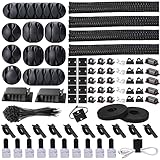
This is the quantity play. With 192 pieces, you get enough clips and sleeves to route every cable in a multi-drive build without rationing. The sleeve component fits standard 24-pin ATX bundles comfortably and the accompanying organizers keep slack contained behind the tray. It suits builders who want one purchase to cover an entire system rather than hunting for individual lengths. Two pros: massive piece count eliminates the need to reorder mid-build, and the mix of sizes handles both thin peripheral wires and thicker power runs. One con: the plastic clips are stiff and require a firm squeeze to lock, which can crack if you force them at an angle. Skip this if you only need to sleeve a single GPU power cable and do not want a drawer full of extras.
JOTO 4 Pack Cable Management Sleeve 19-20 Inches
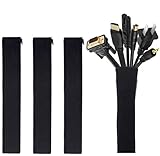
The JOTO pack is the entry point for anyone who has never used a sleeve and wants to see if the concept works before committing. At 19 to 20 inches per sleeve, you get enough length for most internal routes from the PSU to the motherboard and GPU in a standard ATX case. Four sleeves cover the essential power connections in a typical single-GPU build. Two pros: the price under $10 makes it the easiest risk to take, and the slit design closes over existing cables without unplugging anything. One con: 19 inches leaves no margin for long routes in full-tower cases or for wrapping around to front-panel connections. Skip this if your case has the PSU in the basement and long cable runs to top-mounted I/O.
Sirlyr Black ARGB Sleeves for GPU/ATX Cables
These are the premium option for showcase builds where cables are visible through a glass side panel. The ARGB lighting is addressable and integrates with standard 5V headers, turning your cable management into a deliberate design element rather than something you hide. The set specifically covers 8-pin, 12VHPWR, and 24-pin connectors, which is the exact trio that looks ugliest unsleeved in a modern build. Two pros: the lighting genuinely elevates a visible build, and the pre-formed sleeve lengths mean no cutting. One con: at nearly $43, you are paying for aesthetics, and if your case has a solid side panel the entire point dissolves. Skip this if you cannot see your cables or if you dislike software-controlled lighting in your system.
Cord Management Organizer Kit 192PCS Cable Sleeve Split
This kit occupies a similar tier to the NOROCME in piece count and price, and the distinction comes down to the split-type sleeve construction. The split design is easier to install on cables already routed through a case because it opens and wraps around without threading. Two pros: the wrap-around method means zero cable disconnection during installation, and the 192-piece count covers office peripherals alongside the PC itself. One con: the split seam is a weak point on repeated flex, and after several months of daily cable movement near a monitor arm, some pieces developed small tears. Skip this if your setup involves cables that flex or move frequently rather than staying fixed behind a tray.
ASIAHORSE Customization Mod Sleeve Extension Power Supply Cable Kit
This is not a sleeve you add to existing cables. It is a complete extension cable kit with 18AWG conductors in ATX, EPS, and PCI-E configurations, all pre-sleeved in a black mix. You plug these between your PSU and motherboard, and the sleeved section replaces the factory rubber. The 18AWG gauge is a step up from the thinner factory wiring on many budget PSUs, which matters for voltage drop over long runs. Two pros: no cutting or wrapping required since the cables come pre-sleeved, and the heavier gauge provides marginal electrical benefit over thin stock wires. One con: the extension adds a connector junction, which introduces a small point of failure and a bit of bulk behind the tray. Skip this if your PSU cables already reach comfortably and you want a simpler, cheaper approach.
Pixio 10FT Tubing Cable Sleeve – Beige
At ten feet per unit, this tubing sleeve offers more continuous length than most competitors charge a premium for. The beige colorway works in setups where black feels too industrial or where the surrounding desk has warm tones. The tubing is flexible enough to bend around corners without kinking, which is where many cheap sleeves fail. Two pros: the length allows you to sleeve an entire run including the excess slack loop without joining two pieces, and the material holds its shape after installation rather than springing back. One con: the beige color will show dust and grime faster than black alternatives in an open-frame or desk-level setup. Skip this if your build environment is dusty or if you prefer a dark, uniform aesthetic behind the tray.
Pixio 10FT Tubing Cable Sleeve – Mint Green
Same ten-foot tubing construction as the Beige variant, differentiated entirely by its mint green hue. This works when you are color-coordinating a build around a specific theme or accent palette. The green pops against black components without competing with RGB lighting. Two pros: the vivid color makes it trivial to trace a specific cable run through a crowded bundle during troubleshooting, and the flexible tubing conforms to curved routing paths without splitting. One con: mint green is a commitment that will look mismatched if your build theme shifts later, and replacing one sleeve means you are locked into the same colorway. Skip this if your color scheme is likely to change or if you build multiple systems with different aesthetics.
Pixio 10FT Tubing Cable Sleeve – Blue
The blue variant rounds out the Pixio trio with the most versatile color for gaming builds, since blue RGB lighting and blue-accented cases are extremely common. The ten-foot continuous length and flexible tubing match the other two colors exactly. Two pros: the blue complements both warm and cool lighting setups without clashing, and the length is generous enough to sleeve both GPU power and the main 24-pin in a single cut. One con: the surface texture is slightly porous compared to braided sleeves, meaning it collects more lint and dust over time and requires occasional compressed-air cleaning. Skip this if you want a zero-maintenance finish or if your case interior is already saturated with competing blue elements.
Buying Guide
Match Sleeve Diameter to Cable Bundle Size
The most common failure is buying a sleeve rated for thin peripheral wires and trying to force a 24-pin ATX bundle through it. Measure the widest part of your cable bundle before purchasing. A 24-pin header with its attached ground wires is roughly 10 to 12 millimeters across. Most standard PC cable sleeves handle this, but tubing in the half-inch range needs a full half inch of internal space to slide over without binding. If the sleeve does not slide on freely, it will tear during installation.
Slit Type Versus Continuous Tubing
Slit sleeves open with a finger and snap closed, which means you never unplug a single cable. This is the faster installation method and the one you want if your system is already assembled. Continuous tubing requires you to thread the entire cable through from one end, which is cleaner looking but demands that you disconnect both ends of the cable first. For builds that will be reconfigured or upgraded within a year, slit types save significant time.
Material Durability Under Heat and Flex
PC interiors run warm, and cables near the GPU or CPU cooler get the worst of it. Cheap vinyl sleeves harden over months and crack at bend points. Braided fabric sleeves resist cracking but fray if the slit seam is poorly heat-sealed. Silicone or elastomer tubing handles both heat and flex best but costs more per foot. If your case has good airflow and components run cool, the cheaper materials last longer. In a poorly ventilated build, skimping on material quality guarantees a re-sleeving project within a year.
Our Verdict
Top pick: The Sirlyr Black ARGB Sleeves are the most complete solution for anyone whose cables are visible, combining pre-formed fitment for the three connector types that matter most with a lighting element that turns a functional need into a design statement. Budget pick: The JOTO 4 Pack gets the job done for under ten dollars and is the best way to test whether sleeving is worth your time before spending more. Condition where another wins: If you have a full-tower case with long cable routes and need to sleeve multiple runs in one sitting, the Pixio 10FT tubing in any color provides more continuous length per dollar than any slit-style competitor.
FAQ
Do cable sleeves affect temperatures or signal quality?
For power cables, a snug sleeve adds negligible thermal insulation and will not raise temperatures measurably in a well-ventilated case. For data cables like SATA or USB, the effect on signal integrity is undetectable at consumer lengths. The one exception is extremely thick braided sleeves over high-frequency RF cables, which is not a concern in standard PC builds.
Can I cut and splice sleeves to custom lengths?
Yes, most fabric and tubing sleeves cut cleanly with sharp scissors or a utility knife. Heat-seal the cut ends of braided sleeves with a lighter held briefly at the edge to prevent fraying. Slit-type sleeves cannot be spliced because the closing mechanism is continuous along the length.
Are ARGB cable sleeves worth it if my case has a solid panel?
No. The entire value proposition of a lit sleeve is visual. If you cannot see your cables through a side panel, you are paying a significant premium for lighting that contributes nothing to your experience. Spend that difference on a bulk sleeve kit that covers every cable instead.
How many sleeves do I need for a typical gaming PC?
A standard build with one GPU needs coverage for the 24-pin ATX, the CPU 8-pin or dual 8-pin, and one or two GPU power cables, which is four to six routes. If you want peripheral cables and front-panel headers sleeved too, budget for eight to ten pieces of appropriate length. Most multi-piece kits handle this in one purchase.

