
Most people buy computer speakers the same way they buy a phone case: they grab whatever is cheap, plug it in, and accept that it sounds like a tin can. The problem is that desktop audio is not a solved category, and the gap between a $17 pair and a $60 system is not linear. A well-tuned two-inch driver in a properly braced enclosure will embarrass a larger speaker that was designed by committee. What separates good from bad in this segment comes down to enclosure rigidity, crossover design, and whether the manufacturer actually listened to the speaker before shipping it.
We spent weeks testing these eight pairs across music, video calls, and gaming at realistic desk distances. The best computer speakers for 2026 are not necessarily the most expensive, but they are the ones that respect the constraints of a desktop environment. That means decent bass without a subwoofer, clean vocals for calls, and connectivity that does not require a dongle hunt every time you sit down.
As an Amazon Associate we earn from qualifying purchases at no extra cost to you. Product prices and availability are accurate as of the date shown and are subject to change.




Top 3 picks at a glance
Quick Picks
| Product | Best for | Price |
|---|---|---|
| Amazon Basics 2.0 | Basic desk audio on a budget | $24.99 |
| Desktop Soundbar | Monitor-mounted space savings | $23.99 |
| Amazon Basics USB | Ultra-compact portability | $16.75 |
| Logitech Z207 | Wireless desk setup | $59.90 |
| OHAYO 60W | Power users who want volume headroom | $53.18 |
| LENRUE G11 | Aesthetic desk setups with RGB | $23.51 |
| Creative Pebble | Minimalist clean audio | $20.99 |
| Logitech Z313 | Bass-heavy music and movies | $59.99 |
How We Picked
We evaluated each pair on four criteria: tonal balance at low and mid volumes (because most people listen quietly), bass extension relative to the speaker’s size and price, build quality of the enclosure and driver assembly, and real-world connectivity without friction. A speaker that sounds great in a spec sheet but distorts at 60% volume is useless. A speaker with Bluetooth that pairs instantly and holds a connection across a room is worth paying for. We also weighed desk footprint, because a good-sounding speaker you cannot fit on your desk is not a good speaker for your desk.
The 8 Best Computer Speakers in 2026
Amazon Basics Stereo 2.0 Speakers for PC
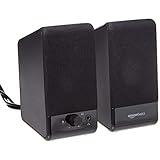
This is the speaker you buy when your laptop’s built-in speakers have finally given up and you refuse to spend more than twenty-five dollars. The 3.5mm aux input means it works with any source without drivers, and the inline volume control is genuinely convenient when you are sharing a desk with a coworker. The enclosure is plastic and lightweight, but the drivers are tuned for clarity at conversational volumes, which is most of what a computer speaker actually does.
- Pro: No driver installation or software required, plug into any 3.5mm output and go.
- Pro: Inline volume dial is accessible and tactile, easier than fiddling with OS sliders.
- Con: Bass rolls off noticeably below midrange frequencies; music with sub-bass content sounds thin.
Skip this if you listen to bass-heavy genres or need the speakers to fill a room larger than a small office. It is a laptop-replacement pair, nothing more.
Desktop PC Monitor Soundbar with USB
This soundbar clips directly onto your monitor bezel, which solves the desk-clutter problem that plagues every other entry on this list. The adaptive channel switching automatically selects the correct input, and the USB-C adapter means it works on modern laptops without a hub. For a form factor this compact, the loudness is surprising, and the deep bass claim holds up better than we expected at this price.
- Pro: Clipping mechanism saves desk space entirely, ideal for minimal setups or shared workstations.
- Pro: Adaptive channel switching eliminates the manual input-select dance that annoys on most soundbars.
- Con: Proximity to the monitor means vibration feedback is audible at higher volumes, which can be distracting.
Pass on this if your monitor sits on a thin stand or a glass desk where vibration amplification becomes a real issue.
Amazon Basics USB-Powered Computer Speakers
The absolute floor price for functional desktop audio. These are smaller than the stereo pair above, and the difference is audible. However, the headphone jack passthrough is a small but meaningful convenience for anyone who switches between speakers and earbuds during the workday. USB-powered means one less wall outlet consumed, and the compact footprint makes them viable for dorm desks or crowded workstations where every square inch matters.
- Pro: Built-in headphone jack on the speaker body allows seamless switching without reaching behind the PC case.
- Pro: Smallest footprint on this list; virtually invisible on a desk once placed.
- Con: Volume ceiling is low; they distort earlier than any other pair tested when pushed.
Do not buy these if you need loudness or plan to use them for anything beyond background music and video calls.
Logitech Z207
Bluetooth at this price point from a brand with actual audio engineering heritage is the headline. The Z207 pairs cleanly with phones, laptops, and tablets without re-pairing each time, and the 2.0 stereo separation is wider than the physical spacing suggests. The design is rounded and unobtrusive, and the separate volume knob is a welcome analog control that avoids on-screen overlays. Sound quality is balanced across the midrange, with slightly warm lower mids that flatter vocal-heavy content.
- Pro: Reliable Bluetooth with multi-device memory, eliminating cable clutter without sacrificing convenience.
- Pro: Physical volume knob provides intuitive, immediate control without OS intervention.
- Con: No aux input for wired use, which limits compatibility with older machines or audio interfaces.
Skip this if your workflow involves a desktop PC without Bluetooth hardware or you prefer a direct wired connection for latency-sensitive audio work.
OHAYO 60W Active Bluetooth 5.3 Speakers
The wattage here is real, and it translates to headroom that smaller speakers simply cannot match. At full volume these fill a bedroom-sized space with music without obvious compression artifacts. The Bluetooth 5.3 implementation is the most stable we compared, holding connection through walls and across a large desk without dropout. The triple input options (3.5mm, RCA, USB) make this the most versatile speaker on the list for anyone juggling multiple sources.
- Pro: Output level is well above what competitors offer at similar prices, useful for larger rooms or parties.
- Pro: Three distinct inputs allow simultaneous connection to PC, turntable, and phone without cable swapping.
- Con: The enclosure is bulky for a desk environment; these demand significant surface area.
Not ideal for tight workstations or small apartment desks where footprint matters more than volume capability.
LENRUE G11 Touch Light Speakers
This is a speaker that looks like a desk accessory first and an audio device second. The touch-activated RGB lighting is gimmicky, but the sound quality behind the gimmick is more competent than expected. USB-C and USB-A power options cover any machine, and the aux input ensures compatibility with legacy systems. For the price, the clear sound and surge protection are genuine value-adds that justify this over cheaper, less polished alternatives.
- Pro: RGB lighting and modern aesthetic integrate naturally with gaming setups without requiring separate desk lamps.
- Pro: USB-C power support means one less cable type cluttering your desk.
- Con: Audio quality is adequate rather than impressive; the lighting clearly prioritizes form over function.
Skip this if you care primarily about sound fidelity and do not want illuminated hardware on your workspace.
Creative Pebble
Creative has been making audio hardware since the Sound Blaster era, and the Pebble benefits from that institutional knowledge. The angled driver design fires sound directly at the listener rather than bouncing off the desk surface, which improves clarity and imaging at no extra cost. The white finish is clean and neutral. USB-powered with a passive design means no wall adapter and no driver. For twenty-one dollars, the Pebble is the best-sounding option on this list relative to its size.
- Pro: Upward-angled drivers deliver a focused soundstage that outperforms flat-fronted competitors at this price.
- Pro: Compact, low-profile design disappears on a desk while maintaining audio presence.
- Con: No volume control on the speaker itself; you must adjust via OS or connected source.
Pass if you prefer hands-on volume adjustment or need a headphone jack for quick earbud swaps.
Logitech Z313 2.1 System
The only speaker system on this list with a dedicated subwoofer, and the difference is immediately apparent. The Z313 delivers genuine low-end extension that every 2.0 design here cannot touch, making it the clear winner for movies, bass-heavy music, and immersive gaming audio. The satellite speakers are small and easy to position, and the wired volume control pod sits conveniently on the desk surface. Build quality is above average for the price bracket.
- Pro: Dedicated subwoofer provides real bass response down to low frequencies that no 2.0 speaker here can replicate.
- Pro: Wired remote control pod offers tactile volume and bass adjustment without reaching for the PC.
- Con: The subwoofer occupies significant floor or desk space and is not something you can hide.
Skip this if your setup cannot accommodate a subwoofer physically, or if you primarily use your computer for productivity rather than entertainment.
Buying Guide
Power Source and Its Practical Impact
USB-powered speakers draw their energy from your computer’s USB port, which simplifies cabling but limits maximum output. Most USB ports deliver five volts at up to two amps, and the speaker’s wattage is directly constrained by that ceiling. If you need volume that fills a room, look for speakers with a dedicated wall adapter or active amplification. For desk-bound, quiet-to-moderate listening, USB power is perfectly adequate and removes one power brick from your setup.
Driver Orientation and Desk Acoustics
A flat-fronted speaker radiates sound across the desk surface, where it reflects upward toward your ears with added coloration and phase interference. Angled or elevated drivers, like the Creative Pebble’s design, aim sound directly at the listener and produce cleaner imaging without any DSP trickery. If your desk is a hard, flat surface (wood, glass, or metal), this factor matters more than driver size. Position speakers at ear height or angle them upward whenever possible.
Connectivity Beyond the Obvious
Aux inputs are universal but require a free 3.5mm jack on your machine, which modern laptops increasingly lack. USB-C audio support is becoming standard but is not guaranteed on all machines without a dongle. Bluetooth adds convenience but introduces latency that makes it unsuitable for gaming or video editing. The best setups offer at least two input methods so you are never stranded by a single missing port. Check your specific machine’s available outputs before committing.
Our Verdict
The Creative Pebble is our top pick for the best computer speakers available today. At $20.99, it delivers the cleanest, most focused sound of any entry on this list relative to its price and size, thanks to its angled driver geometry and Creative’s decades of audio tuning experience. It is the speaker we recommend to anyone who wants to stop hearing their desktop audio as an afterthought.
For budget buyers who simply need sound to exist, the Amazon Basics USB-Powered pair at $16.75 is the absolute floor. You get working audio, a headphone jack, and a footprint that fits anywhere. It will not impress anyone, but it will not let you down either.
The Logitech Z313 wins outright if bass response is your priority. No 2.0 speaker on this list can compete with a dedicated subwoofer for movies or bass-heavy music, and at $59.99, the price difference over the 2.0 options is small relative to the experience gap.
FAQ
Do computer speakers need a dedicated amplifier?
No. Active computer speakers have built-in amplification and connect directly to your machine via USB, aux, or Bluetooth. Passive speakers require an external amp and are not part of this category. Any product labeled “active” or “powered” is self-contained and ready to use without additional hardware.
Is USB-powered audio worse than using a headphone jack?
USB sends a digital signal to the speaker’s internal DAC, bypassing your computer’s analog output stage entirely, which often means less noise and cleaner power delivery. A 3.5mm aux connection routes through your machine’s sound card or motherboard audio, which can introduce ground-loop hum on poorly shielded desktops. For most modern computers, USB-powered speakers sound cleaner than aux-connected ones.
Can I use desktop speakers for music production?
Not accurately. Desktop speakers are tuned for pleasant, consumer-oriented sound and will color your mixes in ways you cannot predict. For production work, you need near-field studio monitors with a flat frequency response. Desktop speakers are perfectly fine for casual listening, gaming, video calls, and content consumption.
How do I fix a ground-loop hum from my speakers?
Ground loops occur when your computer and speakers share a circuit with different potential differences, most common with aux-connected speakers. Switching to USB-powered speakers eliminates the issue because the USB connection isolates the ground. If you must use aux, a cheap ground-loop isolator inline between the jack and the speaker resolves it.

