A marine battery charger is bought on two numbers: how many batteries it has to keep topped up and how many amps each of them needs. A small fishing skiff with one starting battery has almost nothing in common with a cruiser that carries a starting battery, a house bank, and a trolling motor bank. The word “marine” matters too, because boats live in damp, salty, shaking places, so an onboard charger needs a sealed case and protection that a garage charger can skip.
This guide is for boat owners who want a permanently installed charger-maintainer that keeps batteries healthy between trips and recharges them after a day on the water. It compares six onboard chargers from 5 amps on one bank to 30 amps across three banks, drawing only on details in each listing. As the 2026 season approaches, the most useful way to shop is to count your batteries, note their chemistry, and then pick the bank count and amperage that match, instead of buying the largest number you can find. Many owners overspend on amperage and then discover that the wiring, the dock outlet, or the battery itself cannot use it.
Our Top Picks
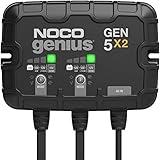
 NOCO GEN5X2 12V 10A 2-Bank OnBoard Marine Battery10A (5A per Bank)9.15 x 7.2 x 5.39 inches4.17 poundsCheck on Amazon
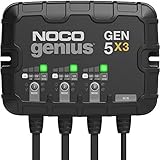
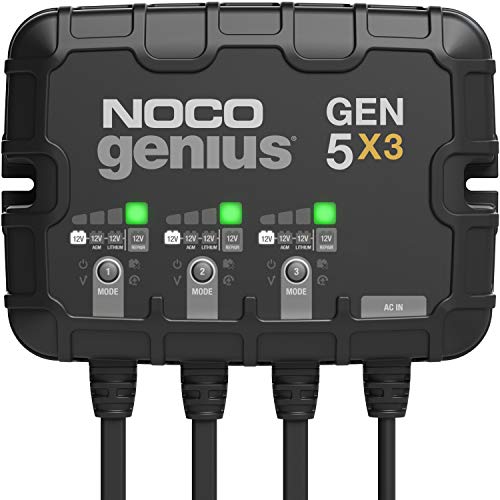 NOCO GEN5X3 12V 15A 3-Bank OnBoard Marine Battery15A (5A per Bank)2.2 x 7.9 x 6.5 inches6.09 poundsCheck on Amazon
 NOCO GENPRO10X2 12V 20A 2-Bank OnBoard Marine Battery20A (10A per Bank)10.28 x 9.25 x 6.06 inchesCheck on Amazon
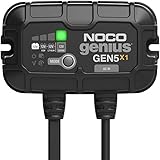
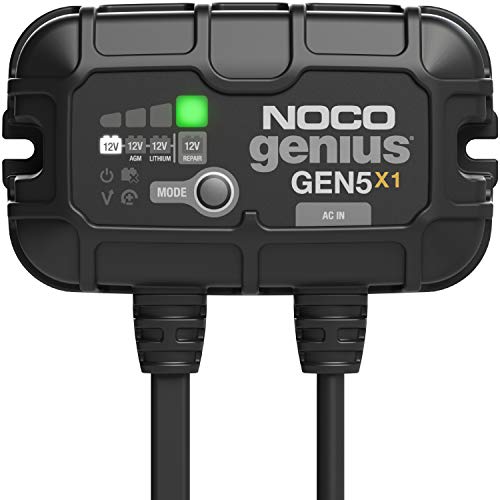 NOCO GEN5X1 12V 5A 1-Bank OnBoard Marine Battery5A (5A per Bank)1.9 x 5.1 x 3.8 inches2.53 poundsCheck on Amazon


Top 3 picks at a glance
Quick Picks
As an Amazon Associate we earn from qualifying purchases at no extra cost to you.



| Product | Best for | Key spec from the title |
|---|---|---|
| NOCO GEN5X1 12V 5A | Single-battery skiffs | 1 bank, 5A, IP68 |
| NOCO GEN5X2 12V 10A | Starting plus house battery | 2 banks, 10A total, IP68 |
| NOCO GEN5X3 12V 15A | Three-battery boats | 3 banks, 15A total, IP68 |
| NOCO GENPRO10X2 12V 20A | Larger batteries on two banks | 2 banks, 20A total, IP68 |
| NOCO GENPRO10X3 12V 30A | Bigger boats with three banks | 3 banks, 30A total, IP68 |
| Smart 2-Bank 10A LiFePO4 Charger | Mixed lithium and lead-acid banks | 2 banks, 5A per bank, desulfator |
How to Choose
Count banks before amps
A bank is one independent charging output for one battery or battery group. A 2-bank charger can charge two batteries at once, a 3-bank charger can charge three. Count the 12V batteries on your boat that need charging: starting battery, house bank, trolling motor, and any separate accessory battery for electronics or a windlass. Buying fewer banks than batteries means you must choose which to leave out. For a boat with a lone cranking battery, a 1-bank unit is plenty. Remember that a trolling motor and a starting battery should not share a bank, because their discharge patterns differ and one will mask the other’s condition.
Amps per bank and charging time
The per-bank amperage tells you how fast a depleted battery refills. A 5A bank handles small starting batteries and maintenance, but a large deep-cycle battery can take a day or more to recover. A 10A bank cuts that time roughly in half. Divide the battery’s amp-hour capacity by the charger’s per-bank amps for a rough hours estimate, then add a margin because the final stretch of charging is slower. If you cycle batteries heavily, a higher per-bank current is worth the extra cost. If you only run the boat on weekends and keep batteries on a maintainer between trips, lower current is perfectly fine and generates less heat.
Battery chemistry compatibility
Not every charger handles every battery type. Look for support for flooded, AGM, gel, and lithium (LiFePO4) as relevant to your boat. Some chargers add a repair mode, such as desulfation, intended to revive sulfated lead-acid batteries, though results vary and cannot rescue a dead cell. Mixed banks, such as a lithium house battery with a lead-acid starter, make chemistry flexibility more important than raw amps.
Waterproofing, protection, and what to ignore
An IP68 class means the case is dust-tight and can withstand continuous immersion as defined by the maker, which suits bilges and open consoles. Overcharge protection and temperature compensation matter because heat changes how a battery should be charged. Ignore marketing about being charged 24/7 as a reason to skip a visual check, and inspect cables for corrosion regularly. Also confirm the input side: an onboard charger needs a shore power outlet or inverter, so plan the AC wiring as carefully as the battery side. Mount the unit where air can circulate and keep wiring short and properly fused. Check the cables each season for green corrosion, loose terminals, or cracked insulation, since a salty environment attacks connections first.
The 6 Best Options
NOCO GEN5X1 12V 5A
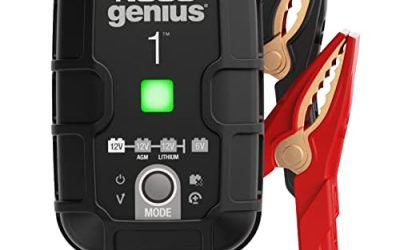
The GEN5X1 is the entry point: a single 5A bank in an onboard marine charger and maintainer with an IP68 waterproof case and overcharge protection. It suits a small boat, a jon boat, or a kayak with an electric motor battery that needs steady topping off rather than fast recovery. Because it is built to stay installed, it can be wired once and left to maintain the battery through the off-season, which is where many owners lose batteries to slow self-discharge.
- Strength: IP68 waterproofing and overcharge protection in a compact one-battery unit.
- Strength: Simple setup for a single-battery boat.
- Trade-off: Only one bank, so a second battery needs another charger.
Skip it if your boat carries two or more batteries.
NOCO GEN5X2 12V 10A
The GEN5X2 doubles the capability with two banks and 10A total, charging two batteries at once while staying waterproof to IP68. The fit is a starting battery plus a house or trolling battery, which describes a large share of fishing and runabout boats. The same bank logic keeps the engine battery from being drained by a fish finder, bilge pump, or stereo, since each battery receives its own output.
- Strength: Two banks cover starter plus accessory battery.
- Strength: IP68 waterproofing and temperature compensation noted in the listing.
- Trade-off: Ten amps total is shared across two banks, so recovery from deep discharge is slow.
Skip it if you cycle large deep-cycle batteries daily.
NOCO GEN5X3 12V 15A
For boats with three batteries, the GEN5X3 lists three banks and 15A total, again with IP68 protection and overcharge safeguards. It serves a typical bass boat layout with a cranking battery and two trolling motor batteries. Each battery is charged independently, so a deeply drained trolling bank does not hold back the starting battery and the starting battery does not hide the true state of the others.
- Strength: Three banks mean each battery gets its own charging output.
- Strength: IP68 case suits open consoles and bilge areas.
- Trade-off: Five amps per bank is modest for large deep-cycle batteries.
Skip it if you want rapid recovery after heavy trolling days.
NOCO GENPRO10X2 12V 20A
The GENPRO10X2 raises the output to 20A across two banks, meaning ten amps per bank. That is the model for owners who run bigger batteries and want a shorter wait between trips, while keeping the same waterproof design and overcharge protection. Owners of boats with large house batteries or bigger electronics loads will notice the difference most in the morning after a long day.
- Strength: Ten amps per bank halves refill time versus 5A banks.
- Strength: IP68 waterproofing and temperature protection are included.
- Trade-off: Higher output suits larger batteries, and is overkill for small ones.
Skip it if your batteries are small or you only need maintenance charging.
NOCO GENPRO10X3 12V 30A
This is the heavy hitter: three banks, 30A total, ten amps per bank. It is aimed at larger boats where several big batteries need to refill overnight at the dock, and it carries the same IP68 and overcharge protection as the rest of the range. Because the listing names the GENPRO line, it signals the high-output tier, and it is the one to compare against the smaller models before settling on amperage.
- Strength: Three 10A banks handle a full set of large batteries.
- Strength: Waterproof construction suited to harsh marine environments.
- Trade-off: Size and cost make it unnecessary for small boats.
Skip it if you only have one or two small batteries.
Smart 2-Bank 10A LiFePO4 Charger
This unbranded-style listing combines two banks at 5A each with lithium LiFePO4 support, a desulfator, and waterproof construction. It is meant for owners who mix chemistries, such as lithium plus AGM or deep-cycle, and want one charger to handle both banks. The title also names AGM and deep-cycle compatibility, which gives a broader chemistry list than the shorter titles of the other models, though buyers should confirm details with the seller before relying on them.
- Strength: Lithium LiFePO4 support alongside AGM and deep-cycle batteries.
- Strength: Desulfator function for lead-acid maintenance.
- Trade-off: Little brand information in the title, so check the warranty terms.
Skip it if you need a better known brand or higher current.
Which One Fits Your Situation
You have a small boat with one battery
The NOCO GEN5X1 is enough, and it keeps a single battery maintained between weekend trips. It is also the easiest to install. Install it near the battery to keep the cable run short.
You fish with a trolling motor
The NOCO GEN5X3 or the NOCO GENPRO10X2 fits well, depending on whether you have three batteries or two larger ones. Both give each battery its own output, which is key when trolling banks drain unevenly.
You run lithium and lead-acid together
The Smart 2-Bank 10A LiFePO4 Charger lists lithium support and a desulfator, so it suits mixed-chemistry banks. Confirm each bank’s setting before connecting a lithium battery.
You manage a large boat with several big batteries
The NOCO GENPRO10X3 provides 30A across three banks for overnight dockside recovery. It pairs well with a shore power outlet at a slip.
Common Mistakes
- Buying more banks than batteries or fewer banks than needed, then paying for unused outputs or leaving a battery uncharged.
- Ignoring battery chemistry, which can mean a charger that cannot properly charge lithium or that undercharges AGM.
- Choosing amps by the biggest number, rather than the per-bank figure, since a 30A total across three banks is only ten amps each.
- Mounting the charger in a hot, unventilated place, which reduces lifespan and can force it to cut its output.
- Skipping inline fuses and proper wire gauge on the connections, a safety issue on any boat.
Related guides
- What Is The Best Budget Most Responsive Gaming Mouse Wired
- Low Latency Gaming Headphones Usb-C 2.4 Ghz Wireless
- Low Latency Gaming Headphones Usb-C Dongle 2.4 Ghz
Frequently Asked Questions
Can I leave a marine charger connected all the time?
Yes, onboard maintainers are designed for that, and most owners wire them to shore power at the slip. Check the connections regularly for corrosion. Keep the area ventilated and clean, and follow the manual for wiring.
What does a bank mean?
A bank is an independent charging output. A 3-bank unit can charge three batteries at the same time, even if they are different sizes or at different charge levels.
Will a charger revive a dead battery?
Not always, and a deeply discharged battery can sometimes be too far gone. A desulfator may help a sulfated lead-acid battery, but a damaged cell cannot be repaired.
Do I need a 20A or 30A charger?
Only if you have large batteries and want fast recovery. For maintenance and light use, 5A or 10A per bank is typically enough. Larger banks only pay off with big batteries or frequent deep discharges.