An RV battery is a power plant, not a starter. The decision behind “best RV batteries” starts with how you camp: a weekend in a campground with hookups needs very little stored energy, while a week of boondocking with a fridge, a furnace fan, lights and a laptop can chew through a few kilowatt-hours without any help from the sun. That is why the choice is really about chemistry and capacity: sealed AGM lead-acid for lower upfront cost and familiar behavior, or lithium iron phosphate for lighter weight, deeper usable capacity and a longer stated cycle life.
This guide is for owners of travel trailers, camper vans, fifth wheels and cabins who are replacing a worn house battery or planning a solar-ready bank. Every product here is judged only from its listing: voltage, amp-hours, watt-hours, battery management system rating, group size and chemistry. We make no performance promises beyond those stated figures. For 2026 trips, the practical question is how many usable amp-hours you need between charges, and whether your charger, solar controller and winter plans suit lithium or AGM.
Our Top Picks

Top 3 picks at a glance
Quick Picks
As an Amazon Associate we earn from qualifying purchases at no extra cost to you.




| Product | Best for | Key spec from the title |
|---|---|---|
| MEYULMOL 12.8V 300Ah LiFePO4 | Long boondocking trips | 300Ah, 3840Wh, 200A BMS, low-temp protection |
| Interstate Marine/RV 12V 70Ah AGM | Light-duty house or starting backup | 70Ah, 750CCA, Group 24 AGM |
| Renogy 12V 200Ah Deep Cycle AGM | Solar-ready lead-acid bank | 200Ah, 3% self-discharge, 2000A max discharge |
| 12V 100Ah LiFePO4 Group 24 | Compact single-battery upgrade | 100Ah, 1280Wh, 100A BMS, low-temp cutoff |
| 12V 100Ah LiFePO4 Group 24, 2-Pack | Doubling capacity from the start | 2 pack, 1280Wh each, 4P4S expansion |
| Daakmax 12V 35Ah AGM, 2-Pack | Small campers and off-grid projects | 35Ah, maintenance-free, pack of 2 |
| 2-Pack 12V 100Ah LiFePO4 Group 31 | Larger battery trays | Group 31, 100A BMS, 1.28kWh, 15000+ cycles |
| BUKNUWO 12V 100Ah LiFePO4 Bluetooth | Monitoring from a phone | Bluetooth, 15000+ cycles, 12.8V 100Ah |
How to Choose
Calculate your daily energy use first
Add up what you run in a typical 24 hours: a compressor fridge, LED lights, a vent fan, device charging, and perhaps an inverter load. A small camper might use 40 to 60 amp-hours a day; a well-equipped trailer with an inverter can use several times that. Multiply by the number of days you want between charges, then compare to the usable capacity. Lead-acid AGM batteries are generally discharged to about half to protect their lifespan, while lithium iron phosphate is commonly rated for much deeper use, so a 100Ah lithium battery can behave like a larger AGM.
A worked example makes this concrete. A compressor fridge averaging 3 amps over a day uses about 72 amp-hours, LED lighting and a vent fan add perhaps 15, and phone and laptop charging another 20. That is roughly 107 amp-hours daily, so a single 100Ah lithium battery covers about one day, two units cover two days, and a 200Ah AGM bank only gives about one day of usable energy once you respect the half-discharge rule. Solar panels stretch these numbers, but always size for a cloudy day.
Chemistry: AGM versus LiFePO4
AGM batteries are sealed, maintenance-free and accept a wide range of chargers, which keeps system changes minimal. Lithium iron phosphate costs more upfront but weighs less, stores more usable energy per pound and lists far higher cycle counts. Check that your converter or charger has a lithium-compatible profile, or plan to add a DC-to-DC charger. Low-temperature protection matters if you camp in freezing weather, since lithium cells should not be charged below freezing without built-in safeguards.
Match the physical size and the BMS rating
Group sizes such as 24 and 31 describe the physical case, and the battery must fit your tray and cable runs. For lithium, look at the battery management system rating, listed in amps. A 100A BMS suits loads up to about 1,200 watts at 12V, so if you run a large inverter or air conditioner, check that the BMS rating covers the peak draw. Expansion statements such as 4P4S tell you how many units can be paralleled or put in series, which matters if you plan to grow the bank.
What to ignore and where budget models cut corners
Big cycle-count claims are marketing until verified, so weigh them lightly against the stated warranty. Cranking amps matter for starting batteries, not for house banks, so ignore CCA unless you want a dual-purpose unit. Budget lithium batteries often have modest BMS ratings, minimal documentation and unclear return policies, and cheap AGMs may have lower real capacity than the label implies. Read the terminal type, weight and support information before buying.
The 8 Best Options
MEYULMOL 12.8V 300Ah LiFePO4
The largest single battery in the lineup, the MEYULMOL lists 300Ah, 3840Wh, an upgraded 200A BMS and low-temperature protection. It is meant for heavy house loads and long stays away from hookups, where one big bank is simpler than wiring several smaller ones.
- Strength: 300Ah and 3840Wh offer the largest stored energy per unit here.
- Strength: a 200A BMS handles higher loads than the 100A units.
- Trade-off: a single large battery is heavy and may not fit standard battery trays.
Skip it if your tray is built for Group 24 or Group 31 sizes.
Interstate Marine/RV 12V 70Ah AGM
This Interstate unit is a Group 24 AGM listed at 70Ah and 750 cold cranking amps. It is a traditional lead-acid choice for owners who want a recognizable brand and a drop-in replacement for a modest house battery or a combined marine and RV application.
- Strength: familiar sealed AGM design works with common chargers.
- Strength: Group 24 size fits many standard trays.
- Trade-off: 70Ah is modest for extended off-grid use.
Skip it if you plan multi-day boondocking with a large power load.
Renogy 12V 200Ah Deep Cycle AGM
The Renogy battery is a 200Ah deep-cycle AGM listed with a 3% self-discharge rate and a 2000A maximum discharge current, and it is described as suitable for RVs, campers and cabins. It is a solid lead-acid option for solar-ready systems where cost matters.
- Strength: 200Ah of AGM capacity in a deep-cycle design.
- Strength: low listed self-discharge helps during storage.
- Trade-off: lead-acid chemistry means heavier weight and shallower recommended discharge than lithium.
Skip it if weight is a priority or you want the deepest usable capacity.
12V 100Ah LiFePO4 Group 24
This listing is a 12V 100Ah lithium iron phosphate battery in Group 24 size, with 1280Wh, a 100A BMS, low-temperature cutoff and support for 4P4S expansion. It is the straightforward lithium upgrade for a trailer or a trolling motor setup.
- Strength: 1280Wh in a common Group 24 footprint.
- Strength: low-temp cutoff and expansion support add flexibility.
- Trade-off: a single 100Ah battery limits boondocking time with heavy loads.
Skip it if you want more capacity from day one.
12V 100Ah LiFePO4 Group 24, 2-Pack
The same battery sold as a two-pack, this option doubles stored energy and lets you wire the pair in parallel for 200Ah at 12V. It fits owners who already know they need a bigger bank for fridge, lights and a small inverter.
- Strength: two batteries in one purchase give a ready-made 200Ah bank.
- Strength: the listed expansion support suggests room to grow later.
- Trade-off: two Group 24 batteries need space and correct parallel wiring.
Skip it if your battery compartment holds only one battery.
Daakmax 12V 35Ah AGM, 2-Pack
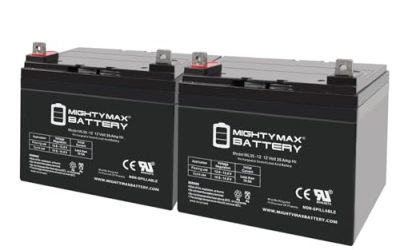
These are two small 12V 35Ah deep-cycle AGM sealed lead-acid batteries, described as maintenance-free for camping, RV and off-grid projects. Together they offer modest capacity, which suits small campers, tent trailers or low-power setups.
- Strength: a low-cost, maintenance-free pair for light loads.
- Strength: small size makes them easy to place in tight spaces.
- Trade-off: 35Ah each is not enough for a typical RV with a fridge and inverter.
Skip it if you plan extended off-grid trips or run heavy appliances.
2-Pack 12V 100Ah LiFePO4 Group 31
This two-pack of lithium iron phosphate batteries is in the larger BCI Group 31 size, with a 100A BMS and 1.28kWh per battery, listed for RV, marine and related uses. It suits trailers with trays designed for the bigger Group 31 case.
- Strength: two batteries and 15000+ listed cycles for heavy seasonal use.
- Strength: Group 31 fit works with larger factory trays.
- Trade-off: Group 31 is larger and heavier than Group 24.
Skip it if your tray only fits Group 24.
BUKNUWO 12V 100Ah LiFePO4 Bluetooth
The BUKNUWO unit adds Bluetooth to a 12V 100Ah lithium battery and lists 15000+ cycles. The Bluetooth link is the standout, since it lets you check state of charge from a phone instead of guessing from voltage.
- Strength: Bluetooth monitoring improves visibility into the bank.
- Strength: listed for trolling motors, off-grid, boat, RV and solar use.
- Trade-off: wireless monitoring is a convenience, not a substitute for a proper battery monitor.
Skip it if you prefer a simple battery without added electronics.
Which One Fits Your Situation
You boondock for a week with a fridge and inverter
The MEYULMOL 300Ah battery gives the most single-unit capacity, while the 100Ah 2-Pack in Group 24 or Group 31 offers a modular alternative.
You camp mostly with hookups and want a cheap replacement
The Interstate 70Ah AGM is a familiar drop-in choice, and the Renogy 200Ah AGM is the step up for owners who need more reserve at a lower-tier cost than lithium.
You tow a small trailer or van and want less weight
A 12V 100Ah LiFePO4 Group 24 battery is the compact upgrade, and the BUKNUWO adds Bluetooth monitoring if you want to see the charge level from your phone.
You are building something small off-grid
The Daakmax 35Ah pair suits tent trailers, small campers and weekend projects where the loads are minimal. Pair them with a small solar panel and a simple charge controller, and they can keep lights and device charging going without touching the vehicle’s starting battery.
Common Mistakes
- Buying on cranking amps when the battery will only run house loads.
- Ignoring the BMS rating on lithium batteries when planning to run an inverter.
- Installing lithium without confirming the converter or solar controller has a compatible charging profile.
- Forgetting physical group size, then discovering the battery does not fit the tray.
- Wiring batteries of different age or chemistry together in the same bank.
Related guides
- What Is The Best Budget Most Responsive Gaming Mouse Wired
- Low Latency Gaming Headphones Usb-C 2.4 Ghz Wireless
- Mechanical Gaming Keyboards Competitive Pc Gaming
Frequently Asked Questions
How many amp-hours do I need?
Estimate your daily use in amp-hours and multiply by the days between charges. Remember that AGM batteries are generally discharged to about half, while lithium allows deeper use.
Can I replace AGM with lithium without other changes?
Often, but check the charger or converter profile first. Some older converters overcharge or undercharge lithium, and a DC-to-DC charger may be needed for alternator charging.
Is a Group 31 battery better than Group 24?
Group 31 is a larger case, so it can hold more capacity, but it only helps if your tray fits it. Compare stated amp-hours rather than group size alone.
Do lithium RV batteries work in cold weather?
They can be used, but charging below freezing can damage lithium cells. Look for low-temperature protection or cutoff, as several listings here mention.