
Top 3 picks at a glance

The short answer
The best Japanese cocktail shakers are the ones whose parts fit your hands and technique: choose a two-piece tin-on-tin Boston set for fast, high-volume mixing, or a three-piece Cobbler shaker for a built-in strainer and simpler setup. For a dependable starting point, consider a weighted Japanese-style Boston set from a known barware maker; choose a Yukiwa-style Cobbler if you specifically want a compact, three-piece tool. “Japanese style” describes a family of shaker designs, not a guarantee that every shaker is made in Japan.
Head-to-head: two-piece versus three-piece
| Design | Typical capacity | Straining | Best for | Main trade-off |
|---|---|---|---|---|
| Two-piece Boston, tin-on-tin | About 500–800 ml per tin | Needs a separate Hawthorne or julep strainer | Frequent mixing, larger batches, and quick service | Requires a separate strainer and practice to open cleanly |
| Three-piece Cobbler | About 500–750 ml in the main tin | Built-in perforated cap | Home bars, occasional cocktails, and fewer loose tools | Small holes can slow or clog, and the cap may stick when cold |
| Two-piece Boston, tin and glass | Often about 500–800 ml for the tin | Needs a separate strainer | People who prefer seeing ingredients in the mixing vessel | Glass adds weight and breakage risk |
Capacity figures are approximate: brands measure sets differently, and the smaller tin’s capacity is not the same as the usable volume when both halves are assembled. For a drink with ice, leave headroom. A practical starting point is a 500–600 ml shaker for one or two cocktails and a larger set when you regularly make three or more at once.
As an Amazon Associate we earn from qualifying purchases at no extra cost to you.
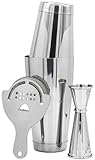


Why bartenders often favor tin-on-tin
A two-piece set uses a smaller tin nested inside a larger one. With no glass to break and no built-in cap to remove, it is quick to load, shake, and rinse. Japanese-style sets often have a tapered, weighted shape that gives the smaller tin a more deliberate feel in the hand. The weight can help the set feel balanced, but it is not a measure of mixing quality by itself.
The catch is the seal. Seat the small tin slightly off-center, then tap the side to set it; do not force the rims into a perfectly flush position. After shaking, hold the larger tin securely and tap near the joint to break the seal. If the tins are difficult to separate, check that the rims are not bent and avoid using excessive force.
When a Cobbler makes more sense
A Cobbler has a main tin, a perforated strainer cap, and a small top cap. It keeps the strainer with the shaker, making it a convenient option for a compact home setup. Yukiwa is a recognized Japanese barware maker with Cobbler-style shakers among its product range; confirm the exact model’s origin and dimensions on the manufacturer’s listing, since product lines and sourcing can vary.
The built-in strainer is convenient, but it does not always strain as quickly or cleanly as a separate Hawthorne strainer, particularly with crushed ice or ingredients that leave pulp. Cold metal can also make the cap snug. If it sticks, hold the body firmly and twist the cap gently rather than pulling hard on a small handle.
What matters beyond the design
Tin construction and balance
Look for stainless steel with a smooth interior, even rims, and no sharp seams. Tin-on-tin sets are usually lighter and less fragile than tin-and-glass combinations. A weighted base changes how the shaker moves and rests in your hand, but a very heavy set can be tiring during repeated rounds. If you are choosing online, check the stated material and individual component weights where available; “Japanese-style” alone does not specify either.
Strainer fit
For a Boston set, the strainer should sit securely on the larger tin without rocking. A Hawthorne strainer’s coil helps catch ice and some solids, while a julep strainer is a simpler perforated cup often used with a mixing glass. Check the shaker’s opening diameter against the strainer’s stated fit range. A mismatched strainer can slip during pouring or leave a gap that lets ice escape.
For a Cobbler, check that the cap fits snugly but can still be removed without tools. Its built-in holes are a convenience, not a substitute for a fine-mesh strainer when a recipe calls for a very clear pour.
Grip, capacity, and cleaning
Hold the shaker as you would while shaking: one hand around each half on a Boston set, or one hand supporting the body and the other securing the cap on a Cobbler. A narrow waist can help smaller hands, while a broader, heavier body may suit a firm two-handed grip. Consider the outside as well as the interior: polished steel can become slippery when wet, and a pronounced taper may feel less secure if your grip is small.
For easy cleaning, choose smooth stainless steel without decorative seams or hard-to-reach joints. Rinse immediately after use, especially after citrus, egg, dairy, or syrup. Wash with warm water and dish soap, then dry the parts separately. Do not store a wet Cobbler assembled: trapped moisture can linger between its cap and strainer.
Match the shaker to your bar
| Your situation | Best fit | Why |
|---|---|---|
| You make cocktails often or several at once | Two-piece tin-on-tin, roughly 600–800 ml tins | Quick workflow, durable construction, and room for ice |
| You want one self-contained tool for occasional drinks | Three-piece Cobbler, roughly 500–750 ml main tin | Built-in strainer means fewer separate pieces |
| You have smaller hands or limited storage | Compact, tapered shaker with a moderate capacity | Easier to grip and store; avoid buying a large set you rarely fill |
| You make drinks with pulp or want a cleaner pour | Boston set plus a well-fitting Hawthorne strainer | A separate strainer is easier to control and replace |
| You are new to shaking and want fewer technique steps | Cobbler, or Boston set with a matched strainer | The Cobbler is self-contained; the Boston set offers a better long-term workflow once sealing feels familiar |
A practical way to choose
-
Pick your workflow first. Choose a Cobbler if integrated straining matters more than speed. Choose a Boston set if you expect to make cocktails regularly and do not mind keeping a separate strainer.
-
Size for the drinks you actually make. A shaker’s listed capacity is not a recommended fill line. Allow space for ice and movement; if you often make multiple servings, select a larger set rather than filling a small one to the rim.
-
Check compatibility before buying. For a Boston set, compare the large tin’s opening with your strainer. For a Cobbler, inspect how the cap and built-in strainer fit together and whether replacement parts are available.
-
Prioritize fit and finish over “Japanese-style” branding. Even rims, a smooth interior, comfortable balance, and easy separation matter more than a label. If country of manufacture matters to you, verify it for the specific model.
Frequently asked questions
How much cocktail can I make in a Japanese shaker at once?
A 500–600 ml shaker is a practical starting point for one or two cocktails. Choose a larger set if you regularly make three or more at once. Listed capacity is approximate and is not the same as usable volume when both halves are assembled, so leave headroom for ice and movement rather than filling the shaker to the rim.
Is a Japanese-style shaker necessarily made in Japan?
No, “Japanese-style” describes a family of shaker designs and does not guarantee that a shaker was made in Japan. If country of manufacture matters to you, verify it for the specific model on the manufacturer’s listing. Product lines and sourcing can vary, including among Cobbler-style shakers from recognized Japanese barware makers.
How do I stop a Boston shaker from becoming stuck?
Set the small tin slightly off-center and tap the side to create the seal; do not force the rims into a perfectly flush position. To open it, hold the larger tin securely and tap near the joint. If separation is difficult, check for bent rims and avoid excessive force.
Can I use a fine-mesh strainer with a Cobbler shaker?
Yes, a fine-mesh strainer can be used when a recipe calls for a very clear pour. A Cobbler’s built-in perforated cap is convenient, but its holes are not a substitute for fine straining, especially when ingredients leave pulp. A separate Hawthorne strainer is also easier to control and replace for Boston sets.
What is the best way to clean and store a cocktail shaker?
Rinse the shaker immediately after use, especially after citrus, egg, dairy, or syrup. Wash it with warm water and dish soap, then dry the parts separately. Do not store a wet Cobbler assembled, because moisture can linger between its cap and strainer. Smooth stainless steel without decorative seams or hard-to-reach joints is easier to clean.
Bottom line
For frequent mixing, a well-fitting two-piece tin-on-tin set is the most versatile choice; pair it with a compatible Hawthorne strainer. For a tidy home bar and occasional use, a three-piece Cobbler is easier to keep as one complete tool. In either case, the best Japanese cocktail shaker for you is the one that seals reliably, fits your grip, and is easy to clean—not simply the heaviest or most elaborate model.


