
Our Top Picks
 Lynnoland Industrial Farmhouse Semi Flush Mount Ceiling LightLarge8.7 x 8.7 x 7.1 Inches2.59 poundsCheck on Amazon
 Black Flush Mount Ceiling Light Fixtures12in * 12in * 4in12 x 12 x 4.3 inches5 PoundsCheck on Amazon
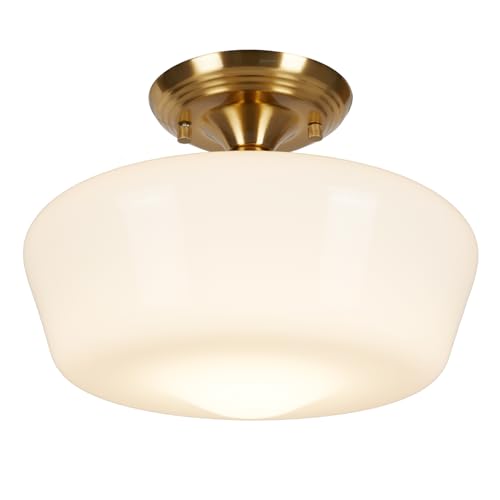 Schoolhouse Style Semi Flush Mount Ceiling Light FixtureMedium11.8 x 11.8 x 8.9 inchesCheck on Amazon

Top 3 picks at a glance
Best semi flush ceiling lights for every room
The best semi flush ceiling lights are sized to the room, leave enough headroom for safe passage, and provide the right brightness and light color for the task: choose a compact, diffused fixture for a bedroom or hallway and a brighter, easy-to-clean design for a kitchen. Before choosing a style, measure the ceiling height and fixture diameter, then check the light’s total output and whether its bulbs or LED module can be replaced.
Choose by ceiling height, room size, and use
A semi-flush light sits slightly below the ceiling, usually on a short stem or mount. That gives it more visual presence than a flush fixture without the drop of a pendant. The trade-off is that its shade or arms reduce headroom, so the fixture’s total height matters as much as its diameter.
As an Amazon Associate we earn from qualifying purchases at no extra cost to you.


As a practical starting point, aim for at least 7 feet of clearance from the floor to the lowest part of the fixture in a room or passage where people walk beneath it. In a low-ceiling room, measure rather than relying on a product label such as “low profile.” For a bedroom, a fixture may hang over the bed without being in a walking path, but check its position before buying.
| Room or situation | Useful fixture diameter | Starting light output | Good design priorities |
|---|---|---|---|
| Small bedroom, about 10 × 10 ft | 12–16 in | 1,500–2,500 lumens | Diffuser, dimming, warm white |
| Medium bedroom, about 12 × 14 ft | 16–20 in | 2,500–3,500 lumens | Even light distribution, dimmable bulbs or integrated LED |
| Kitchen, about 10 × 12 ft | 16–22 in | 3,000–4,500 lumens for general lighting | Easy-clean shade, neutral white, supplementary task lighting |
| Hallway, about 3–4 ft wide | 10–14 in | 800–1,500 lumens per fixture | Low profile, enclosed or diffused light, consistent spacing |
These are planning ranges, not guarantees of room brightness. Wall color, ceiling height, shade material, and existing lamps all affect how much light reaches useful surfaces. A dark or unusually tall room may need more output or additional fixtures; a small, bright bedroom may need less.
Match the light to the room
Bedrooms: favor comfort and control
For a bedroom, look for a frosted or fabric-covered diffuser that softens glare when you look up from the bed. Warm white light—about 2700–3000K—usually feels more relaxed than cool white. Dimming is useful for winding down, but confirm that the fixture, bulb, and wall dimmer are compatible; an incompatible combination can flicker, buzz, or fail to dim smoothly.
Choose the diameter to suit the room and furniture, not just the bed. A broad shade can look balanced in a larger bedroom but dominate a small one. If the fixture is centered above the bed, consider how low it hangs and whether its shape will cast strong shadows on the walls.
Kitchens: separate ambient light from task light
A semi-flush fixture can provide general kitchen lighting, but it should not be expected to illuminate every counter by itself. Cabinets and people can block ceiling light, so use under-cabinet lighting or another task source where you prepare food. For the main fixture, a neutral white range of about 3000–4000K can make work surfaces easier to read without the blue cast some people dislike.
Check the shade’s construction before choosing a decorative design. Grease and dust are easier to wipe from smooth glass or metal than from intricate fabric or deep ornament. If the fixture uses exposed bulbs, verify that the bulbs are suitable for the intended use and that they will not create uncomfortable glare from the usual sightlines.
Hallways: prioritize clearance and even spacing
Hallways benefit from low-profile fixtures that provide a clear path without visually crowding a narrow ceiling. If one fixture leaves dim stretches, two or more smaller lights spaced along the hall may work better than a single oversized light. As a rough layout, start by placing fixtures about 8–10 feet apart, then adjust for the hallway’s length, ceiling height, and each fixture’s beam spread. Avoid placing a bright light directly where it shines into a person’s eyes as they enter from a darker room.
Calculate brightness instead of guessing
Use lumens—not watts—to compare brightness. Watts describe electrical power consumption; lumens describe light output. A simple planning method is to multiply room area by a target illuminance in foot-candles. For general ambient lighting, a bedroom might use roughly 10–20 foot-candles, while a kitchen may need around 30–50 foot-candles on working areas. These are starting points; the ceiling fixture alone may not deliver the full target evenly.
Example: A 12 × 14 ft bedroom has an area of 168 square feet. At 15 foot-candles, the planning target is 168 × 15 = 2,520 lumens reaching the room. A fixture rated at 2,500 lumens is a reasonable starting point, but its shade may absorb or redirect some light. If the room still feels dim, add a bedside lamp rather than automatically replacing the ceiling fixture with a much brighter one.
For a kitchen, do a separate check for counters: a ceiling light may have enough total lumens while leaving work surfaces in shadow. More total output does not always solve poor placement or a narrow beam.
Compare common fixture styles
- Frosted-glass dome: Spreads light broadly and hides the bulb. A practical choice for hallways and bedrooms, though the glass may need occasional cleaning.
- Fabric drum: Gives a softer, decorative look that suits bedrooms. Confirm the diffuser and bulb arrangement control glare, and consider whether the material is appropriate for the room’s cleaning needs.
- Metal shade or cage: Adds a more industrial or traditional look and can suit kitchens. Open designs may expose bulbs, so choose a comfortable bulb brightness and shape.
- Integrated LED: Often slim and energy-efficient. Check its listed lumens, color temperature, dimming compatibility, warranty, and whether the light source can be replaced if it fails.
- Replaceable-bulb fixture: Makes it easier to change brightness or color temperature later. Confirm the fixture’s bulb base, maximum wattage, and whether the shade fits the bulb you plan to use.
Check fit and installation before buying
Record three measurements: ceiling height, fixture height from ceiling to its lowest point, and fixture diameter. For a hallway, also note the narrowest width so the fixture does not feel oversized. Compare the fixture’s lowest point with the 7-foot clearance guideline wherever people walk beneath it.
Next, confirm whether the fixture is rated for a standard ceiling junction box and whether the included mounting hardware suits your setup. Turn off power at the breaker before installation and verify the circuit is de-energized with an appropriate tester. Follow the manufacturer’s wiring instructions and local electrical rules. If wiring is damaged, the box is loose, or you are unsure which conductor is which, stop and use a qualified electrician.
Before finalizing a dimmable fixture, check the compatibility list for the exact LED bulbs or dimmer model when available. For integrated LED models, check whether color temperature is fixed or selectable: selectable settings can be convenient, but make sure the control will not be easy to change accidentally after installation.
A quick decision guide
| Your situation | What to prioritize | Likely direction |
|---|---|---|
| Ceiling near 8 ft, busy hallway | Clearance and diffuse light | Compact, low-profile dome, roughly 10–14 in wide |
| Bedroom used for relaxing and reading | Dimming, low glare, warm color | Diffused fixture around 2700–3000K, plus bedside lamps |
| Kitchen with shadowed counters | Cleanable shade and separate task lighting | Brighter ambient fixture around 3000–4000K, with under-cabinet lights |
| Want to change brightness later | Replaceable bulbs and dimmer compatibility | Socket-based fixture with compatible dimmable bulbs |
| Want a very slim profile | Specified fixture height and serviceability | Low-profile integrated LED; check replacement and warranty details |
Frequently asked questions
Can a semi-flush light be the only light in a kitchen?
Usually not if you need well-lit work surfaces. A semi-flush fixture can provide general kitchen lighting, but cabinets and people may block its light from counters. The article recommends adding under-cabinet lighting or another task source where food is prepared, and checking counter lighting separately from the room’s overall brightness.
What is the difference between lumens and watts?
Lumens describe how much light a fixture produces, while watts describe its electrical power consumption. To estimate a room’s general lighting needs, multiply its area by a target illuminance in foot-candles. The result is a planning target, not a guarantee that the ceiling fixture will light every surface evenly.
Are integrated LED lights or replaceable-bulb fixtures easier to maintain?
Replaceable-bulb fixtures make it easier to change brightness or color temperature later. With an integrated LED fixture, check the listed output, dimming compatibility, warranty, and whether the light source can be replaced if it fails. Those details help you compare future flexibility and serviceability before choosing.
Why might a dimmable ceiling light flicker or buzz?
An incompatible combination of fixture, bulb, and wall dimmer can flicker, buzz, or fail to dim smoothly. Before buying a dimmable fixture, check compatibility for the exact LED bulbs or dimmer model when that information is available. Compatibility matters even when the fixture itself is labeled dimmable.
What should I do if I am unsure about the ceiling wiring?
Stop and use a qualified electrician if wiring is damaged, the junction box is loose, or you are unsure which conductor is which. Before installation, turn off power at the breaker and verify that the circuit is de-energized with an appropriate tester. Follow the manufacturer’s instructions and local electrical rules.
Bottom line
To find the best semi flush ceiling lights for your home, choose the fixture’s height and diameter first, then match lumens and color temperature to the room. A diffused, dimmable light is often the most comfortable bedroom choice; kitchens benefit from cleanable fixtures plus dedicated counter lighting; and hallways call for low-profile designs spaced to avoid dark gaps. Checking clearance, bulb or LED replaceability, and dimmer compatibility before purchase prevents the most common fit and usability problems.


