
The best compost tumblers for most households are the FCMP Outdoor IM4000 for low-effort everyday composting, the Lifetime 60058 for large weekly volumes, and the Jora JK270 when faster, better-insulated composting matters more than price or assembly time.
As an Amazon Associate we earn from qualifying purchases at no extra cost to you.

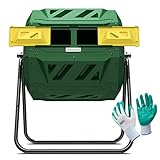


Top 3 picks at a glance
Best compost tumblers at a glance
| Model | Capacity | Chamber design | Best for | Typical market range |
|---|---|---|---|---|
| FCMP Outdoor IM4000 | 37 gal / 140 L | Two independent chambers | Small to medium households | Usually $100–$160 |
| Envirocycle Compost Tumbler | 35 gal / approximately 132 L | Single chamber with liquid collection | Compact gardens and households wanting a built-in base | Usually $150–$250 |
| Lifetime 60058 Compost Tumbler | 80 gal / approximately 303 L | Single large chamber | Large households and high garden waste | Usually $200–$350 |
| Jora JK270 | 270 L / approximately 71 gal | Insulated dual chamber | Fast, high-volume composting | Usually $500–$800 |
| Jora JK400 | 400 L / approximately 106 gal | Insulated dual chamber | Very large households and intensive gardens | Usually $800–$1,200 |
Capacities are maximum internal volumes, not the amount you should fill. A tumbler needs empty space for mixing, and composting works best when the active chamber is filled to roughly one-half to two-thirds of its usable volume.
Our top choices by household size
Best overall for most homes: FCMP Outdoor IM4000
The FCMP Outdoor IM4000 is a practical choice for a two- to four-person household producing kitchen scraps, coffee grounds, leaves, and occasional grass clippings. Its 37-gallon capacity is large enough for regular use without becoming excessively heavy to rotate.
The two-chamber layout is more useful than a single large compartment. You can keep adding fresh material to one side while the other side finishes. This avoids the common tumbler problem of having nowhere to put new scraps while an entire batch matures.
Rotation effort is moderate when the chamber is not overfilled. The central divider and relatively compact shape also make it easier to mix than a large 80-gallon drum. Ventilation holes provide basic aeration, although you still need to add enough dry, carbon-rich material to prevent a wet, compacted mass.
Assembly is a meaningful consideration. Expect a longer first setup than with a simple garden bin because the panels, frame, divider, and hardware must be aligned correctly. Work on a flat surface and leave all fasteners slightly loose until the panels are seated; tightening each section immediately can make later alignment difficult.
Best compact option with liquid collection: Envirocycle Compost Tumbler
The Envirocycle is suited to smaller gardens, patios, and households that want a contained system rather than maximum capacity. Its approximately 35-gallon drum is close in size to the FCMP, but its base is designed to collect compost liquid, sometimes called compost tea or leachate.
This design can be convenient on a hard surface because the tumbler does not need to sit directly on soil. It also reduces the chance of wet material pooling beneath the unit. The trade-off is that a single chamber does not provide the same continuous-batch flexibility as a dual-chamber tumbler.
Choose it when footprint, appearance, and liquid management matter more than the shortest possible composting cycle. Avoid applying undiluted collected liquid to edible crops; the contents and concentration are variable, so dilute it substantially and treat it as a garden by-product rather than a standardized fertilizer.
Best high-capacity value choice: Lifetime 60058
The Lifetime 60058 provides 80 gallons of capacity for households with substantial food scraps, leaves, shredded cardboard, and garden trimmings. It is a better match for four or more people, large yards, or gardeners who generate more material than a 35- to 37-gallon tumbler can handle.
The extra capacity comes with a cost that specifications do not show: a fully loaded drum can be difficult to turn. Wet food scraps and grass clippings are particularly heavy. Load it in layers instead of filling it with one dense material, and rotate it before it reaches maximum capacity.
This is a single-chamber system, so use a separate lidded container, wire bin, or second tumbler for fresh material while the main batch finishes. If you have no secondary storage, the dual-chamber FCMP or Jora design may be more convenient despite having less total volume.
Best for faster, more controlled composting: Jora JK270
The Jora JK270 is an insulated, dual-chamber tumbler with approximately 270 liters of total capacity. Insulation helps the active material retain heat, while the two chambers allow one batch to finish as the other receives new inputs.
It is a strong choice for gardeners who want to process a larger proportion of kitchen and garden waste and are willing to pay more for construction and thermal control. The insulated body is also helpful in cool weather, though no tumbler can compensate for an unbalanced recipe, insufficient moisture, or very small batches.
Assembly is more involved than with basic plastic tumblers, and the unit is best treated as a permanent installation. The Jora JK400 extends the same concept to approximately 400 liters, but its larger drum demands more room, stronger ground support, and more care when rotating a full chamber.
Decision matrix: match the tumbler to your situation
| Your situation | Recommended class | Why | What to avoid |
|---|---|---|---|
| One or two people, mostly kitchen scraps | 30–40 gal dual-chamber tumbler | Manageable rotation and a separate finishing chamber | 80+ gal models that will remain half empty |
| Three or four people with garden waste | 35–50 gal dual-chamber tumbler | Balances capacity, mixing effort, and batch continuity | Single-chamber units without a backup storage plan |
| Large yard or four-plus people | 70–80 gal tumbler or two medium tumblers | Handles more volume without constant emptying | Overfilling a small drum with wet grass |
| Cold climate or priority on faster batches | Insulated dual-chamber tumbler | Retains heat and supports continuous processing | Thin, uninsulated drums placed in exposed wind |
| Apartment patio or hard paving | Compact tumbler with stable base | Controls mess and avoids soil contact | Large units that require wide clearance to rotate |
Capacity is not the same as processing speed
A useful planning calculation is to estimate your weekly input before choosing a drum. Suppose two adults produce about 0.5 gallons of food scraps per day, plus 2 gallons of shredded cardboard and leaves per week. The weekly input is:
(0.5 × 7) + 2 = 5.5 gallons per week.
Because a tumbler should not be packed solid, a 37-gallon model has roughly 18–25 gallons of practical active capacity. That gives enough room for approximately three to four weeks of additions, depending on how quickly the material breaks down and how much it compresses.
For a household producing 12 gallons per week, the same tumbler could become overloaded in less than two weeks. In that case, an 80-gallon unit or two 37-gallon chambers is more sensible. Two medium tumblers can also be easier to rotate than one huge drum because each load weighs less.
What to compare beyond the capacity label
Rotation effort
Look for a low center of gravity, a reasonably small drum diameter, and handles or gripping surfaces that remain accessible. A tumbler is easiest to turn when it is between one-half and two-thirds full. If you must use your whole body weight to start rotation, the load is probably too wet, too dense, or too large.
Aeration
Air holes are necessary but not sufficient. A good tumbler should have vents distributed across the body, yet material still needs structural carbon such as dry leaves, shredded cardboard, or untreated paper. A useful starting ratio is approximately two to three volumes of dry brown material for each volume of wet food scraps, adjusted by feel.
Leak resistance
Seams and access doors matter most when the mixture is wet. A sealed drum helps contain odors and rain, but it should not be completely airtight. Place the tumbler on a level base, keep the door latch clean, and avoid adding excess water. A few drops of moisture are normal; continuous liquid draining indicates an overly wet recipe.
Assembly and placement
Check whether the frame must be bolted together, whether the drum requires panel assembly, and whether you have clearance for a full rotation. Leave at least 12 inches of free space around the rotating body where possible. For large models, assemble the frame where it will remain, because moving a finished unit can be awkward.
How to get faster compost from any tumbler
- Cut large scraps to roughly 1–2 inches so microbes have more surface area to work on.
- Add dry carbon material whenever the contents look glossy, sticky, or smell sour.
- Keep the mixture damp like a wrung-out sponge rather than wet like sludge.
- Rotate the tumbler several full turns every few days, especially after adding fresh scraps.
- Do not add meat, dairy, pet waste, diseased plants, or chemically treated yard waste to a basic household tumbler.
- Let finished compost rest outside the active chamber for one to three weeks if recognizable food pieces remain.
Frequently asked questions
How full should I fill a compost tumbler?
Aim to fill the active chamber to roughly one-half to two-thirds of its usable volume. Leave room for the material to mix as you rotate the drum. Filling it to the maximum can make rotation difficult, especially if the contents include wet food scraps or grass clippings.
What should I do if my compost tumbler smells or feels too wet?
Add dry, carbon-rich material such as leaves, shredded cardboard, or untreated paper, and avoid adding excess water. A starting point is two to three volumes of dry brown material for each volume of wet food scraps. Continuous liquid draining indicates the recipe is too wet.
Can I keep adding scraps while a batch is finishing?
Yes, if you use a dual-chamber tumbler: add fresh material to one chamber while the other batch finishes. With a single-chamber tumbler, plan on a separate lidded container, wire bin, or second tumbler for fresh material while the main batch matures.
Can I put a compost tumbler on a patio or other hard surface?
Yes. The Envirocycle is designed with a base that collects compost liquid and can be convenient on a hard surface because it does not need to sit directly on soil. Place the unit on a level base, and make sure there is enough clearance to rotate it.
What can I do with liquid collected from a tumbler?
Treat collected liquid as a garden by-product rather than a standardized fertilizer, because its contents and concentration vary. Avoid applying it undiluted to edible crops, and dilute it substantially before use.
Final recommendation
For the widest range of households, choose the FCMP Outdoor IM4000: its dual chambers, moderate 37-gallon capacity, and manageable rotation effort make it easier to maintain than many larger drums. Choose the Envirocycle when compact placement and liquid collection are priorities. Move to the Lifetime 60058 for substantially higher volume, but plan for heavier rotation and a separate place for fresh scraps. If faster, more controlled processing justifies a much higher budget and more involved assembly, the insulated Jora JK270 or JK400 is the premium option.


