
The best double wall whiskey glasses are borosilicate-glass tumblers with a comfortable 250–350 ml capacity, a thin but reinforced drinking rim, stable bases, and clearly stated dishwasher-safe construction.
Double-wall glasses are useful for slow sipping because the air gap reduces heat transfer from your hand and helps a chilled pour warm more gradually. They are not miniature thermoses, however: the design improves temperature stability and handling, but it does not replace good ice, proper storage, or a sensible serving size.
As an Amazon Associate we earn from qualifying purchases at no extra cost to you.
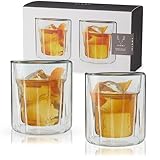

What to look for in the best double wall whiskey glasses
1. Borosilicate glass for thermal shock resistance
Borosilicate glass contains boron oxide, which gives it a lower coefficient of thermal expansion than ordinary soda-lime glass. In practical terms, it is better suited to changes such as adding a cold whiskey stone to a room-temperature glass or pouring a room-temperature spirit over ice.
This does not make it unbreakable. A thin double-wall tumbler can still crack if it is dropped, struck against a sink, or exposed to a sudden extreme temperature change. Avoid pouring boiling water into a glass that has been chilled, and do not move a very hot glass directly into cold water.
Look for product descriptions that specifically say “borosilicate glass” rather than simply “heat-resistant glass.” If the material is not disclosed, durability and thermal performance are harder to judge.
2. Insulation that protects temperature and your hand
The space between the inner and outer walls contains air, which conducts heat less efficiently than solid glass. That creates two useful effects:
- Your hand transfers less warmth to the whiskey, especially when holding the bowl rather than the base.
- A chilled drink generally stays cool longer than it would in a single-wall tumbler of similar shape.
Insulation is most noticeable with whiskey served neat or with one large cube. It is less important for a highball, where a large volume of mixer and ice already dominates the temperature. Double-wall construction also keeps condensation off the table, although moisture can still appear if the outer surface becomes colder than the surrounding air.
A double-wall glass does not actively keep whiskey cold. A useful rule is to chill the glass for neat whiskey only if you want a cooler, less aromatic pour; for tasting, a room-temperature glass usually reveals more aroma.
3. Rim design affects aroma and comfort
The rim is where premium-feeling and inexpensive-feeling glasses often diverge. A thin, smoothly finished rim makes small sips easier and directs whiskey cleanly onto the tongue. A slightly rounded rim feels more durable and forgiving, particularly in a household dishwasher, but may feel less refined.
For nosing and slow sipping, choose a rim approximately 2–4 mm thick with no visible seam, sharp edge, or uneven lip. A gently tapered or inward-curved bowl can concentrate aroma, while a wide rocks-glass opening makes adding large ice cubes easier. If you prefer bourbon with an oversized cube, prioritize access and stability over a narrow tasting shape.
4. Capacity is more important than maximum size
A glass advertised as 300 ml or 10 oz is usually describing capacity to the brim, not a sensible serving level. Filling it completely leaves no room to swirl, smell, or add ice without spilling.
| Glass capacity | Practical pour | Best use | What to watch for |
|---|---|---|---|
| 180–220 ml | 30–45 ml | Neat whiskey or a small cube | Limited room for large ice |
| 250–320 ml | 30–60 ml | Most everyday sipping | Best balance of aroma, stability, and capacity |
| 350–450 ml | 45–75 ml | Large rocks glasses and cocktails | Can make a modest pour look and feel undersized |
A 30 ml pour occupies only about 10% of a 300 ml glass before ice is added. That spare volume is useful: it leaves a large aroma space above the liquid and prevents the drink from reaching the rim when the glass is tilted. For a 60 ml pour, the same glass uses about 20% of its nominal capacity, still leaving room for one large cube.
For most people, 250–320 ml is the most versatile range. Choose 180–220 ml if you mainly drink neat pours and value compact storage. Move to 350 ml or more only if you routinely use large cubes or prepare whiskey cocktails.
Decision matrix: choose by serving style
| Your usual serving | Recommended specification | Why it fits |
|---|---|---|
| Neat Scotch, slow aroma-focused sipping | 200–300 ml; gently tapered bowl; thin smooth rim | Concentrates aroma without making a 30 ml pour feel lost |
| Bourbon with one large cube | 280–350 ml; wide opening; heavy stable base | Accepts a large cube and gives it room to move |
| Whiskey with several small cubes | 300–400 ml; straight-sided bowl; reinforced rim | Provides headroom and reduces splash risk |
| Whiskey highballs or mixed drinks | 350–450 ml; dishwasher-safe; sturdy walls | Leaves space for mixer, ice, and a garnish |
| Small hands or crowded desk | 200–280 ml; low center of gravity; non-slip base | Improves grip and lowers the chance of tipping |
| Frequent dishwasher use | Explicit dishwasher-safe rating; no removable seals | Reduces maintenance and avoids trapped moisture |
Dishwasher safety: the detail that needs checking
Never assume that every double-wall glass is dishwasher-safe. The sealed cavity, rim finish, and thin glass can react differently to repeated heat cycles. Some manufacturers approve the glass itself but recommend a particular rack or a gentle cycle.
Before buying, check for all three of these details:
- Explicit care instructions: “Dishwasher-safe” is more useful than vague claims about durability.
- Rack placement: the upper rack is generally safer because it is farther from the heating element and experiences less mechanical movement.
- Seal condition: inspect the bottom after washing. A damaged seal can allow water into the cavity, producing fogging or a sloshing sound.
Even dishwasher-safe double-wall glasses last longer when placed with space around them. Do not stack them unless the manufacturer specifically permits stacking, and do not let cutlery strike the rim.
Product families and spec classes worth considering
Several established product types illustrate the choices without making one shape right for everyone.
- Bodum Pavina-style glasses: compact, rounded double-wall tumblers suited to neat pours, espresso-sized servings, and small cocktails. Their curved profile is comfortable in the hand, but the smaller capacities are less suitable for oversized ice.
- JoyJolt Savor-style tumblers: modern double-wall glasses commonly offered in whiskey-friendly sizes. They suit people who want a more conventional rocks-glass appearance while retaining insulation.
- Large double-wall rocks-glass designs: typically 300–400 ml, with a broad opening and heavier base. These are the practical choice for bourbon, large cubes, and whiskey cocktails, provided the rim and care instructions are well specified.
- Small tasting-oriented double-wall glasses: narrower bowls and capacities around 200–250 ml. These emphasize aroma and controlled sipping rather than ice capacity.
Model names and sets can change, so verify the current capacity, material, and care instructions rather than relying on photographs. A premium-looking shape is not enough if the glass is too small for your preferred pour or is hand-wash-only when you need daily convenience.
How to use double-wall glasses for a slower, better pour
- Choose the temperature first. Serve whiskey neat at room temperature for maximum aroma, or use a single large cube when you want dilution and cooling.
- Pour 30–60 ml. This range leaves adequate headspace in a 250–320 ml glass.
- Let the drink settle for one minute. The air space above the liquid gives volatile aromas time to collect without requiring vigorous swirling.
- Hold the lower bowl or base. Although the double wall reduces heat transfer, avoiding the upper bowl minimizes warming and fingerprints.
- Add water gradually if desired. A few drops can open some spirits without overwhelming the drink; use a straw or dropper for control.
- Wash according to the manufacturer’s instructions. Rinse sugary cocktails promptly, since residue around the base or rim can become difficult to remove.
Common compromises and buying mistakes
Double-wall glasses can be lighter than they look, which makes some designs feel less stable than a thick single-wall rocks glass. Check the base diameter and weight if you often drink near a keyboard, on a narrow side table, or outdoors.
They can also be harder to manufacture consistently. Small bubbles or slight visual distortion may appear in the cavity and do not necessarily affect use, but cracks, loose seals, sharp rims, or liquid trapped between the walls are defects rather than cosmetic variations.
Finally, insulation can reduce tactile feedback. A traditional heavy tumbler communicates temperature and weight more clearly, while a double-wall design prioritizes a cooler exterior and less condensation. Decide whether that trade-off matters to you before paying extra.
Frequently asked questions
Do double-wall glasses keep whiskey cold like a thermos?
No. Their air gap slows heat transfer from your hand and can help a chilled drink stay cool longer, but double-wall glasses do not actively keep whiskey cold. Good ice, proper storage, and a sensible serving size still matter.
Should I chill a double-wall glass before pouring whiskey?
Only if you want a cooler, less aromatic pour. For tasting, the article recommends a room-temperature glass because it usually reveals more aroma. A single large cube is another option when you want cooling and dilution.
Can double-wall whiskey glasses be stacked for storage?
Do not stack them unless the manufacturer specifically permits it. The article also recommends leaving space around the glasses in the dishwasher and preventing cutlery from striking the rim, to help avoid damage.
What does water inside the glass’s cavity mean?
Water in the cavity can indicate a damaged seal. After washing, inspect the bottom; fogging or a sloshing sound can also signal that water has entered the sealed space.
Are small bubbles or visual distortion in a double-wall glass a defect?
Not necessarily. The article notes that small bubbles or slight visual distortion may appear in the cavity and do not necessarily affect use. Check the current product details for material and care instructions rather than judging by appearance alone.
Bottom line
For the broadest range of whiskey, choose a borosilicate double-wall glass around 250–320 ml, with a smooth 2–4 mm rim, a stable base, and explicit dishwasher-safe instructions. Select a smaller tapered glass for neat, aroma-focused sipping; choose a wider 300–400 ml rocks-style glass for large ice and cocktails. The right capacity and care requirements will affect daily enjoyment more than decorative styling or maximum advertised volume.


