
The best camping stoves depend on your cooking setup: choose a compact canister stove for backpacking, an integrated system for fast one-pot meals, a liquid-fuel stove for cold or remote trips, or a two-burner propane stove for car-camping meals for several people.
As an Amazon Associate we earn from qualifying purchases at no extra cost to you.
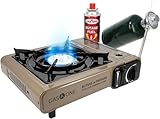
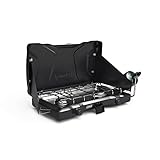
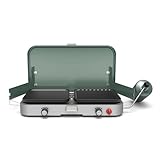

Top 3 picks at a glance
Best camping stoves by camping style
| Camping situation | Best stove type | Strong choice | Why it fits |
|---|---|---|---|
| Solo or two-person backpacking | Remote canister stove | SOTO WindMaster | Light weight, excellent burner control, and better wind performance than most ultralight burners |
| Fast boiling and dehydrated meals | Integrated canister system | Jetboil Flash | Pot, burner, heat exchanger, and wind protection work together efficiently |
| Three-season backpacking with real cooking | Remote canister or liquid-fuel stove | MSR WhisperLite Universal | Supports canister fuel and liquid fuels, with a broader cooking range than an integrated boiler |
| Family car camping | Two-burner propane stove | Camp Chef Everest 2X | Two independent burners and enough output for a pot and skillet at the same time |
| Tabletop cooking and cast-iron pans | Two-burner propane stove | Primus Tupike | Stable platform, strong simmer control, and a design intended for repeated camp-kitchen use |
How to choose among the best camping stoves
1. Match the fuel to your trip
Isobutane-propane canisters are the simplest choice for most backpackers. They screw onto compact stoves, light easily, and provide clean, controllable heat. The main limitation is cold-weather performance: vapor pressure drops as the canister gets colder, and a nearly empty canister may struggle in freezing conditions.
Propane cylinders power most car-camping stoves. They are convenient for high heat and multi-person meals, but the cylinders are bulky and heavier than backpacking canisters. A standard two-burner stove is usually excessive for a single backpacker but ideal when cooking eggs, coffee, pasta, or a skillet meal simultaneously.
White gas and other liquid fuels are useful for extended trips, international travel, and cold conditions. They require priming and occasional maintenance, but a refillable bottle can be more practical than carrying many small canisters. The MSR WhisperLite Universal can burn a range of fuel types, although its liquid-fuel setup takes more preparation than a screw-on canister stove.
Alcohol and wood-burning stoves can be extremely light, but they generally offer slower heating, limited flame control, and weaker performance in wind. They make sense for minimalist trips where low weight matters more than speed and cooking flexibility.
2. Decide whether you need boiling speed or cooking control
An integrated system such as the Jetboil Flash is optimized for boiling water. Its burner connects directly to a heat-exchanger pot, and the surrounding structure reduces heat loss. Manufacturer-rated boil times are around 100 seconds under favorable conditions, while real-world times commonly become roughly two to four minutes with cold water, wind, elevation, or a partially full canister.
A standard burner such as the SOTO WindMaster or MSR PocketRocket Deluxe is more versatile. It can boil water in a compatible pot, but it can also simmer rice, warm soup, or fry small portions. Typical one-liter boil times are approximately three to five minutes in calm conditions, depending on the pot, fuel, water temperature, and burner setting.
For car camping, burner output is only part of the answer. A stove with two 20,000-BTU-class burners can heat a large pan quickly, but spacing, grate stability, and simmer range determine whether it can cook a complete meal without scorching it.
Key specifications compared
| Stove | Fuel | Output | Approx. packed size | Approx. weight | Typical boil behavior | Cooking capacity |
|---|---|---|---|---|---|---|
| Jetboil Flash | Isobutane-propane canister | About 9,000 BTU/h | 7.1 x 4.1 in; pot components nest together | About 13.1 oz without fuel | Fastest with its 1-liter integrated cup; roughly 1.5–4 minutes depending on conditions | Boils water for 1–2 people; limited pan cooking |
| SOTO WindMaster | Isobutane-propane canister | About 11,000 BTU/h | Burner roughly 3.5 x 3.5 in; pot sold separately | About 2.3 oz for the burner with standard support | About 3–5 minutes for 1 liter with a suitable pot in calm conditions | One pot; good simmering and small-pan use |
| MSR PocketRocket Deluxe | Isobutane-propane canister | About 9,000 BTU/h | About 2 x 2 x 3.5 in folded | About 2.9 oz | Roughly 3.5–5 minutes for 1 liter, varying substantially with pot and wind | One pot; strong choice for boiling and basic simmering |
| MSR WhisperLite Universal | Canister or liquid fuel | About 10,000 BTU/h | About 6 x 5 x 4 in with parts packed | About 11.2 oz without fuel bottle | Usually around 3.5–6 minutes for 1 liter, with setup and fuel affecting results | One large pot; better for group cooking than tiny remote burners |
| Camp Chef Everest 2X | Propane cylinder | Two burners, about 20,000 BTU/h each | About 23.5 x 13.5 x 4.5 in closed | About 12 lb | Not designed primarily for boiling speed; heats large pots and pans quickly | Two pots or a pot and skillet simultaneously |
| Primus Tupike | Propane canister or cylinder, depending on configuration | Two burners, about 7,000 BTU/h each | About 18.8 x 11.6 x 4.3 in closed | About 9.5 lb | Moderate heating speed with strong low-heat control | Two smaller pans; suited to deliberate camp-kitchen cooking |
The dimensions and weights above are approximate representative specifications; accessories, fuel adapters, pot supports, and regional versions can change the packed figure.
Wind resistance matters more than headline BTUs
Wind strips heat from the flame and carries hot air away from the pot. A remote-canister stove with a broad burner and built-in wind resistance can outperform a higher-output burner used in exposed conditions.
The SOTO WindMaster is particularly well suited to windy backpacking because its burner design and support system help maintain a stable flame. The Jetboil Flash has an advantage of a different kind: its burner and heat-exchanger cup form a partly enclosed system, so less heat is lost before reaching the water.
Two-burner propane stoves usually need a separate windscreen. Use a screen around the sides—not directly over the burner or in a way that traps heat beneath the fuel cylinder. A windscreen that blocks airflow can create a dangerous overheating condition.
Cooking capacity: calculate before buying
A useful rule is to budget about 0.75 liter of boiling water per person for a dehydrated meal, hot drink, and a small breakfast. For four people, that is approximately:
4 people × 0.75 liter = 3 liters of hot water.
An integrated 1-liter backpacking system can handle that volume, but it requires three heating cycles and leaves little capacity for cooking food in the pot. A two-burner car-camping stove can heat a 2-liter pot while a second burner handles a pan, reducing the total meal time and avoiding a queue for hot water.
For two people who mainly eat freeze-dried meals, choose a 1-liter integrated system. For two people cooking pasta, sauce, and coffee at the same time, choose a conventional burner with a 2- to 3-liter pot. For four or more people, a two-burner stove is usually the practical minimum.
Best choices by scenario
Best for lightweight backpacking: SOTO WindMaster
Choose the WindMaster when low weight, wind performance, and real simmer control matter more than an all-in-one pot. You will need to add a pot, lid, and possibly a windscreen, but the system can be tailored to solo or group cooking. Its larger support option is also more reassuring with a wider pot than many ultralight burners.
Best for fast solo meals: Jetboil Flash
The Flash is the efficient choice for boiling water with minimal fuss. The pot, burner, and accessories nest together, and the heat exchanger reduces wasted heat. It is less suitable for frying or cooking foods that need constant stirring, so do not choose it as your only stove if pancakes, fresh vegetables, or skillet meals are central to the trip.
Best for cold-weather flexibility: MSR WhisperLite Universal
The WhisperLite Universal makes sense when one stove must work across seasons or fuel supplies. Canister operation is convenient in moderate weather, while liquid fuel offers a practical alternative in colder conditions. The trade-off is weight, priming procedure, and maintenance.
Best for family car camping: Camp Chef Everest 2X
The Everest 2X is designed around cooking capacity rather than minimum packed weight. Independent controls, two powerful burners, and a broad cooking surface make it suitable for a large pot plus a skillet. It is a poor backpacking choice but a strong fit for a vehicle-based kitchen.
Best for compact camp-kitchen cooking: Primus Tupike
The Tupike favors portability and refined low-heat control over maximum burner output. It works well for couples who want to cook fresh food without carrying a full-size home-style range. Check the fuel connection and cylinder requirements for your specific regional version before purchasing.
Practical setup steps for better stove performance
- Use a level, stable surface. A level stove keeps liquid fuel and pans balanced and prevents a tall pot from tipping.
- Match the pot to the burner. A very wide pot can reflect heat toward the controls, while a tiny pot wastes heat around the edges. Use the manufacturer’s recommended pot diameter when available.
- Keep the lid on while boiling. A lid reduces heat loss and can shorten boil time more effectively than turning the burner to maximum.
- Protect against side wind. Use the stove’s built-in shielding or a properly placed windscreen, leaving the fuel container ventilated and away from trapped heat.
- Reduce power after boiling. Once water reaches a boil, turn the burner down. Maximum output adds noise and fuel consumption without improving simmered food.
- Test the complete setup before leaving. Check that the pot support, fuel connection, lighter, and cooking utensils all work together; compatibility problems are easier to solve at home than at camp.
Frequently asked questions
Can I use a backpacking stove for car camping?
Yes, but it may be limiting if you need to cook for several people or use multiple pans. A standard burner such as the SOTO WindMaster can simmer and handle small-pan cooking, while an integrated system such as the Jetboil Flash is mainly suited to boiling water. For family meals, a two-burner propane stove is usually more practical.
What cookware do I need with a remote canister stove?
You need to add a pot and lid, and you may also need a windscreen. The SOTO WindMaster is sold as a burner rather than an all-in-one cooking system, so cookware is separate. Its larger support option is more reassuring with a wider pot than many ultralight burners, but the final setup depends on your meal size.
Are integrated camping stoves suitable for frying food?
They are generally less suitable for frying than conventional burners. The Jetboil Flash is optimized for boiling water, and its integrated pot, burner, and heat exchanger favor fast one-pot meals. If pancakes, fresh vegetables, or skillet meals are central to your trip, choose a more versatile burner with a separate pot or pan instead.
How should I protect a camping stove from wind safely?
Use a windscreen around the sides of a two-burner propane stove, while keeping it away from the burner and fuel cylinder. Blocking airflow or trapping heat beneath the cylinder can create a dangerous overheating condition. Backpacking stoves may have built-in wind advantages, but exposed conditions can still affect heating performance and fuel use.
How many heating cycles might four people need with an integrated system?
A four-person group may need three heating cycles with a 1-liter integrated backpacking system if each person requires about 0.75 liter of hot water. That system can handle the total volume, but it leaves little capacity for cooking food in the pot. A two-burner stove can heat a 2-liter pot while another burner handles a pan.
Bottom line
The best camping stoves are not all the same kind of product. Pick the Jetboil Flash for fast backpacking boils, the SOTO WindMaster for a lightweight and wind-capable modular setup, the MSR WhisperLite Universal for fuel flexibility, or a two-burner stove such as the Camp Chef Everest 2X for family meals. The right choice comes down to fuel availability, packed size, wind exposure, and whether you are boiling water for one person or cooking several dishes at once.


