
The best luxury freestanding whirlpool and jetted bathtubs are the ones whose jet layout, soaking depth, heater capacity, electrical load, and plumbing requirements fit your bathroom—not simply the tub with the most jets.
As an Amazon Associate we earn from qualifying purchases at no extra cost to you.

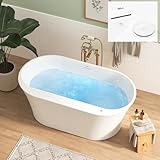


Top 3 picks at a glance
Quick comparison: which tub type suits your bathroom?
| Bathroom situation | Recommended tub class | Typical dimensions | Why it fits |
|---|---|---|---|
| Compact luxury bathroom | Single-seat air or low-output whirlpool tub | 55–60 in. long × 30–32 in. wide | Needs less floor area and usually has a lower electrical demand |
| Couples’ bathroom | Two-person whirlpool or combination air-and-water tub | 66–72 in. long × 36–42 in. wide | Provides two backrests, shoulder room, and separate jet zones |
| Deep soaking priority | Freestanding soaking tub with optional air massage | 59–71 in. long × 30–38 in. wide | Usually gives more usable water depth than a heavily molded whirlpool shell |
| Remodel with limited electrical capacity | Air-jet tub or pump-only whirlpool | 60–67 in. long × 30–36 in. wide | May avoid the additional circuit required by an inline water heater |
| Large primary suite | Luxury dual-zone whirlpool with heater | 72–78 in. long × 40–48 in. wide | Allows generous seating, directional jets, and longer sessions |
What separates a luxury freestanding jetted tub from a basic model?
A premium tub should be judged by how effectively it delivers pressure, warmth, comfort, and serviceability. A high jet count is not automatically an advantage. Twelve well-positioned directional jets can be more useful than thirty small jets that spray unevenly across the back and legs.
- Directional back jets: Look for adjustable jets aligned with the lumbar and upper-back areas rather than concentrated only around the sides.
- Foot and calf jets: These are valuable in a long tub, but they need to be positioned where your feet naturally rest.
- Independent zones: Separate controls for back, side, and foot jets let you reduce pressure in sensitive areas without weakening the entire system.
- Variable-speed pump: This provides more control than a single on/off pump and can reduce noise during a gentle cycle.
- Dry-run protection: A useful safety feature that prevents the pump from operating when the water level is too low.
- Accessible service components: Pumps, controls, and heaters should be reachable through a planned access panel or removable finish section.
Head-to-head: whirlpool jets versus air jets
Water whirlpool jets
Water jets deliver the strongest, most focused massage. They are better for users who want noticeable pressure on the lower back, hips, or feet. The tradeoff is higher plumbing complexity, more pump noise, and a greater need to clean internal water passages.
Water systems also tend to use more bathwater. A tub with a deep 18-inch bathing well may require approximately 60–80 gallons to cover the jets and fill above the overflow, depending on its shape and occupant displacement.
Air jets
Air systems push warmed air through many small openings in the floor or seat. They produce a softer, bubbling sensation that is quieter on the body but less effective for concentrated muscle pressure. Air jets can be a better match for households that want relaxation rather than hydrotherapy-style force.
Because air systems do not circulate bathwater through large plumbing lines in the same way, they can be easier to maintain. However, the air blower still needs electrical power, and the bubbling action can cool bathwater unless the system includes heated air or an inline water heater.
Combination systems
A combination air-and-water tub offers the broadest range of sensations, but it also takes the most space, power, and maintenance planning. Choose this configuration only if you expect to use both systems; otherwise, you may pay for equipment that adds little practical value.
Dimensions, soaking depth, and usable comfort
Exterior dimensions do not tell you how comfortable a tub will be. Thick rims, molded armrests, pump housings, and sloped backs can reduce the interior bathing area substantially.
- Exterior length: 60–67 inches works for many bathrooms; 72 inches or longer is better for taller users or two-person seating.
- Exterior width: A 30–34-inch width is easier to install in a standard bathroom. Widths above 38 inches provide more shoulder room but require larger clearances.
- Interior bathing length: Check this separately from the outside length. A large rim can remove several inches of usable legroom.
- Soaking depth: About 15–17 inches is comfortable for a conventional bath. Deep-soak models may provide 18–22 inches, although they require more water and often a taller step-in height.
- Rim height: A 24-inch-plus rim can look dramatic but may be difficult to enter, especially if the floor is slippery.
- Seat angle: A steep reclining back improves comfort but can force your knees upward if the tub is too short.
For a freestanding tub, plan more than the tub’s footprint. Leave roughly 30 inches of clear entry space along the open side and at least 4–6 inches behind the tub where the manufacturer permits. A tub positioned tightly against a wall may be technically freestanding but difficult to clean and service.
Materials: acrylic, stone resin, and cast iron
Reinforced acrylic
Reinforced acrylic is the most practical luxury material. It is relatively light, warm to the touch, available in many shapes, and easier to carry upstairs. Quality varies, so look for a rigid reinforced base and a fully supported underside rather than a shell that flexes under load.
Stone resin or solid-surface composite
Stone resin provides a substantial appearance, excellent rigidity, and strong heat retention. It is often the best choice for a minimalist bathroom, but the weight can exceed 300 pounds before water and occupants are added. Confirm the floor structure and delivery route before ordering.
Cast iron
Cast iron holds heat well and resists flexing, but it is exceptionally heavy and less common in sophisticated freestanding jetted configurations. It may require structural review, reinforced flooring, and specialized delivery equipment.
Heater options and the real electrical load
An inline heater helps maintain water temperature while the pump operates, but it does not instantly heat a cold bath. A heater rated at 1.5 kilowatts adds meaningful load to the circuit and may require a dedicated 15- or 20-amp branch circuit, depending on the complete system and local code.
Here is a practical load calculation. Suppose a tub has a 1.2 kW pump, a 1.5 kW inline heater, and a 0.3 kW control or air-blower load:
Total running load = 1.2 kW + 1.5 kW + 0.3 kW = 3.0 kW.
At 120 volts, that equals approximately 25 amps because 3,000 watts ÷ 120 volts = 25 amps. That cannot be treated as a normal shared bathroom outlet. A 240-volt configuration would draw about 12.5 amps for the same wattage, but the tub must be specifically designed and approved for that supply.
Ask the manufacturer for the total connected load, required breaker size, GFCI protection, disconnect location, and whether the pump and heater may share a circuit. Have a licensed electrician confirm the installation rather than sizing the circuit from the heater wattage alone.
Plumbing requirements that are easy to miss
- Waste location: Confirm whether the drain is centered, offset, or adjustable. A floor drain that misses the tub outlet by even a few inches can complicate installation.
- Overflow arrangement: Some tubs use an integrated overflow; others require a specific exposed or concealed waste-and-overflow kit.
- Floor-mounted faucet: A freestanding faucet needs secure blocking or a properly anchored supply connection. Do not rely on flexible lines hanging unsupported inside the floor.
- Access panel: A concealed pump is attractive, but there must still be a realistic way to replace the pump, heater, or controller.
- Water supply: High-flow fillers can fill a deep tub faster, but verify that the home’s hot-water system can keep up.
- Drainage: A large tub discharges quickly. Confirm that the trap and waste line can handle the manufacturer’s recommended flow rate.
Installation-space checklist
Before choosing a model, tape its full footprint onto the finished floor. Then mark the faucet, drain, electrical access, door swing, toilet clearance, and shower entrance. Include the space required to tilt the tub through the doorway and around corners; an oversized stone-resin tub may fit the bathroom but fail during delivery.
Also calculate the loaded weight. A 70-gallon tub can contain roughly 584 pounds of water because one gallon weighs about 8.34 pounds. Add a 250-pound tub and a 200-pound occupant:
584 + 250 + 200 = approximately 1,034 pounds.
That load is distributed across the base, but a floor review is sensible for older homes, upper floors, and heavy stone-composite tubs.
Best buying decision by priority
| Your priority | Look for | Avoid |
|---|---|---|
| Strong massage | Adjustable directional water jets, dedicated pump, separate zones | High jet counts with no pressure or zone specifications |
| Long, hot baths | Deep basin, insulated shell, inline heater, well-sized water heater | Very large tub on a small domestic hot-water system |
| Quiet operation | Variable-speed pump, vibration isolation, enclosed motor compartment | High-output single-speed pumps mounted directly to the floor |
| Easy maintenance | Accessible service panel, drainable jet lines, removable filters where applicable | Fully sealed equipment with no documented service route |
| Small bathroom | 60–66-inch tub, narrow rim, wall-mounted or compact floor-mounted filler | Deep 42-inch-wide models that restrict entry and cleaning space |
Frequently asked questions
How many jets should a luxury jetted tub have?
Jet quality and placement matter more than the total jet count. Adjustable directional jets should align with the lumbar and upper-back areas, while foot and calf jets should meet the natural position of your feet. Independent zones and variable-speed control can provide more useful comfort than many small jets that spray unevenly.
Will an inline heater keep the bath hot throughout a long session?
An inline heater helps maintain water temperature while the pump operates, but it does not instantly heat a cold bath. Air bubbling may cool the water unless the system includes heated air or an inline water heater. Ask the manufacturer about heater operation and the complete connected load before planning electrical work.
Can a freestanding jetted tub sit directly against the wall?
A freestanding jetted tub can sit near a wall, but leaving clearance makes cleaning and servicing easier. Plan more than the tub’s footprint, including roughly 30 inches of clear entry space along the open side and at least 4–6 inches behind the tub where the manufacturer permits.
What should I check before ordering a heavy stone-resin or cast-iron tub?
Check the floor structure and the delivery route before ordering a heavy tub. Stone resin can exceed 300 pounds before water and occupants are added, while cast iron may require structural review, reinforced flooring, and specialized delivery equipment. Also confirm that the finished bathroom can accommodate the tub and provide service access.
What should I verify about the drain and overflow before installation?
Verify the drain location, overflow arrangement, and required waste-and-overflow kit before installation. The drain may be centered, offset, or adjustable, and a floor drain that misses the tub outlet can complicate the work. Also confirm access to the pump, heater, and controller, plus whether the waste line can handle the recommended flow rate.
Bottom line
For most luxury renovations, a 66–72-inch reinforced-acrylic freestanding tub with a moderate number of directional water jets, an inline temperature-maintenance heater, independent massage zones, and a planned service access route offers the best balance. Choose a deep stone-resin soaker with air massage when quiet relaxation and appearance matter more than concentrated pressure. Before ordering, confirm the loaded floor weight, total electrical demand, drain alignment, overflow kit, faucet location, and the manufacturer’s required clearances—those details determine whether the tub remains luxurious after installation.


