
Top 3 picks at a glance
Best Jewelry Polishing Machines: The Right Pick Depends on the Metal and the Work
The best jewelry polishing machine for most small workshops is a variable-speed, bench-mounted motor with a roughly 1/3–1/2 HP rating, tapered spindles, and a properly fitted dust hood. Choose a lighter-duty flex-shaft setup for tiny, detailed pieces; choose a more powerful, rigid bench polisher for frequent work on larger pieces. The crucial distinction is not maximum RPM alone: controllable speed, safe wheel fit, dust capture, and enough room to hold the work securely matter more.
Compare the machine types before comparing models
| Machine class | Typical power | Useful speed range | Best for | Main trade-off |
|---|---|---|---|---|
| Compact single-speed bench buffer | About 1/6–1/4 HP | About 3,450 RPM | Occasional polishing of small pieces | Limited control; can be too aggressive for delicate work |
| Variable-speed bench polisher | About 1/3–1/2 HP | About 1,750–3,450 RPM | General jewelry finishing and varied compounds | Higher cost and greater need for dust control |
| Heavy-duty bench buffer | About 1/2–1 HP | Often around 1,750 or 3,450 RPM | Long sessions, larger parts, or tougher preliminary work | More torque and weight can make small parts harder to manage |
| Flex-shaft handpiece system | Often about 1/6–1/3 HP | Variable; depends on motor and handpiece | Setting, detail work, and localized polishing | Does not replace the broad, even action of a large buffing wheel |
These are practical ranges, not guarantees: manufacturers may rate motors differently, and loaded speed can differ from unloaded speed. Check the machine’s manual for its actual speed, duty cycle, spindle dimensions, and approved accessories.
As an Amazon Associate we earn from qualifying purchases at no extra cost to you.

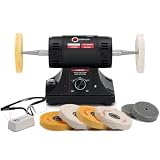


Match the machine to your work
| Your situation | Best-fit setup | Why it fits |
|---|---|---|
| Mostly rings, small pendants, or occasional repairs | Variable-speed bench polisher, around 1/3 HP | Enough capacity for common buffs without defaulting to an overly powerful motor |
| Fine details, settings, and hard-to-reach recesses | Flex shaft with a compatible handpiece and small attachments | Lets you work locally rather than bringing a tiny feature to a large wheel |
| Frequent polishing of larger silver or gold pieces | Bench polisher around 1/2 HP, with a rated dust hood | More reserve for sustained contact and larger buffs |
| Mostly delicate, thin, or hollow pieces | Variable speed plus small, soft buffs; use the low end of the speed range | Lower speed and controlled pressure reduce heat and edge rounding |
| Mixed metals or multiple compounds | Two-spindle machine or separate dedicated wheels | Reduces compound contamination between coarse and final stages |
What to look for in the machine
Motor power: buy for sustained work, not a headline number
Motor power affects how well a machine holds speed when a buff meets the workpiece. A small motor may slow under firm pressure; that is a cue to lighten your touch, not push harder. For occasional small-jewelry work, a 1/3 HP class machine is often a sensible middle ground. Frequent work on larger pieces can justify more power, but extra torque makes secure grip and controlled presentation even more important.
Also check the duty cycle. A motor intended for intermittent use may overheat during long sessions, even if its horsepower looks adequate. Favor a machine with a stated continuous-duty rating if you polish for extended periods.
Speed control: a real advantage for delicate metals
A variable-speed control is useful when switching from a robust silver component to a thin gold edge or a small setting. A practical starting point for a buffing wheel is roughly 1,750–2,500 RPM for delicate or small work, and around 2,500–3,450 RPM for sturdier pieces when the wheel and machine are rated for it. These are starting ranges, not universal settings: wheel diameter changes surface speed, and compound instructions may specify limits.
Use light contact and keep the piece moving. If an edge heats quickly, the surface starts to smear, or a thin part flexes, stop and reassess speed, pressure, and wheel choice. Polishing removes material; it cannot be reversed by changing the setting afterward.
Wheel compatibility: measure before you order
Spindles, adapters, and wheel bores are not universal. Confirm the shaft diameter, thread direction, arbor or taper style, and the wheel’s bore before buying buffs. Check the machine’s manual for maximum wheel diameter and permitted accessories. A wheel that wobbles, is poorly centered, or requires an improvised adapter is not a safe fit.
Wheel diameter affects the work as well as compatibility. Larger wheels have higher surface speed at the same RPM and may contact more area; small buffs can reach confined details but concentrate force. Keep separate buffs for separate compounds, label them, and avoid putting a coarse compound on a final-polish wheel.
Dust management: treat it as part of the machine
Polishing can send abrasive compound and fine metal particles into the air and onto the bench. Look for a hood designed for the machine, a clear view of the work area, and a dust-collection connection that matches your extraction setup. Verify airflow and filter suitability with the hood and collector manufacturer; a household vacuum is not automatically an appropriate collector for metal dust.
Use eye protection and follow the shop’s respiratory-protection guidance. Do not polish materials of uncertain composition, such as unidentified plated parts or alloys that may contain hazardous metals, without first establishing safe handling and extraction requirements.
Workpiece capacity: clearance is more than wheel size
Check the distance between the wheel and motor housing, the hood opening, and the space available to hold a piece without striking the guard or bench. Larger clearance helps with broad cuffs and components, but can reduce convenience for small parts. For rings and tiny settings, a flex shaft or a smaller buff may offer better access than a large wheel.
Never hold a small piece in a way that lets the wheel catch and pull it from your hands. Use an appropriate holding method, keep the work supported, and follow the machine maker’s guidance on safe presentation. Avoid polishing pieces with loose stones, vulnerable settings, or coatings unless the process is suitable for them.
A practical setup for mixed gold and silver work
- Fit the correct wheel. Confirm bore, spindle, rotation, and speed rating; secure the wheel using the maker’s hardware.
- Separate stages. Use one buff for pre-polish and another for final polish. Mark them so compound residue does not transfer.
- Start conservatively. Begin around 1,750–2,000 RPM for a small or delicate piece, if that speed is within the machine and wheel ratings. Increase only if the finish and control require it.
- Use a light touch. Present a sturdy piece steadily and keep it moving across the face of the buff. Do not lean on the wheel to compensate for a slow cut.
- Inspect between passes. Stop to check heat, edges, settings, and surface condition. Thin gold, hollow forms, and sharp details need less pressure and less time than a thick silver component.
- Clean and store safely. Remove compound buildup as directed, keep each buff with its compound, and maintain the hood and collector according to their manuals.
Frequently asked questions
Can one polishing machine handle both gold and silver?
Yes, a variable-speed bench polisher can handle mixed gold and silver work if you use suitable settings and separate buffs for different compounds. Start conservatively, use light pressure, and inspect the piece between passes. Separate wheels for pre-polishing and final polishing help prevent compound residue from transferring between stages.
Should I use a tumbler or a bench polisher for jewelry?
The article’s comparison favors a bench polisher for general jewelry finishing and a flex shaft for localized detail work; it does not explain when to choose a tumbler. The listed tumbler is a rotary finisher, but the article provides no comparison of its results or suitability against buffing wheels.
Can polishing damage gemstones or delicate settings?
Yes, polishing may affect vulnerable settings, loose stones, coatings, or delicate metal. The article advises avoiding pieces with loose stones or vulnerable settings unless the process is suitable. Use low speed, a suitable wheel, and minimal pressure for delicate work, and stop to inspect the piece between passes.
Do I need a separate dust collector for a polishing machine?
The article recommends a dust hood and a collector connection compatible with your extraction setup, but does not say that every machine needs a separate collector. Check airflow and filter suitability with the hood and collector manufacturer. A household vacuum is not automatically appropriate for collecting metal dust.
What should I do if the polishing wheel slows down against the piece?
Lighten your touch rather than pushing harder. The article notes that a small motor may slow under firm pressure, and pressing harder can compromise control. Keep the piece moving, use a suitable speed and wheel, and reassess the setup if the work heats quickly, smears, or flexes.
Bottom line
For a first dedicated jewelry polisher, prioritize variable speed, about 1/3 HP, compatible tapered spindles, a safe working clearance, and a proper dust hood over sheer motor size. Add a flex shaft when the work includes settings and fine details. If you polish larger pieces for long sessions, step up in motor capacity—but keep delicate-metal work on low speed, with a suitable wheel and minimal pressure. That combination is more useful than choosing a machine by RPM or horsepower alone.


