
Top 3 picks at a glance
Best Humidifiers for Large Rooms
The best humidifier for a large room depends on whether you prioritize maximum moisture, quiet gaming-room operation, low-maintenance evaporative output, or smart controls; for most bedrooms and gaming rooms, the Levoit LV600S is the best-balanced choice, while the AIRCARE MA1201 is better for a large open floor plan.
Best Large-Room Humidifiers Ranked
| Model | Best realistic room size | Tank or reservoir | Runtime and output | Noise and controls | Typical market range |
|---|---|---|---|---|---|
| Levoit LV600S | 400–700 sq. ft. | 6 L | Approximately 25–36 hours on low; strong ultrasonic output | Quiet; app, remote, timer, humidity target | Usually $70–$110 |
| Venta LW45 Comfort Plus | 500–800 sq. ft. | Approximately 10 L water capacity | Roughly 20–30 hours between fills, depending on setting | Low fan noise; simple controls and app features on supported versions | Usually $300–$450 |
| AIRCARE MA1201 | 800–1,500 sq. ft. in an open layout | Approximately 3.6 gallons | About 24–36 hours at moderate output; high evaporative output | Audible fan; digital humidistat and automatic mode | Usually $180–$280 |
| Levoit Superior 6000S | 700–1,200 sq. ft. | Approximately 12 L | Long runtime on low; very high ultrasonic mist output | Quiet on low; app, scheduling, and humidity control | Usually $150–$220 |
| Dreo HM713S | 300–500 sq. ft. | Approximately 6 L | About 24–30 hours on low; warm and cool mist modes | Quiet; display, app, timer, and automatic humidity mode | Usually $80–$130 |
Coverage figures are best treated as estimates rather than guarantees. A humidifier rated for 1,000 square feet may struggle in a drafty room with high ceilings, open doorways, or forced-air heating. A closed 500-square-foot room is a much easier target than a connected living room, hallway, and kitchen totaling the same advertised area.
As an Amazon Associate we earn from qualifying purchases at no extra cost to you.


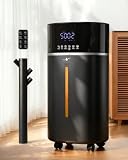

1. Levoit LV600S: Best Overall for a Large Bedroom or Gaming Room
The Levoit LV600S is the most practical all-rounder for a large bedroom, office, or gaming room. Its 6-liter tank offers useful overnight capacity, and the ultrasonic mist output can raise humidity faster than a small tabletop unit. It supports cool and warm mist, automatic humidity control, a timer, and app-based scheduling.
Its realistic strength is controlled operation rather than maximum whole-home coverage. In a closed 400–700-square-foot room, set the target to 40% or 45% relative humidity and place the unit several feet from the PC, monitor, walls, and furniture. Do not aim mist directly at electronics. The low setting is quiet enough for games, voice chat, and sleep, although higher output can produce a noticeable fan and water sound.
The main drawback is cleaning. Ultrasonic units turn minerals in tap water into fine white dust, especially when water hardness is high. Use distilled or demineralized water when practical, and empty and wipe the tank frequently. This is the best pick when smart controls and quiet performance matter more than avoiding daily maintenance.
2. Venta LW45 Comfort Plus: Best Low-Mist Option
The Venta LW45 Comfort Plus uses an evaporative air-washer design rather than spraying visible ultrasonic mist. A fan moves dry air across rotating discs, allowing the water to evaporate naturally. That makes it a strong choice near a gaming PC, wood furniture, or a room where white mineral dust would be unacceptable.
Its large water capacity reduces refilling, and the evaporative process naturally slows as the room approaches its equilibrium humidity. This makes over-humidification less likely than with a high-output ultrasonic humidifier, though a built-in humidity control setting is still preferable.
The trade-offs are price, footprint, and cleaning. The fan is not silent, and the rotating discs and water reservoir need regular washing. Expect a visible appliance rather than a discreet desk accessory. Choose the LW45 when cleaner-looking moisture and reduced mineral dust are worth paying more for.
3. AIRCARE MA1201: Best for a Large Open Floor Plan
The AIRCARE MA1201 is a console-style evaporative humidifier designed for substantially larger spaces than typical bedroom models. Its advertised coverage is much higher than what many homes achieve in practice, but it remains one of the better choices for an open living area, basement, or connected gaming and living space.
The realistic limitation is airflow. If the unit sits in one closed room with the door shut, only that room benefits. In an open layout, place it near the center of the occupied area with clear space around the intake and outlet. Its fan noise is more noticeable than an ultrasonic unit, particularly at high speed, so it is better for a living room than a microphone-sensitive streaming setup.
The digital humidistat and automatic mode are useful because the machine can reduce output after reaching the selected humidity. Replacement wick filters add an ongoing cost, but the evaporative design avoids the white dust that can settle on monitors and PC components.
4. Levoit Superior 6000S: Best High-Output Smart Humidifier
The Levoit Superior 6000S is aimed at users who want a very large reservoir and more aggressive ultrasonic output. It is a better fit than the LV600S when a large room dries out quickly during winter heating, provided you can keep the humidity under control.
Its app and automatic mode make it easier to schedule operation around work, sleep, or gaming sessions. A useful starting schedule is 45% humidity during occupied hours and 35%–40% overnight. High output can create condensation on windows, walls, or desks if the room is small or poorly ventilated, so the advertised maximum coverage should not be treated as permission to run it continuously at full power.
Maintenance is the same fundamental concern as with other ultrasonic models: mineral buildup, stagnant water, and microbial growth. A large tank does not remove the need to empty unused water. If the room is under 500 square feet, this model may be excessive unless it is operated on low.
5. Dreo HM713S: Best for Warm Mist and Compact Smart Controls
The Dreo HM713S suits a medium-to-large bedroom where warm mist, quiet operation, and app controls are useful. Warm mist can help disperse moisture in a cool room, but it uses more electricity and involves hot water, so it should be kept away from children, pets, and the edge of a desk.
Its practical coverage is below the largest console humidifiers. It is a sensible choice for roughly 300–500 square feet, especially when the door is closed. Use cool mist or the lowest effective warm-mist setting near a computer, and keep the humidifier on a stable, waterproof surface rather than on top of the PC or a shelf above it.
How to Choose by Room and Use Case
| Your situation | Best type | Recommended choice | Why |
|---|---|---|---|
| Large bedroom, quiet sleep, one closed door | Quiet ultrasonic | Levoit LV600S | Good tank size, humidity automation, and low-speed noise |
| Gaming room with a PC and monitor | Evaporative or carefully controlled ultrasonic | Venta LW45 or Levoit LV600S | Evaporative output reduces mineral dust; LV600S offers more compact smart control |
| Open living room or basement | Large evaporative console | AIRCARE MA1201 | High airflow and output are more useful than a small tank |
| Very dry winter conditions | High-output ultrasonic | Levoit Superior 6000S | Large reservoir and strong output can recover humidity faster |
| Hard tap water and little tolerance for white dust | Evaporative | Venta LW45 or AIRCARE MA1201 | Minerals remain largely in the water and wick rather than becoming airborne dust |
How Much Capacity Do You Actually Need?
Tank size alone does not determine runtime. Runtime is approximately the reservoir capacity divided by the hourly water-use rate. For example, a 6-liter tank running at 0.20 liters per hour lasts about 30 hours:
6 L ÷ 0.20 L per hour = 30 hours
At a high setting using 0.40 liters per hour, the same tank lasts only 15 hours. That is why a manufacturer’s “up to” runtime usually applies to the lowest setting. For overnight use, choose enough capacity for at least 10 hours at your intended setting, then leave a safety margin of roughly 20%.
For a 400-square-foot room with an 8-foot ceiling, the air volume is 3,200 cubic feet. Raising that air from 30% to 45% relative humidity requires only a modest amount of water in the air itself, but walls, bedding, flooring, ventilation, and heating continuously absorb or remove moisture. In practice, output capacity matters more than calculating the room volume alone.
Placement and Settings That Prevent Problems
- Start at 40% relative humidity. Increase toward 45% only if the room remains dry and windows stay clear.
- Do not routinely exceed 50% humidity. Persistent condensation encourages mold and can damage wood, paint, and electronics.
- Place the humidifier at least 2–3 feet from a wall, monitor, PC, or speaker, with the mist outlet unobstructed.
- Use a separate hygrometer placed across the room. The humidifier’s built-in sensor can read inaccurately when it is sitting beside its own mist.
- Use distilled water in ultrasonic models if tap water leaves scale or powder. Evaporative units are more forgiving but still need clean water.
- Empty standing water when the unit will not run for a day or more. Wipe the reservoir and follow the manufacturer’s descaling instructions.
Frequently asked questions
Can I use tap water in an ultrasonic humidifier?
You can, but hard tap water may leave fine white mineral dust. The article recommends distilled or demineralized water when practical for the Levoit LV600S and notes that ultrasonic models need frequent tank emptying and wiping. Evaporative models keep most minerals in the water or wick rather than dispersing them as airborne dust.
How can I tell if my humidifier is too powerful for my room?
Condensation on windows, walls, or desks can mean the output is too high for the room or its ventilation. The article advises against treating advertised coverage as a reason to run a humidifier continuously at full power. The Superior 6000S, for example, may be excessive in a room under 500 square feet unless used on low.
Will a humidifier work throughout several connected rooms?
It can help in an open layout, but coverage depends on airflow and how the spaces connect. The article says a unit in a closed room mainly benefits that room, while an open floor plan is better suited to the AIRCARE MA1201. Place it near the center of the occupied area with clear space around its intake and outlet.
How often will I need to refill a humidifier?
Refill frequency depends on tank capacity and the output setting. A 6-liter tank using 0.20 liters per hour lasts about 30 hours, while at 0.40 liters per hour it lasts about 15 hours. The article notes that advertised maximum runtimes generally apply to the lowest setting, so high output can mean more frequent refills.
Can I leave water sitting in the tank between uses?
The article advises emptying unused water rather than leaving it sitting. Even a large reservoir does not eliminate the need to empty it, and ultrasonic models also require regular cleaning because of mineral buildup and the risk of stagnant water and microbial growth. The LV600S tank should be emptied and wiped frequently.
Final Verdict
Choose the Levoit LV600S for the best combination of realistic large-room coverage, quiet operation, tank runtime, and smart controls. Choose the Venta LW45 Comfort Plus when avoiding airborne mineral dust is the priority, and select the AIRCARE MA1201 for a genuinely large open area where fan noise is acceptable. The Levoit Superior 6000S is the high-output option for very dry rooms, while the Dreo HM713S is a capable choice for a medium-large bedroom that benefits from warm mist and app control.


