
Top 3 picks at a glance


Best Canon Cameras for Wildlife Photography in 2026
The Canon EOS R5 Mark II is the best all-round Canon camera for wildlife photography, while the EOS R7 delivers the most affordable crop reach, the EOS R1 is the strongest choice for fast professional action, and the EOS R6 Mark II offers the best value for photographers who prioritize autofocus and low-light performance over resolution.
Quick comparison
| Camera | Sensor | Maximum burst | Wildlife advantage | Typical body price range |
|---|---|---|---|---|
| Canon EOS R1 | 24.2MP full frame | Up to 40 fps electronic | Best tracking consistency and action handling | Usually $5,500–$6,500 |
| Canon EOS R5 Mark II | 45MP full frame | Up to 30 fps electronic | Best balance of detail, cropping, speed, and video | Usually $3,800–$4,500 |
| Canon EOS R7 | 32.5MP APS-C | Up to 30 fps electronic | Strongest reach-per-dollar | Usually $1,200–$1,500 |
| Canon EOS R6 Mark II | 24.2MP full frame | Up to 40 fps electronic | Excellent autofocus and high-ISO performance for less money | Usually $1,800–$2,300 |
| Canon EOS R3 | 24.1MP stacked full frame | Up to 30 fps electronic | Very fast readout, superb ergonomics, and eye-control AF | Usually $3,000–$4,000 |
1. Canon EOS R5 Mark II: best overall for wildlife
The EOS R5 Mark II is the most complete choice for wildlife photographers who need both speed and detail. Its 45MP full-frame sensor gives you room to crop distant animals, while the electronic shutter can capture bursts at up to 30 frames per second. That combination is especially useful for birds taking off, mammals fighting, and unpredictable wing or paw positions.
As an Amazon Associate we earn from qualifying purchases at no extra cost to you.
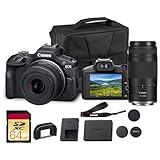

Its subject-detection autofocus can recognize animals and maintain tracking across a busy frame. The camera is also a strong choice when wildlife photography is mixed with landscape, travel, or video because its high-resolution sensor provides more flexibility than the lower-resolution R1, R3, and R6 Mark II.
The crop-reach calculation
Resolution is not the same as optical reach, but it affects how much detail remains after cropping. If you crop the 45MP R5 Mark II image to the same APS-C-sized area used by the EOS R7, the remaining image is approximately:
45MP × (22.2mm ÷ 36mm)2 ≈ 17.1MP
The EOS R7 retains roughly 32.5MP across that APS-C frame. Therefore, for a small distant bird under good light, the R7 can place more pixels on the subject with the same lens framing. The R5 Mark II catches up when you need a wider full-frame view, better high-ISO results, or substantial cropping that does not fit neatly into an APS-C crop.
2. Canon EOS R7: best crop camera for distant wildlife
The EOS R7 is one of the most effective Canon bodies for photographers who regularly work at the limit of their lens reach. Its APS-C sensor applies a 1.6x field-of-view factor: a 500mm lens frames a subject similarly to an 800mm lens on full frame, although it does not create the same optical magnification or depth of field.
Its 32.5MP resolution is particularly useful for birds, squirrels, reptiles, and other small subjects that occupy only a small part of the image. The camera can shoot at up to 15 fps with its mechanical shutter or up to 30 fps electronically, giving you many chances to capture a sharp wing position.
The trade-offs are a smaller viewfinder and less forgiving high-ISO performance than the full-frame models. Electronic-shutter distortion can also appear when a fast-moving subject crosses the frame. Use the mechanical shutter when a bird’s wings or a running animal look geometrically distorted in electronic mode.
3. Canon EOS R1: best for professional action
The EOS R1 is designed around responsiveness, autofocus reliability, and handling rather than maximum pixel count. Its 24.2MP stacked full-frame sensor supports bursts up to 40 fps electronically, with rapid readout that helps reduce rolling-shutter artifacts compared with conventional sensors.
For sports-like wildlife action, the R1’s advantages are noticeable: fast subject acquisition, dependable tracking, a large professional body, dual-card workflow, and controls that remain practical while wearing gloves. Its in-camera upscaling and noise-reduction features can help produce larger output files, but they do not replace the fine feather detail captured by a native high-resolution sensor.
Choose the R1 when your priority is getting the decisive frame in difficult motion. Choose the R5 Mark II instead if your subjects are usually distant and stationary enough that cropping detail matters more than the highest burst rate.
4. Canon EOS R6 Mark II: best value for low light
The EOS R6 Mark II remains an excellent wildlife body for dawn, dusk, woodland, and overcast conditions. Its 24.2MP full-frame sensor produces clean files at high ISO settings, and its autofocus system recognizes animals and birds while tracking them across the frame. Electronic bursts can reach up to 40 fps, while the mechanical shutter provides up to 12 fps.
Its lower resolution means less cropping freedom than the R5 Mark II or R7. That limitation is less important if you use a 400mm, 500mm, or 600mm lens and fill the frame at capture. In poor light, the R6 Mark II can produce a more usable image than a higher-resolution camera forced to use an aggressive ISO setting and heavy noise reduction.
5. Canon EOS R3: the specialist choice
The EOS R3 sits between the R1 and R6 Mark II in professional handling and performance. Its 24.1MP stacked full-frame sensor offers fast readout, up to 30 fps electronic shooting, and an especially comfortable body for long sessions. Eye Control AF can move the focus area based on where you look in the viewfinder, which can be useful when an animal appears suddenly against a cluttered background.
The R3 is a compelling used or discounted option for photographers who value its ergonomics, rugged construction, and fast sensor more than maximum resolution. The R1 is newer and more advanced, but the R3 can provide much of the same professional shooting experience at a lower market price.
Autofocus, burst speed, and real-world settings
High frame rates help only when focus, shutter speed, and light are already under control. Start with these settings and adjust them to the subject:
- Birds in flight: use 1/2000 to 1/3200 second, Auto ISO, animal or bird subject detection, and a zone or expanded-area AF mode if the background is cluttered.
- Running mammals: begin at 1/1600 second and use a flexible AF area. Increase to 1/2500 second for sudden direction changes.
- Perched birds: use 1/1000 second for general sharpness, or 1/2000 second if the bird may launch unexpectedly. Reduce the aperture only when you need more light; f/5.6 to f/8 often gives useful feather detail and depth.
- Large animals at rest: use 1/500 to 1/1000 second, single-point or small-area AF, and a lower ISO when possible.
- Electronic shutter warning: test it with wingbeats, galloping legs, and fast pans. If vertical objects bend or wings stretch unnaturally, switch to mechanical shutter or a slower electronic burst mode.
Continuous AF tracking also needs enough shutter speed. A 30 fps burst lasts only one second, so selecting the right moment still matters. Short bursts of 6–12 frames are easier to review, conserve card space, and reduce the chance of filling the buffer during a long sequence.
Weather sealing and field durability
The EOS R1 and EOS R3 have the most confidence-inspiring professional bodies for prolonged exposure to rain, dust, and cold. The R5 Mark II, R7, and R6 Mark II also provide weather-resistant construction, but protection depends on the complete setup: camera, lens, adapter, battery door, and cable covers all matter.
Weather resistance is not waterproofing. Use a rain cover during sustained rain, keep a microfiber cloth and spare battery in a sealed pouch, and avoid changing lenses in blowing dust. If you use an EF lens with an EF-EOS R adapter, the adapter becomes another sealing interface to keep clean and dry.
Canon lens choices for wildlife
Canon’s RF system offers a useful range of wildlife lenses. The RF 100-500mm F4.5-7.1 L IS USM is a versatile travel and general-purpose option. The RF 200-800mm F6.3-9 IS USM provides exceptional reach for birds and distant animals at a comparatively accessible size and price, although its relatively narrow maximum aperture is less suitable for dim forests or fast action at dusk.
For demanding professional work, the RF 100-300mm F2.8 L IS USM is excellent for large mammals and action in low light. The RF 400mm F2.8 L IS USM and RF 600mm F4 L IS USM provide outstanding subject isolation and shutter-speed flexibility, but they are expensive and heavy. The RF 600mm F11 IS STM and RF 800mm F11 IS STM are lighter options for daylight wildlife, provided you can accept their fixed f/11 aperture.
EF supertelephoto lenses can also be used on RF cameras with Canon’s EF-EOS R mount adapter. This expands the used-lens market, but check autofocus behavior, image stabilization compatibility, and the physical condition of the lens before relying on an older setup for critical work.
Which Canon wildlife camera should you buy?
| Your situation | Best choice | Why |
|---|---|---|
| Small birds are usually far away | EOS R7 | High pixel density and 1.6x framing advantage |
| One camera for wildlife, landscape, and video | EOS R5 Mark II | 45MP detail, fast bursts, and broad capability |
| Fast professional action in difficult conditions | EOS R1 | Rapid readout, reliable tracking, and pro handling |
| Dawn, dusk, or shaded woodland on a budget | EOS R6 Mark II | Strong high-ISO results and fast autofocus |
| Professional ergonomics at a reduced price | EOS R3 | Stacked sensor, robust body, and responsive operation |
For most photographers, the EOS R5 Mark II is the safest recommendation because it combines resolution, autofocus, burst speed, and lens flexibility without specializing too heavily in one area. Pick the EOS R7 when reach and budget dominate the decision, or the EOS R1 when autofocus consistency and action timing are worth more than maximum resolution.
Frequently asked questions
Is the EOS R5 Mark II better than the EOS R7 for photographing distant birds?
Not always: the EOS R7 can retain more pixels on a small distant bird when both cameras use the same lens framing. Its APS-C sensor and 32.5MP resolution provide strong reach-per-dollar. The EOS R5 Mark II is more versatile when you need a wider full-frame view, better high-ISO results, substantial cropping, or a mixture of wildlife, landscape, travel, and video.
Does the EOS R7 make a 500mm lens equivalent to an 800mm lens?
The EOS R7 gives a 500mm lens a field of view similar to an 800mm lens on full frame, because its APS-C sensor has a 1.6x field-of-view factor. It does not create the same optical magnification or depth of field. The benefit is framing, not a transformation of the lens itself.
When should I use a mechanical shutter instead of an electronic shutter?
Use the mechanical shutter when fast movement causes electronic-shutter distortion. Birds with rapidly beating wings, running animals, and fast pans can produce bent vertical objects or unnaturally stretched wings in electronic mode. The EOS R7 can shoot at up to 15 fps mechanically, while its electronic mode reaches up to 30 fps.
Which Canon wildlife lens is most suitable for low-light action?
The RF 100-300mm F2.8 L IS USM is the strongest choice listed for large mammals and action in low light. Its relatively wide maximum aperture is better suited to maintaining shutter speed in dim conditions than the RF 200-800mm F6.3-9 IS USM, whose narrower maximum aperture is less suitable for dim forests or fast action at dusk.
Can I use EF lenses with these Canon mirrorless wildlife cameras?
Yes, you can use an EF lens with an EF-EOS R adapter. The adapter becomes another sealing interface, so it should be kept clean and dry when photographing wildlife outdoors. The article also emphasizes that weather resistance is not waterproofing, and the complete setup includes the camera, lens, adapter, battery door, and cable covers.


