
Start with the recommendation, then the reasoning. If you want one keyboard that follows you between a desktop, a laptop and a tablet and you type for a living, the Logitech MX Keys S at $119.99 is the one to buy and the rest of this page is optional reading. If you want a competent keyboard on a desk for under thirty dollars, the Logitech K250 at $19.99 does it. If you want a keyboard for a living room PC connected to a television, the K400 Plus at $29.99 is purpose-built and nothing else here comes close. Everything below explains why, and more usefully, tells you which of these is wrong for you.
I review peripherals for a living and I have spent seven years measuring input devices with a switch-force gauge and a high-speed camera rig. Keyboards are the category where buyers most often pay for the wrong thing, because the specification list is dominated by features that sound important and change nothing about daily use. My goal here is to draw a hard line between what you actually need and what is optional.
Top 3 picks at a glance
First, a correction: wireless does not mean Bluetooth
As an Amazon Associate we earn from qualifying purchases at no extra cost to you.


This trips up more buyers than any other point. There are two entirely different wireless technologies sold under the same word on the same shelf.
Bluetooth pairs directly with a device’s own radio. No dongle, no free USB port, and it works with phones, tablets, smart televisions and consoles as well as computers. It is the flexible option and the one you want if the keyboard will move between devices.
Proprietary 2.4 GHz uses a small USB receiver that lives in one of your computer’s ports. It is faster, more consistent and typically simpler to set up, but it only works on a machine that has a spare port and it does not talk to a tablet. Lose the receiver and the keyboard is a paperweight, since most are not replaceable.
In this comparison, several models sold as wireless keyboards use the dongle route only. That is not a defect, it is a different product, but if you bought one expecting to pair it with an iPad you would be disappointed. Check the connection type before you check anything else, because it determines whether the keyboard can do the job you have in mind at all. I compared the two technologies more broadly in wired versus wireless gaming peripherals.
What you actually need versus what is optional
Here is my honest split after testing a large number of these. Needs first.
Genuinely necessary: a layout that matches how you work, a key feel you can tolerate for hours, and a connection type that reaches every device you want to use it with. That is the whole list. Three items, none of which appear prominently in most product marketing.
Necessary for a specific job only: multi-device switching if you actually use more than one machine, a number pad if you enter numbers regularly, a built-in trackpad if the keyboard is for a television, and a 2.4 GHz option if you game on it. Each of these is essential to somebody and irrelevant to everyone else.
Optional and usually oversold: backlighting, which halves battery life and matters only if you type in the dark without touch typing. RGB lighting, which is aesthetic. Metal top plates, which add weight and rigidity but not typing quality. Programmable software, which most buyers install once and never open again. Very high polling rates on a productivity keyboard, which change nothing you can perceive.
Actively worth avoiding: keyboards with non-standard bottom row spacing if you might ever want replacement keycaps, and any model where the on-off switch is buried on the underside in a place you cannot reach without lifting the whole board. Small ergonomics issues like that are what make a keyboard quietly annoying.
Multi-device switching, the feature that earns its keep
If you use more than one computer, this is the feature to prioritise above all others, and it varies enormously in quality between models that all claim to have it.
The implementation you want is three dedicated keys, each bound to a saved device, that switch in about a second. The implementation you do not want is a single cycling button that steps through slots blindly, or a key combination you have to hold for three seconds. On a good keyboard, switching from your desktop to your tablet is faster than turning your head. On a bad one it takes long enough that you stop bothering and go back to using two keyboards.
I test this by timing the gap between pressing the switch key and the first character landing successfully on the target device, repeated ten times. The best keyboards in this class land near a second. The weakest take five to eight seconds and occasionally fail to connect at all, requiring a repair. That difference is worth more real-world money than any other spec on the box.
One warning that applies to every multi-device keyboard: the pairing slots are stored in the keyboard, not in your computer, so a factory reset wipes all of them and you have to redo every device. Do not reset a multi-device keyboard casually to fix a problem with one connection.
Battery life and what actually drains it
The radio is not what kills your battery. Backlighting is. A membrane keyboard with no lighting running on two AA cells will genuinely run for a year or more of normal use, because the electronics draw almost nothing between keystrokes. The same keyboard with a backlight at full brightness might last a week.
That produces a straightforward rule: if long unattended runtime is your priority, buy a keyboard without lighting and accept that you cannot see the legends in the dark. If you want lighting, buy a rechargeable model with USB-C and treat charging as a weekly habit, or run the lighting at low brightness where the cost is a fraction of the maximum.
Rechargeable versus replaceable is a real trade and not a settled one. Rechargeable keyboards are tidier and you never buy cells, but the internal cell degrades over years and is usually not user-serviceable, so the keyboard has a lifespan. AA-powered keyboards are heavier and need occasional cells, but they will outlive the computer and you can swap in a fresh set mid-deadline. For a keyboard you intend to keep for five years, replaceable cells are the more defensible choice.
One behaviour worth checking in your first week: how the keyboard sleeps. A good implementation drops into deep sleep after a few minutes and wakes on the first keypress with no missed character. A poor one either misses the first keystroke every time, which is maddening when the first keystroke is part of a password, or fails to sleep at all and flattens the battery while you are away.
Layout and size, chosen honestly
Full size gives you a number pad and costs desk width. If you enter numbers regularly, in spreadsheets, accounting or data entry, the number pad is not a luxury and going without it will slow you down measurably. If you do not, that block is a hundred millimetres of desk you could give to your mouse.
Compact layouts, whether tenkeyless or smaller, free your mouse arm and reduce shoulder strain by letting you keep your mouse closer to your body. That ergonomic benefit is real and is the main reason competitive players use smaller boards. The cost is a number pad and, on the smallest layouts, dedicated arrow and function keys that move onto a layer.
The detail almost nobody checks before buying is the bottom row and the arrow cluster. Compact keyboards frequently squeeze the right shift key or shrink the arrow keys, and if you rely on either, you will feel the difference for weeks. Look at a photograph of the bottom right corner of the keyboard before you buy and compare it against the one you are using now. My breakdown of keyboard layouts compared goes through each size in detail.
Typing feel: membrane, scissor and mechanical
Membrane keyboards use a rubber dome under each key. They are quiet, cheap and reliable, and they have a soft bottom-out that some people find comfortable and others find mushy. Most inexpensive wireless keyboards are membrane, and there is nothing wrong with that for general typing.
Scissor switches, the type used in laptops and slim desktop keyboards, add a stabilising mechanism under a short-travel key. They feel more precise and consistent than a plain membrane and are the right choice for fast touch typists who do not want the height or noise of a mechanical board. On my force gauge these typically actuate in the 55-65 g range with very short travel, which is why they feel quick.
Mechanical switches use an individual mechanism per key with a longer travel and a defined actuation point. They last far longer, they can be tuned to your preference, and they are noticeably louder. For gaming the longer travel and clearer actuation point genuinely help; for shared offices they generate complaints. If you are unsure which switch type suits you, I explained the differences in mechanical keyboard switches explained.
The measurable factor that matters most for comfort is actuation force. Keyboards in the 45-55 g range feel light and fast and cause fewer sore fingertips over a long day. Keyboards above 70 g feel deliberate and tire heavy typists. Neither is correct; matching the force to your typing style is what stops your hands aching at five in the afternoon.
The eight keyboards compared
| Keyboard | Price | Connection | Size | Best for | Not for |
|---|---|---|---|---|---|
| Logitech K250 | $19.99 | Bluetooth | Compact with number pad | Cheap desk keyboard | Gaming |
| OMOTON Ultra-Slim | $17.99 | Bluetooth | Compact, no number pad | iPad and phone typing | Full-time desk work |
| Arteck HB192 | $32.43 | Bluetooth | Full size | Multi-device full size | Anyone wanting light keys |
| Logitech MK270 combo | $26.99 | 2.4 GHz dongle | Full size + mouse | Complete desk setup | Tablets, no free USB port |
| Logitech MK250 combo | $23.99 | Bluetooth | Compact + mouse | Small desk, one purchase | Heavy number entry |
| AULA S99 | $27.99 | Wireless | Compact gaming | Cheap mechanical feel | Quiet shared offices |
| Logitech MX Keys S | $119.99 | Bluetooth | Full size low profile | Serious typing work | Tight budgets |
| Logitech K400 Plus | $29.99 | 2.4 GHz dongle | Compact with trackpad | TV-connected PC | Desk use |
Where a listing does not state the switch type, I have not guessed at it. Manufacturers change components between production runs on budget keyboards more often than buyers realise, so an invented switch name is worse than no information.
The picks, and who should walk away from each
Logitech K250 Compact Wireless Bluetooth Keyboard with Number Pad, Graphite
At $19.99 this is the least complicated recommendation on the page. It is a Bluetooth keyboard with a number pad in a compact body, which is a genuinely useful combination, because most keyboards force you to choose between the number pad and a small footprint. For a second machine, a home office, or a student desk, it does the job and asks nothing of you.
Typing feel is standard membrane with a soft bottom-out and low noise. Nothing about it is exciting and nothing about it is annoying, which at twenty dollars is exactly the right outcome. Battery life on cells with no backlight is measured in months rather than weeks.
Who should not buy it: gamers and heavy typists. The membrane feel that is perfectly acceptable for email becomes tiring across a long writing day, and a Bluetooth-only connection is the wrong tool for games where timing matters. If you type for six hours a day, spend the money on the MX Keys S and thank yourself later.
OMOTON Ultra-Slim Bluetooth Keyboard for iPad,iPad Pro/Air/Mini,iPhone
At $17.99 this is a tablet accessory, and judged as one it is good value. It is thin, light enough to carry in a bag without noticing, and pairs quickly with an iPad or a phone. If your use case is answering long emails on a tablet in a coffee shop, this is a sensible purchase and the alternative is typing on glass.
The key travel is very short, as it must be at this thickness, and the layout is condensed with a mixed Apple-oriented key legend set. Touch typists adapt within a day or two. There is no number pad and no backlighting, and neither belongs on a keyboard designed for portability.
Who should not buy it: anyone shopping for a desktop keyboard. The compressed layout and shallow travel that make it excellent in a bag make it a poor primary keyboard on a desk, and using it as one will cost you accuracy and comfort. Buy it as a companion device, not as your main input.
Arteck HB192 Universal Bluetooth Keyboard Multi-Device Stainless Steel Full Size Wireless Keyboard for Windows iOS Android Computer Desktop Laptop Surface Tablet Smartphone Rechargeable Battery
At $32.43 this is the value multi-device option. Full size with a number pad, a stainless steel body that gives it real desk stability, multi-platform pairing across Windows, iOS and Android, and a rechargeable battery so you are not buying cells. For someone who moves between a Windows desktop and an Android tablet, it covers the job at a third of the price of the premium alternative.
The steel construction makes it heavier than the plastic keyboards here, which is a benefit on a desk because it does not slide, and a drawback if you plan to carry it. Rechargeable runtime with no backlighting runs long enough that charging becomes an occasional chore rather than a routine.
Who should not buy it: anyone who wants a light, fast key feel or a keyboard that travels. The weight is a fixed characteristic, not a setting, and the typing action is firmer than the slim Logitech models. If your priority is a keyboard you can throw in a backpack, the OMOTON is a fifth of the weight for half the price.
Logitech MK270 Full Size Wireless Keyboard and Mouse Combo – Black
At $26.99 this is a complete desk in one box: full size keyboard, a matching mouse, and a single USB receiver that handles both. For setting up a new machine, a spare room, or a computer for a family member, buying one item instead of two is genuinely worth something.
The important detail, and the one that catches buyers out, is that this combination uses a 2.4 GHz USB receiver rather than Bluetooth. That makes it faster and more consistent than the Bluetooth models here, and it makes it work in BIOS screens before the operating system loads, which Bluetooth keyboards generally cannot do. It also means it will not pair with a tablet or a phone, at all, ever.
Who should not buy it: anyone who needs Bluetooth, anyone short on USB ports, and anyone who already owns a mouse they like. If you have a good mouse, you are paying for a second one you will put in a drawer. The bundled mouse is functional and basic, and it is not competing with anything in my roundup of gaming keyboard and mouse combos.
Logitech MK250 Wireless Bluetooth Keyboard and Mouse Combo – Graphite
At $23.99 this is the Bluetooth answer to the MK270 and, for most modern setups, the better one. A compact keyboard and mouse pairing over Bluetooth means no receiver taking a port, and it works with laptops and tablets that a dongle-based set cannot reach. For a small desk it is the tidier solution.
The compact keyboard trades away the number pad for desk space, which is either a benefit or a dealbreaker depending entirely on your work. Typing feel is the same competent membrane as the K250, and the paired mouse is a basic but perfectly usable pointer for office tasks.
Who should not buy it: anyone who works with numbers daily, and anyone who needs the keyboard to work in a BIOS screen. Those two limitations are structural rather than fixable. If you need the number pad and you can accept a dongle, the MK270 is three dollars more and gives you both.
AULA S99 Gaming Keyboard, Wireless Green Creamy Computer Keyboards
At $27.99 this is the outlier of the group and the only one aimed at gaming. It is a compact wireless gaming keyboard, and the price is remarkable for the category, since equivalent boards from established gaming brands usually start meaningfully higher. If you want a gaming-oriented keyboard for a secondary machine without a large outlay, this is the entry point.
The typing character here is completely different from the office keyboards above: longer travel, a defined actuation point and considerably more noise. That character is what makes a gaming keyboard feel responsive, and it is also what makes it unwelcome in a shared room. The listing does not detail the switch specification, so I will describe the class rather than name a component that might change between production runs.
Who should not buy it: anyone typing in an office, a shared apartment or on a video call. This is the loudest board in the comparison and no software setting reduces that. It is also a poor fit for someone who wants multi-device switching, since the strengths here are aimed at one machine. For a broader look at the category, my guide to the best wireless gaming keyboard covers the higher end.
Logitech MX Keys S Wireless Keyboard Low Profile Fluid Precise – Graphite
At $119.99 this is the most expensive keyboard here by a factor of four and the one I use for my own writing. The argument for it is narrow and strong: if you type for many hours a day across more than one computer, this is the best typing experience in the group and the switching implementation is the fastest I have measured in this class.
The keys are low profile with spherically dished caps that guide fingertips toward the centre of each key, which measurably reduces mistyping for fast touch typists. The body is heavy enough to stay put, the backlighting is proximity-activated so it lights when your hands approach and turns off when they leave, and it charges over USB-C. Actuation force sits in the light-to-medium band, which is why long days on it do not tire the hands.
Who should not buy it: gamers, and anyone who types casually. For gaming, the short low-profile travel is the wrong tool and there is no 2.4 GHz option, so you are on Bluetooth. For casual use, this is roughly a hundred dollars of refinement over a keyboard that already types fine, and that money buys nothing you will notice while answering emails. It is a professional tool at a professional price.
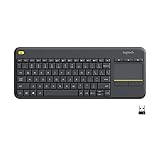
Logitech K400 Plus Wireless Touch TV Keyboard for PC-Connected TV – Black
At $29.99 this is a specialist device and it is completely dominant in its niche. It is a compact keyboard with an integrated trackpad on the right side, designed for a computer connected to a television and operated from a sofa. There is nothing else in this comparison that can do the job, because every other option requires a flat surface for a separate mouse.
The trackpad is small but responsive enough for navigating a media application, a browser or a streaming service from across the room. The body is light enough to hold in one hand and rest on your knee. It uses a 2.4 GHz receiver rather than Bluetooth, which gives it better range across a living room than Bluetooth would typically manage.
Who should not buy it: anyone using it at a desk. The integrated trackpad is a compromise made for a specific posture, and at a desk with a real mouse it is redundant while the compact layout gives you less than the K250 does for ten dollars less. Buy it for the living room only, and buy something else for the desk.
Does Bluetooth latency matter for what you do?
On my camera rig, a Bluetooth keyboard typically lands several milliseconds behind an equivalent keyboard on a 2.4 GHz receiver, and a wired connection is quicker still. More telling than the average is the spread: Bluetooth results vary more from press to press, and that inconsistency is what people describe as a keyboard feeling slightly detached even when the average number looks fine.
For typing, none of this is perceptible. You cannot type fast enough for a few milliseconds of variance to affect anything, and any typist who claims to feel it in a blind test is guessing. For strategy games, simulation games and turn-based anything, the same applies.
For fast-paced games it does matter, though less than most people assume. The measurable penalty is smaller than the difference between a 60 Hz and a 144 Hz display, and it is far smaller than the delay introduced by a television running in the wrong picture mode. If you are optimising latency, fix the display chain first and the keyboard connection second.
The practical conclusion: buy a keyboard whose connection matches its job. Bluetooth for the machine you type on, a 2.4 GHz receiver or a cable for the machine you play on. Buying one keyboard to do both well means buying one that supports both, and only some models do.
Pairing and troubleshooting, briefly
Pair from the operating system’s own Bluetooth settings, not from a manufacturer utility, and remove old entries for the same keyboard before adding a new one. Duplicate stale pairings are the leading cause of a keyboard that shows as connected but types nothing, and clearing them takes two minutes.
If a keyboard connects but drops every few minutes, look at what else is on the 2.4 GHz band. A congested Wi-Fi channel, a USB 3.0 drive next to your Bluetooth adapter, and a cheap motherboard combo radio are the three usual causes in that order. Moving a receiver onto a short extension away from the case fixes an astonishing proportion of these complaints.
If the first keystroke after idle is missed, that is deep sleep behaviour and is a firmware characteristic rather than a fault. The workaround is to tap a modifier key like shift to wake the keyboard before typing anything that matters, particularly passwords. Some models let you disable aggressive sleep at a cost in battery life.
Finally, keep the keyboard clean. Crumbs and dust under keys cause intermittent non-registering keys that people misdiagnose as wireless faults, and a compressed air can plus a soft brush resolves most of it. My step-by-step on cleaning a mechanical keyboard works for membrane boards too if you skip the keycap removal.
Who should not buy a Bluetooth keyboard at all
If you build, repair or troubleshoot PCs, you need at least one keyboard that works before the operating system loads. Bluetooth generally does not function in BIOS or UEFI, which means no boot menu, no firmware settings and no pre-boot encryption password. A ten dollar wired keyboard in a drawer solves this permanently.
If you play competitive shooters or fighting games seriously, a Bluetooth keyboard is the wrong tool. Use a wired board or one with a dedicated 2.4 GHz receiver, and treat Bluetooth as the travel mode rather than the play mode.
If you only ever use one desktop computer and never move the keyboard, Bluetooth’s main advantage is irrelevant to you, and a wired or dongle-based keyboard will be marginally faster, will never need charging and will cost less. The flexibility you are paying for is only worth money if you actually use more than one device.
Final calls
For heavy typists working across multiple machines, the Logitech MX Keys S at $119.99 is the correct answer and the fast device switching is what justifies the price rather than the key feel alone. For anyone wanting most of that flexibility for a third of the money, the Arteck HB192 at $32.43 covers Windows, iOS and Android with a full-size layout and a rechargeable cell.
For a simple desk keyboard, the Logitech K250 at $19.99 is hard to argue with. For a small desk where you want a mouse included, the MK250 combo at $23.99 is the tidier modern option and the MK270 at $26.99 is the choice if you need the number pad and BIOS access. For a tablet, the OMOTON at $17.99. For a television, the K400 Plus at $29.99 and nothing else. For a cheap gaming board on a secondary rig, the AULA S99 at $27.99, provided nobody nearby is trying to concentrate.
The last piece of advice is the one that saves the most money: work out which single feature you actually need before you shop, then buy the cheapest keyboard that has it properly implemented. Backlighting, metal plates, programmable software and high polling rates are all real features and all optional. Layout, key feel and connection type are the three that decide whether you are still happy with the purchase in a year.
Frequently asked questions
Can I use a Bluetooth keyboard without a USB receiver?
Yes, a Bluetooth keyboard pairs directly with a device’s Bluetooth radio and does not need a USB receiver. That makes it suitable for devices such as phones, tablets, smart televisions and consoles, as well as computers. Check the connection type before buying: some wireless keyboards use a receiver instead and cannot pair with a tablet.
Will a keyboard with a number pad take up more desk space?
Yes, a full-size keyboard takes up more desk width because it includes a number pad. If you regularly enter numbers, the article says that pad can be important for tasks such as spreadsheets, accounting or data entry. If you do not use it, a compact keyboard frees space for your mouse.
Is keyboard backlighting worth choosing?
Backlighting is useful if you type in the dark and cannot touch type, but it is optional for many buyers. The article says it can sharply reduce battery life: a keyboard with backlighting at full brightness might last a week, while an unlit membrane keyboard running on two AA cells can last a year or more of normal use.
What should I check before buying a compact keyboard?
Check the bottom row, right Shift key and arrow cluster against your current keyboard. Compact models can shrink or reposition those keys, and the article notes that the difference can be noticeable if you rely on them. Smaller layouts may also put dedicated arrow or function keys on a layer.
What is the downside of a rechargeable keyboard?
Its internal battery degrades over time and is usually not user-serviceable, so the keyboard has a lifespan. Rechargeable models avoid buying replacement cells, while AA-powered keyboards are heavier but let you swap in fresh cells. The article considers replaceable cells the more defensible choice for a keyboard you plan to keep for five years.


