
Top 3 picks at a glance
The Short Answer
For two 27 inch monitors, you want a dual monitor stand or mount rated for screens up to 27–32 inches, with a VESA pattern of 75x75mm or 100x100mm and a weight capacity of at least 17–22 lbs per arm. Most quality dual stands have a base footprint of roughly 26–31 inches wide by 9–10 inches deep, and the monitors themselves need about 48–50 inches of total width once mounted side by side. Budget $28–$60 for a reliable free-standing or clamp-on model.
The two biggest numbers to check before buying are your desk depth (you need at least 24 inches, ideally 28+) and the stand’s arm reach, since a 27 inch panel is about 24 inches wide on its own. If your desk is shallow or narrow, look for a stacked vertical or gas-spring model rather than a wide free-standing base.
As an Amazon Associate we earn from qualifying purchases at no extra cost to you. Product prices and availability are accurate as of the date shown and are subject to change.



Standard Sizes
Dual monitor stands for 27 inch screens fall into a few standard size categories. Here’s how the most common types compare:
| Stand Type | Base / Footprint | Fits Screens | Weight Capacity | Typical Price |
|---|---|---|---|---|
| Free-standing base (flat feet) | Approx. 26–31 in W x 9–10 in D (66–79 x 23–25 cm) | Up to 27 in each | Up to 17.6 lbs (8 kg) per arm | $28–$40 |
| C-clamp / grommet mount, single pole | Clamp footprint approx. 3–4 in x 4.5 in; pole height 15–18 in | Up to 30–32 in each | Up to 22 lbs (10 kg) per arm | $35–$60 |
| Dual-pole or crossbar mount | Clamp span approx. 25–32 in (64–81 cm) | Up to 27–32 in each | Up to 19.8–22 lbs per arm | $45–$70 |
| Stacked vertical (one above the other) | Base approx. 16–19 in W x 10 in D; needs 30+ in of vertical clearance | Up to 27–32 in each | Up to 19.8 lbs per arm | $40–$65 |
VESA mounting holes on virtually all 27 inch monitors are either 75x75mm or 100x100mm, and every stand in this category supports both patterns. A 27 inch 16:9 monitor measures roughly 24 inches wide by 14–15 inches tall (61 x 37 cm), so two side by side consume about 48–50 inches of horizontal space including a small gap between panels.
How to Measure Your Space
- Measure your desk width. You need a minimum of 50 inches for two 27 inch monitors side by side, plus room for the stand base. A 55–60 inch desk is comfortable; anything under 48 inches means you should consider a vertical stacked mount.
- Measure desk depth. Free-standing bases with extended feet need 24–30 inches of depth. Clamp mounts need less floor space on the desk but require at least 1–2 inches of clearance underneath for the clamp, and your desktop thickness must fall within the clamp’s range — most handle 0.4 to 3.5 inches (10–90 mm).
- Check for a grommet hole. If your desk has one, confirm its diameter. Most grommet mounts fit holes up to 2.4–3 inches wide.
- Verify your monitors’ VESA pattern. Look at the back of each monitor or check the spec sheet. If the holes measure 100mm apart horizontally and vertically, you need 100x100mm support — which all stands in this class include.
- Weigh your monitors. Most 27 inch panels weigh 10–16 lbs without the stand. Make sure each arm is rated above that number; note that some gas-spring arms list a minimum weight (often around 4.4 lbs) too.
- Measure vertical clearance. Height-adjustable poles raise monitors 12–20 inches above the desk. Confirm you have headroom, especially under shelves or cabinets.
By Room or Use Case
Home Office
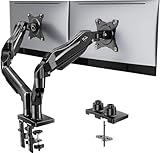
A C-clamp mount like the VIVO STAND-V002 ($34.99) is the workhorse choice — it holds two screens up to 30 inches and 22 lbs each, frees up desk surface, and clamps to desktops up to about 3.5 inches thick. Clamp mounts suit desks at least 48 inches wide and 24 inches deep. The trade-off is that the pole sits where you clamp it, so plan the position before tightening.
Gaming Setup
Gamers should prioritize full-motion gas-spring arms for smooth repositioning between games and streaming layouts. The HUANUO FlowLift ($59.99) fits 13–32 inch screens with each arm holding 4.4 to 19.8 lbs and offers both C-clamp and grommet mounting. Expect to pay $50–$80 for gas-spring dual arms versus $28–$40 for fixed-pole designs. Check that the arm reach (typically 16–22 inches per arm) suits your seating distance.
Small Desks and Dorm Rooms
If your desk is under 48 inches wide or shallower than 24 inches, a free-standing stand with a wide base will crowd you. Choose a single-pole clamp mount or a vertical stacked configuration instead. The MOUNT PRO free-standing model ($27.98) works on deeper desks, but for tight spaces, a clamp with a small 3–4 inch footprint is the better fit.
Trading or Data-Heavy Workstations
Traders and analysts often prefer free-standing bases because they reposition instantly and don’t require drilling or clamping — useful on glass or sit-stand desks. Just confirm the base (typically 26–31 inches wide) fits your desk and that the feet extend far enough forward to balance two 27 inch panels; counterweighted free-standing models handle up to about 17.6 lbs per screen.
Sit-Stand Desk Users
On a height-adjustable desk, a clamp mount moves with the desktop, which keeps your monitor height consistent as the desk rises. Free-standing bases also work, but verify the feet stay within the desk’s usable surface throughout its travel range. Gas-spring arms are ideal here because you can fine-tune height at every desk position.
Common Sizing Mistakes
- Ignoring desk depth. A free-standing base with 26+ inch wide feet needs a genuinely deep desk. Buyers with 20–22 inch deep desks end up with feet hanging over the edge.
- Buying for screen size but not weight. A stand “up to 27 inch” may still cap at 14.3 lbs per arm. Ultrawide-adjacent 27 inch panels or monitors with built-in power bricks can exceed that. Always check the pound rating, not just the diagonal.
- Assuming VESA is universal. Nearly all 27 inch monitors use 75x75mm or 100x100mm, but some slim models have no VESA holes at all. Confirm before ordering.
- Forgetting clamp thickness limits. Most C-clamps fit desktops from about 0.4 to 3.5 inches thick. Desks with thick tops, metal frames, or cable trays may not clamp at all — grommet mounting is the fallback.
- Underestimating total width. Two 27 inch monitors take roughly 48–50 inches side by side. On a 47 inch desk, they will overlap your keyboard zone unless you angle them.
- Overloading a single pole. Entry-level single-pole stands sag when both arms hold heavy panels at full extension. If your monitors weigh over 15 lbs each, choose a dual-pole or crossbar design.
FAQ
Will two 27 inch monitors fit on a 48 inch desk?
Barely. Two 27 inch panels measure about 48–50 inches side by side, so a 48 inch desk leaves no room for the stand pole or speakers. A 55–60 inch desk is recommended; otherwise, choose a vertical stacked mount to halve the horizontal footprint.
What VESA size do 27 inch monitors use?
Almost all 27 inch monitors use either 75x75mm or 100x100mm mounting holes. Heavier panels (16+ lbs) typically use 100x100mm. Any dual stand marketed for screens up to 27–32 inches will support both patterns.
How much weight should each arm hold?
Most 27 inch monitors weigh 10–16 lbs without their factory stand. Choose arms rated for at least 17.6 lbs per screen, and 22 lbs per arm if you want headroom for heavier panels or future upgrades. Gas-spring arms like the HUANUO FlowLift list a minimum too (4.4 lbs), so lightweight portable monitors may fall below the range.
Should I get a free-standing stand or a clamp mount?
Clamp mounts cost about the same ($28–$60 range) and free up dramatically more desk space, making them the default recommendation. Choose free-standing if your desk can’t be clamped (glass tops, metal frames, thickness over 3.5 inches), if you reposition frequently, or if you rent and want zero hardware attached to the desk. Expect to pay $28–$40 for free-standing and $35–$60 for clamp or grommet models in 2026.
Related guides
- Best Kvm Switch for Dual Monitors and Laptop in 2026: Tested and Ranked: 6 Tested (2026)
- 8 Best Usb C Hubs for Ipad Pro with Hdmi in 2026: Tested and Ranked (2026)
- 5 Best Usb C Hubs for Macbook Air with Dual Monitors in 2026: Tested and Ranked (2026)
- How Much Desk Space Does a Kvm Switch Need? Size Guide With Measurements


