Your phone slides onto the pad, the LED flickers, and then… nothing. Or worse: the light glows a confident green, your phone chirps like it just connected, and thirty minutes later the battery percentage hasn’t moved a single point. A wireless charger pad that stops charging is one of the most common accessory failures, and it usually shows up as one of three symptoms: no charging indicator at all, an indicator that pulses on and off repeatedly, or intermittent charging that only works when you nudge the phone into exactly the right spot.
Here’s the good news: this is rarely an emergency, and it’s rarely a dead pad. Most wireless charging failures are caused by alignment issues, case interference, or a power source that can’t deliver enough current — all fixable in under ten minutes with nothing but your hands and a little patience. Even the most stubborn software-side causes can be resolved with a restart or a settings reset. Work through the fixes below in order, from easiest to hardest, and you’ll almost certainly get charging again without buying anything new.
Likely Causes
| Cause | How to confirm | Fix difficulty |
|---|---|---|
| Misaligned phone on the coil | Charging starts briefly, then drops, or only works in one spot | Easy |
| Thick case, magnets, or popsocket blocking the coil | Charges fine caseless, fails with the case on | Easy |
| Underpowered wall adapter or USB port | Pad LED flickers, or charging is extremely slow | Easy |
| Foreign object or debris on the pad | Pad beeps or flashes a warning LED when the phone is placed | Easy |
| Overheating protection kicking in | Charging starts, stops after a few minutes, phone feels warm | Moderate |
| Buggy charging firmware or cache on the phone | Pad works with other phones but not yours | Moderate |
| Failed pad or damaged cable | No LED ever lights up, even on a known-good outlet | Hard (replace) |
Fix 1: Re-center the Phone on the Charging Coil
What causes it
Wireless charging coils are small — typically 30 to 50 mm in diameter — and the phone’s receiving coil may sit off-center if the phone has a large camera bump. If the coils are even slightly misaligned, the pad either won’t trigger or will cycle on and off.
How to check
Place the phone on the pad, then slowly slide it a few millimeters in each direction (up, down, left, right), pausing two seconds at each position. Watch for the charging icon or pad LED. If charging only triggers at one off-center spot, alignment is your problem. On many phones you can open Settings > Battery and see whether it says “Charging” or “Not charging” in real time while you adjust.
What to do
Center the phone so the middle of its back sits over the pad’s coil — usually marked by a small circle or logo on the pad’s surface. For phones with large camera modules, position the phone slightly lower than you think, since the coil sits below the camera bump. If the pad has a rubber alignment ring, seat the phone inside it. Once charging holds steady for a full minute without dropping, you’re done.
How to undo it
Nothing to undo — just lift the phone off and place it normally. Repositioning is fully reversible.
Fix 2: Remove Case Accessories and Magnetic Plates
What causes it
Phone cases thicker than about 3 mm, metal plates for magnetic car mounts, credit card holders, ring holders, and popsockets all sit between the transmitter coil and the receiver coil. Metal especially causes two problems: it blocks the magnetic field and heats up rapidly, which trips the pad’s safety shutoff.
How to check
Take the phone completely out of its case and place it bare on the pad. If it charges reliably every time without the case, the case or something attached to it is the culprit. Thicker rugged cases (OtterBox Defender-style, battery cases) are the most common offenders.
What to do
Remove any metal plate, card, or grip accessory. If you want to keep the case, swap to a wireless-charging-compatible one that’s under 3 mm thick and explicitly rated for Qi charging. If you need the metal plate for a car mount, choose plates labeled “wireless charging compatible,” which are cut and positioned to avoid the coil.
How to undo it
Reattach any accessories you removed. Nothing on the phone or pad changes.
Fix 3: Use a Proper Wall Adapter and Cable
What causes it
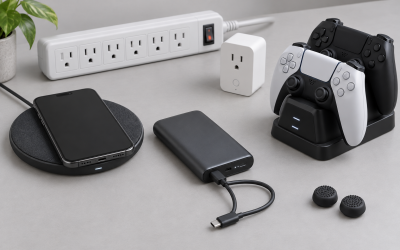
A wireless pad converts wall power into a magnetic field, and it loses a lot of energy along the way — wireless charging is only roughly 60–75% efficient. A pad rated for 15W input typically needs a 5V/2A (10W) or higher USB power adapter. Plugging the pad into a laptop USB-A port (usually 0.5–0.9A), a hub, or an old 5W phone charger leaves the pad unable to sustain a charging session.
How to check
Look at the fine print printed on your wall adapter — it will list output like 5V⎓3A or 9V⎓2A. Compare it to the input requirement printed on the bottom of the pad or in its manual. Then test: plug the pad into a known-good adapter rated 10W or higher (a USB Power Delivery adapter from a modern phone or laptop works) and see whether the flicker or failure stops.
What to do
Use a wall outlet, not a USB port on a computer, monitor, or power strip. Use the cable that shipped with the pad if you still have it — cheap third-party cables with thin 28 AWG conductors can drop too much voltage. Route the cable so it isn’t bent sharply at the micro-USB or USB-C connector, since a partially broken cable can deliver power intermittently.
How to undo it
Plug everything back the way it was. No settings are changed.
Fix 4: Clear Foreign Objects and Debris
What causes it
Qi pads detect foreign objects — coins, paper clips, aluminum foil, even sand — via a loss of resonance in the coil, then refuse to charge or blink a warning to avoid heating the object. Dust, crumbs, and pocket lint can also build up on the pad’s surface and physically hold the phone a few millimeters above the coil.
How to check
Hold the pad under a bright light. Look for a blinking or amber-colored LED, or listen for a repeating beep when you place the phone down — many pads distinguish “foreign object detected” from normal charging this way. Run your finger across the surface to feel for grit, and inspect the pad’s underside seam where debris collects.
What to do
Unplug the pad, wipe the surface with a slightly damp microfiber cloth, and let it dry fully before reconnecting. Remove any metal objects from the pad’s vicinity — within a few centimeters — including desks with embedded metal strips. Reconnect and test with a bare phone.
How to undo it
No changes to undo beyond putting items back where they were.
Fix 5: Let Everything Cool Down
What causes it
Both the phone and the pad throttle or stop charging above roughly 35–40 °C battery/surface temperature to protect the battery. A pad sitting in direct sunlight, on top of a warm laptop, or charging a phone running a heavy game will start charging and then quit — then resume once cool, which looks like random on/off cycling.
How to check
Feel the phone and pad after a failed session. If the phone’s back is noticeably warm, open the phone and check whether apps are running hot: on Android, Settings > Battery > (device care or battery usage) shows per-app drain; on iPhone, Settings > Battery shows usage by app. Navigation, video recording, and hotspot use all generate significant heat.
What to do
Move the pad to a hard, cool surface away from sunlight and other electronics. Close background-heavy apps before charging, or enable a low-power overnight routine. Remove the case while charging, since cases trap heat. If your phone has a battery protection option like Settings > Battery > Charging optimization or a “charge limit” (85–90% on Samsung and iPhone models), note that it may deliberately pause charging near full — that’s not a fault.
How to undo it
Return the pad to its original spot and reopen apps as needed. The cooling behavior is automatic and re-engages whenever temperatures rise.
Fix 6: Restart the Phone and Toggle Charging Settings
What causes it
The phone’s wireless power receiver is managed by the OS, and background services or a stuck battery-stats process can make the phone refuse negotiated power. A restart clears the wireless charging subsystem entirely.
How to check
Test the pad with a different Qi-capable phone if you have one. If the second phone charges fine, the pad is healthy and the problem is on your phone. Also check whether the phone charges via cable — if wired charging also misbehaves, the issue is broader than wireless.
What to do
Restart the phone: hold the power button (or power + volume down on most Androids; side button + volume up, release, then hold side button on recent iPhones) and confirm the restart. While you’re in settings, verify wireless charging is enabled: on Samsung, check Settings > Battery > Charging settings (some models have a fast wireless charging toggle worth toggling off and back on). On iPhone, there’s no wireless toggle, but disabling Settings > General > AirDrop/attention features isn’t needed — instead just confirm iOS is current under Settings > General > Software Update, since charging bugs are periodically fixed in updates.
How to undo it
Toggle any setting you flipped back to its original position. Restarts have nothing to undo.
Fix 7: Update or Reset Phone Software Settings
What causes it
Corrupted system-cache data or a bad update can break the wireless power negotiation handshake, especially after major OS upgrades.
How to check
If the failure began right after a system update, and the pad charges other phones but never yours even after a restart, suspect software. Check for pending updates under Settings > System > System update (Android) or Settings > General > Software Update (iPhone).
What to do
Install any pending updates first. If that doesn’t help, on Android run a cache refresh via Settings > Battery > (three-dot menu) > Battery optimization reset, or perform Settings > System > Reset options > Reset Wi-Fi, mobile & Bluetooth — wireless charging shares low-level radio management with these subsystems on some devices. As a last resort before factory reset, back up the phone and use Settings > System > Reset options > Erase all data, then test wireless charging on the setup screen before restoring apps.
How to undo it
The network-reset is reversible simply by re-entering Wi-Fi passwords and re-pairing Bluetooth devices. A factory reset is undone only by restoring your backup, so create one first under Settings > Google > Backup (Android) or via iCloud/Finder backup (iPhone).
Fix 8: Test with Replacement Cable, Adapter, and Pad
What causes it
After everything above, the remaining suspects are hardware failure: a dead solder joint in the pad, a fried coil from years of heat cycling, or a cable that broke internally where no visual inspection can reach.
How to check
Swap components one at a time. Use a different USB cable, then a different wall adapter, then the pad in a different outlet. If the pad’s LED never lights on any outlet with any cable, the pad itself has failed. You can also test your phone’s wireless receiver by placing it on a friend’s pad or a public Qi charger in a café or car — if it charges there, your phone is fine.
What to do
If the pad is under warranty (most carry 12–24 months), contact the manufacturer with your proof of purchase for a replacement. If it’s out of warranty, replacement is usually the economical choice — pad failures are generally not user-repairable because the coil and driver board are sealed. When buying a replacement, match the input rating to an adapter you already own and pick a pad with a foreign-object detection feature.
How to undo it
Keep the old pad’s cable and adapter — they work with other devices. There’s nothing to roll back.
If Nothing Works
If you’ve worked through every fix and the phone still won’t charge wirelessly, isolate the hardware definitively: confirm the phone charges on another wireless pad and confirm the pad charges another phone. Whichever device fails that cross-test is the one to service. For a phone that fails, the wireless charging coil or its connector may be damaged — common after drops — and a repair shop can test the coil directly, though wired charging remains fully usable in the meantime. For a pad that fails with multiple phones on multiple outlets, replace it; there is no practical internal repair. Until you’re back up and running, a standard USB-C cable charger is a perfectly good substitute for daily use.
FAQ
Why does my wireless charger blink but not charge?
A blinking LED usually means the pad detected a problem and stopped: either misalignment, a foreign object, an incompatible or underpowered power source, or overheating. Count the blinks and check the pad’s manual — many manufacturers encode the fault type in the blink pattern.
Can a phone case really block wireless charging?
Yes. Cases over roughly 3 mm thick weaken the magnetic field enough to interrupt charging, and anything metal — plates, cards, magnets — blocks it almost completely and can trigger the pad’s safety shutoff. A bare-phone test takes thirty seconds and settles the question.
Does wireless charging damage the battery over time?
Modern phones manage charging carefully regardless of method, and heat is the only real concern. Keeping the pad off hot surfaces, removing thick cases while charging, and avoiding charging in direct sunlight keeps thermal stress comparable to wired charging.
Why does my phone charge on the pad but very slowly?
Slow wireless charging is usually an input-power problem: the pad needs a 10W+ adapter to hit its rated output, and the phone may also throttle near full battery or in warm conditions. Check the adapter’s output rating on its label and verify your phone’s fast-wireless-charging toggle is enabled where the option exists.