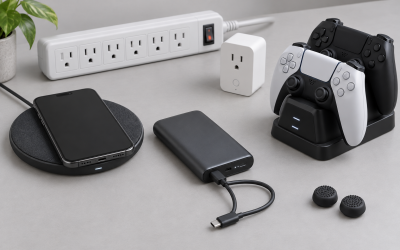
Wireless charging is convenient, but it is less tolerant of poor alignment, excess heat, weak power adapters, and thick cases than a wired connection. A phone can show the charging symbol while adding battery percentage very slowly—or even losing charge during gaming, navigation, video calls, or hotspot use. The key is to determine whether the limitation comes from the charger, its power source, the phone’s settings, heat management, or a physical obstruction.
This guide applies to Qi and Qi2-style pads, stands, multi-device docks, magnetic chargers, and car mounts. In 2026, many newer phones support faster wireless modes, but those modes usually require a compatible charging pad and a sufficiently powerful USB-C wall adapter.
Most Common Causes
| Cause | Symptom | Likelihood |
|---|---|---|
| Phone is misaligned on the coil | Charging starts and stops, or the phone charges only when placed in one exact spot | Very high |
| Case, wallet, metal plate, or magnetic accessory blocks charging | Slow charging, heat, intermittent charging, or a “foreign object” warning | Very high |
| Underpowered wall adapter or cable | Pad works, but only at basic charging speed; multi-device dock slows with multiple devices attached | High |
| Phone or charger is overheating | Charging slows after several minutes, pauses, or resumes after cooling | High |
| Fast wireless charging is disabled | Phone charges reliably but never enters its faster wireless mode | Medium |
| Battery protection or optimized charging is active | Charging slows or holds near 80% overnight or at a scheduled time | Medium |
| Damaged pad, cable, adapter, or USB port | Charging cuts out when the cable moves or only works with a certain cable | Medium |
| Battery wear or background power use | Battery percentage rises slowly despite steady charging; phone drains quickly off the charger | Lower |
Diagnose Step by Step
1. Confirm that the phone is actually receiving stable power
Place the phone on the charger, wait 30 seconds, and watch for repeated charging sounds, vibration alerts, or screen wake-ups. Those usually indicate coil misalignment or unstable power. Leave the display off for five minutes, then compare the battery percentage. Do not judge charging speed while actively gaming, streaming, downloading a large update, or using GPS navigation; those tasks can consume as much power as a basic wireless charger supplies.
2. Remove the case and every attached accessory
Take off the case, wallet attachment, ring grip, magnetic plate, pop grip, camera accessory, and any card holder. Metal plates used for older magnetic car mounts are a frequent cause of slow or failed wireless charging. Even a case labeled “wireless charging compatible” can reduce efficiency if it is thick, has a kickstand, or positions the phone too far from the pad.
3. Test alignment and orientation
Center the phone on a flat pad, then move it slowly in small increments until charging becomes stable. On a stand, confirm the phone’s charging coil is aligned with the stand’s center rather than sitting too high or too low. Try the phone in portrait and landscape orientation. Magnetic Qi2-style chargers should snap into a consistent position; if they do not, the case may not be magnetically compatible.
4. Check the adapter, cable, and outlet
Read the input requirement printed on the bottom of the wireless charger or in its manual. A pad that expects USB-C Power Delivery may charge slowly when connected to an old USB-A adapter, a computer USB port, a monitor USB port, or a low-output travel adapter. Test with a known-good wall outlet, a different USB-C cable, and a wall adapter that meets or exceeds the charger’s stated input requirement. Do not assume that a physically matching USB-C adapter provides the needed power profile.
5. Check for heat and thermal throttling
After 10 to 15 minutes, touch the back of the phone and the charging pad. Warm is normal; uncomfortably hot is not. Remove the phone immediately if you smell hot plastic, see swelling, or receive a temperature warning. Heat causes the phone to reduce charging power to protect the battery. Direct sunlight, a warm desk, a thick case, and running demanding apps all make this more likely.
6. Review wireless charging and battery settings
On Samsung Galaxy phones, open Settings > Battery > Charging settings and look for Fast wireless charging. On many Pixel phones, open Settings > Battery > Battery health and review Charging optimization. On iPhone, open Settings > Battery > Charging and review Optimized Battery Charging and Charge Limit, if available. These features are useful, but they can intentionally reduce or delay charging under certain conditions.
7. Compare with another charger and another phone
Test your phone on a second known-good wireless charger. Then, if possible, test another Qi-compatible phone on your original charger. If only one phone is slow, focus on its case, settings, battery condition, and coil area. If every phone is slow on the same pad, adapter, cable, or charging pad is the likely fault.
Fixes by Cause
Misalignment or poor coil contact
What causes it: The transmitter coil in the pad and receiver coil in the phone are not centered closely enough for efficient power transfer.
How to check: Charging disconnects when the phone shifts, improves when you reposition it, or works only in one small area of the pad.
What to do: Center the phone, rotate it 180 degrees, and use the orientation that produces stable charging. Clean the phone back and charger surface with a dry microfiber cloth. For a flat pad, place a small nonmetallic visual marker beside the best position. If you regularly charge overnight, a stand or magnetic Qi2-compatible setup can make alignment more repeatable.
How to undo: Remove any alignment marker or return to your existing pad placement. No phone setting is changed.
Case or accessory interference
What causes it: Excess distance, metal, magnets in the wrong location, cards, or a thick accessory interrupts the wireless charging field.
How to check: Compare charging with the case installed and removed. If charging becomes stable or noticeably cooler without the case, the case is the problem.
What to do: Remove metal plates, wallet cases, card holders, and ring grips before charging. Use a thin Qi-compatible case with no metal between the phone and charger. For magnetic charging, use a case specifically designed for your phone’s magnetic charging system rather than attaching an adhesive metal ring at random.
How to undo: Reinstall your original case or accessory after charging. If you need a wallet case daily, charge with a cable or remove the wallet section first.
Weak adapter, cable, or shared multi-device dock
What causes it: The charger cannot draw enough power from its USB adapter, or a dock divides its available power among a phone, watch, and earbuds.
How to check: Disconnect all other devices from the dock. Inspect the charger label for required input, such as USB-C PD or a specified wattage range. Test another certified cable and wall adapter.
What to do: Connect the pad directly to a wall outlet using an adapter that meets the manufacturer’s input specification. Replace bent, frayed, loose, or unusually hot cables. Avoid powering a fast wireless pad from a PC, game console, monitor, keyboard USB passthrough, or unpowered hub.
How to undo: Reconnect your previous adapter if needed, though slower charging may return. Keep the higher-capacity adapter dedicated to the wireless charger for consistent results.
Overheating
What causes it: Wireless charging naturally produces more heat than wired charging, and heat rises further when the phone is under load or insulated by a case.
How to check: Charging is faster when the phone is cool, slows after several minutes, or pauses until the device cools. The phone may display a temperature-related message.
What to do: Move the charger away from sunlight, radiators, consoles, PC exhaust vents, and enclosed shelves. Remove the case, stop demanding apps, and lock the screen. On Android, open Settings > Battery > Battery usage to identify high-use apps. On iPhone, open Settings > Battery and review activity by app. Charge on a hard, open surface rather than bedding or fabric.
How to undo: Re-enable or reopen apps after charging, and reinstall the case once the phone is cool.
Fast charging or battery protection settings
What causes it: Fast wireless charging may be disabled, while optimized charging features can intentionally hold or slow charging near a configured limit.
How to check: Review the battery menu paths listed in the diagnostic section. Look for a charge limit, adaptive charging schedule, optimized charging notice, or disabled fast wireless charging toggle.
What to do: Enable Fast wireless charging if your phone and pad support it. If you need a full battery before an unusual trip, temporarily disable optimized charging or raise the charge limit. Restart the phone after changing settings if the charger does not renegotiate correctly.
How to undo: Turn optimized charging back on and restore your preferred charge limit. Battery protection is generally worth keeping enabled for routine overnight charging.
When to Replace or Reinstall
Replace the cable first if it is loose, damaged, intermittently disconnecting, or becomes hot. Replace the wall adapter if it fails with multiple devices or does not meet the charger’s required input specification. Replace the charging pad if multiple phones charge slowly on it after testing with a known-good cable and adapter.
Restart the phone before assuming a hardware failure. If the problem began after an operating system update, install the latest available update through Settings > System > Software update on Android or Settings > General > Software Update on iPhone. Reinstalling apps rarely fixes wireless charging itself, but removing a power-hungry app can reduce battery drain while charging. Seek manufacturer service if the phone will not charge on any known-good Qi charger, shows battery swelling, has back-glass damage near the charging coil, or overheats even while idle.
FAQ
Why does my wireless charger charge slowly only after 80%?
Charging normally slows as the battery approaches full capacity to reduce heat and battery stress. Optimized charging, adaptive charging, and charge-limit features can make that slowdown more obvious. Check your battery settings before treating it as a charger fault.
Can I use my phone while it is wirelessly charging?
Yes, but active use can make charging appear slow. Gaming, video streaming, navigation, and hotspot use generate heat and consume power. For the fastest practical result, lock the screen and avoid demanding apps until charging is complete.
Why does my wireless charger work without the case but not with it?
The case is likely too thick, contains metal or cards, includes a poorly placed magnet, or holds the phone too far from the charging coil. Use a thinner Qi-compatible case or remove the case during charging.
Is a slower wireless charger necessarily defective?
No. It may be operating normally with a basic adapter, a non-fast-charging phone, or a charger designed for overnight use. It becomes suspicious when charging repeatedly disconnects, gets excessively hot, or remains slow after you test a compatible wall adapter, cable, bare phone, and correct alignment.