
Top 3 picks at a glance
The Short Answer
For comfortable eye-level typing with an external keyboard and mouse, your laptop screen should sit so the top of the display is roughly at or slightly below your eye level. For most seated adults, that means the screen center lands 20 to 26 inches off the desk surface, which typically requires a laptop stand adjusted to a height of 6 to 10 inches. If you type directly on the laptop keyboard, the ideal stand height drops to 1 to 3 inches, because reaching up to a raised keyboard strains your shoulders and wrists.
In other words, the “right” height depends on how you use the laptop:
As an Amazon Associate we earn from qualifying purchases at no extra cost to you. Product prices and availability are accurate as of the date shown and are subject to change.


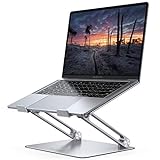

- External keyboard setup: 6 to 10 inches of stand height, so the screen reaches eye level while your arms stay at a neutral 90 to 110 degree elbow angle.
- Typing on the laptop itself: 1 to 3 inches of lift, enough to tilt the screen up and improve airflow without forcing you to reach.
- Standing desk use: 10 to 13 inches of elevation, matched to your standing elbow height.
Every stand on this guide adjusts across at least one of these ranges, which is why adjustability matters more than any single fixed height.
Standard Sizes
Adjustable laptop stands cluster into a few common height ranges. Here’s how the most popular designs compare, including the four stands we reference throughout this guide.
| Stand | Height Range | Folded Footprint | Weight Capacity | Price |
|---|---|---|---|---|
| Gogoonike Adjustable Metal Riser | 2.2 to 6.3 in (5.6 to 16 cm) | Approx. 10.6 x 9.4 in folded panel | Up to 22 lbs (10 kg) | ~$16.99 |
| Lamicall Aluminum Stand (10–17.3″) | Approx. 5.5 to 8 in (14 to 20 cm) | Approx. 10 x 8 in base | Up to 44 lbs (20 kg) | ~$28.99 |
| LOXP Adjustable Stand with 360 Rotating Base | Approx. 6.3 to 10.2 in (16 to 26 cm) | Approx. 11 x 10 in with base | Up to 22 lbs (10 kg) | ~$27.99 |
| tounee Telescopic Pull-Out Riser (10–16″) | Approx. 6.3 to 13 in (16 to 33 cm) | Approx. 11.4 x 10.2 in extended | Up to 22 lbs (10 kg) | ~$43.99 |
A few patterns worth noting: budget risers under $20 rarely exceed 6 to 7 inches of maximum height, which is fine for direct-keyboard typing but usually falls short of true eye level. Mid-range aluminum stands in the $25 to $30 bracket typically reach 8 to 10 inches, enough for most seated users with an external keyboard. Telescopic designs like the tounee, which extend past 12 inches, are the category you want for standing desks or taller users. Weight capacity matters more than most buyers expect, because a 17-inch gaming laptop can weigh 5 to 6 pounds, and a wobbly platform at 10 inches of height amplifies every keystroke.
How to Measure Your Space
Getting the height right takes about five minutes with a tape measure. Follow these steps:
- Measure your seated eye height. Sit in your usual chair with your feet flat on the floor. Have someone measure from the desk surface to the outer corner of your eye. For most adults this lands between 22 and 30 inches above the desk.
- Subtract half your laptop’s screen height. A 14-inch laptop’s display panel is roughly 8.5 inches tall, a 16-inch model about 9.5 inches, and a 13-inch model around 7.5 inches. Since the screen center should sit at eye level, subtract half the panel height from your eye measurement.
- Subtract the laptop’s own thickness. Add roughly 0.6 to 0.8 inches back, since the laptop body itself contributes height on top of the stand.
- The result is your target stand height. Example: 26-inch eye height minus 4.75 inches (half of a 16-inch panel) plus 0.7 inches of laptop body means you want a stand set to about 9 inches.
- Check your elbow angle. With your external keyboard on the desk, your elbows should bend between 90 and 110 degrees with shoulders relaxed. If your shoulders creep upward, your screen is too high; if you hunch forward, it’s too low.
- Measure your depth clearance. Stands with forward-tilted or pull-out arms, like the tounee’s telescopic design, need 11 to 13 inches of desk depth beyond the stand’s footprint so the screen doesn’t hang over the edge.
By Room or Use Case
Home Office Desk
This is the classic case for a 6 to 10 inch adjustable stand paired with a separate keyboard and mouse. The Lamicall aluminum stand, topping out around 8 inches, suits users roughly 5’4″ to 5’10” seated in a standard 29 to 30 inch desk chair setup. Taller users should look at the LOXP or tounee, both of which clear 10 inches. Expect to spend $17 to $44 depending on maximum height and build material.
Standing Desk
Standing elbow heights typically run 40 to 46 inches off the floor, so the stand needs to add 10 to 13 inches above the (now raised) desk. Only telescopic models reliably reach this range; the tounee’s 13 inch maximum makes it a natural fit. Keep total screen weight in mind: the stand, laptop, and any lever arm must stay well under the stand’s rated capacity, usually around 22 pounds for these designs.
Couch and Bed
Lap and bed use favors low, wide, stable platforms rather than tall risers, since a narrow stand at height on a soft surface tips easily. Look for stands with broad bases or 360-degree rotating feet, like the LOXP, so you can swing the screen toward you without lifting the whole unit. A height of 4 to 8 inches works for reclined viewing, and a folded footprint under 12 inches wide fits most lap desks.
Travel and Shared Workspaces
Portability changes the math. Folding X-frame and panel-style stands like the Gogoonike collapse to under an inch thick and weigh 1 to 2 pounds, trading maximum height for packability. If you split time between a coffee shop and a home desk, a 2 to 6 inch riser plus a stack of books on tall days is a pragmatic compromise most frequent travelers settle into.
Gaming and Creative Work
Large laptops, 16 to 17.3 inches and 4.5 to 6 pounds, need both height capacity and thermal clearance. Aluminum stands with open frames dissipate heat better than solid panels, and the Lamicall’s 44 pound rating leaves generous headroom. For external-monitor-style ergonomics at this screen size, target 8 to 10 inches of stand height with a keyboard and mouse.
Common Sizing Mistakes
- Buying a tall stand but typing on the laptop keyboard anyway. Anything above 3 inches forces upward wrist flexion and shoulder shrugging. The screen gain isn’t worth the wrist cost; budget for a $15 to $30 keyboard.
- Ignoring eye height differences in shared setups. A stand set for a 5’3″ user leaves a 6’1″ user hunching. Adjustable-height models spanning at least 4 to 5 inches solve this cheaply.
- Overloading a lightweight riser. Plastic stands often rate for only 8 to 11 pounds. A heavy gaming laptop plus a nudging hand can exceed that, and the failure happens at full height where it hurts most.
- Forgetting depth clearance. Angled and pull-out designs push the screen 3 to 5 inches toward you. On desks shallower than 24 inches, that can leave the laptop overhanging the edge.
- Matching stand height to the screen top instead of the center. The center of the display should sit at eye level, meaning the top of the screen lands at or slightly above it. Sizing to the top overshoots and strains the neck downward.
- Assuming one height fits sitting and standing. The gap between seated and standing screen positions is typically 5 to 7 inches. If you alternate, you’ll re-adjust daily, so smooth telescopic adjustment beats stacked notches.
FAQ
Is a 6 inch laptop stand tall enough?
It depends on your body. A 6 inch platform puts a typical 14 to 16 inch laptop’s screen center 11 to 13 inches above the desk, which suits users around 5’2″ to 5’6″ seated at a standard desk. Taller users will want 8 to 10 inches, which points toward the Lamicall, LOXP, or tounee tiers rather than basic budget risers.
Should my laptop screen be at eye level or slightly below?
Slightly below to at eye level is the ergonomic sweet spot. Aim for the top edge of the screen at or just under your eye height, which means the display center sits 2 to 4 inches below your eyes. This keeps your neck near its neutral 0 to 15 degree downward tilt instead of forcing constant upward craning.
What height should a laptop stand be for a standing desk?
Plan for 10 to 13 inches of stand height. Measure your standing elbow height (usually 40 to 46 inches from the floor), subtract roughly half your screen’s panel height plus an inch, and confirm the stand’s maximum clears the result. Telescopic models reaching 12 to 13 inches, like the tounee, are the safest bet.
Can I use books instead of a laptop stand?
Temporarily, yes. Stacking books to reach 6 to 10 inches replicates the height of a mid-range stand for free. The downsides are stability, no tilt adjustment, blocked ventilation on solid stacks, and zero portability. As of 2026, capable adjustable stands start under $17, so most people upgrade within a few weeks of the book-stack experiment.
Related guides
- Best Kvm Switch for Dual Monitors and Laptop in 2026: Tested and Ranked: 6 Tested (2026)
- 8 Best Usb C Hubs for Ipad Pro with Hdmi in 2026: Tested and Ranked (2026)
- 5 Best Usb C Hubs for Macbook Air with Dual Monitors in 2026: Tested and Ranked (2026)
- What Size Monitor Stand for Two 27 Inch Monitors? Size Guide With Measurements


