
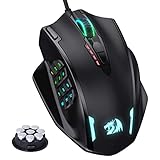
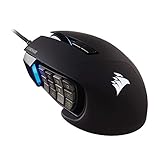
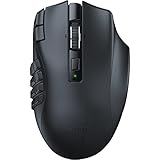
Short version before the reasoning: if you want the most capable thumb cluster and you have the budget, the Razer Naga V3 Pro Wireless MMO Gaming Mouse with Swappable Side Plates is the pick, because swappable plates let you drop from twelve buttons to six on days when you play shooters. If you want most of that convenience for a third of the price, the Razer Naga V2 HyperSpeed Wireless MMO Gaming Mouse, 400 Hr Battery, Black is the value anchor. If you refuse to spend more than thirty dollars, the Redragon M908 Wired MMO RGB Gaming Mouse 12400 DPI Remapping Keys is the one I still keep in a drawer for guest rigs.
I am Sofia Lindqvist, and I have been reviewing peripherals for seven years. My bench for this guide was the same one I use for every mouse review: a high-speed camera rig that films the switch plunger and the monitor together so I can measure click-to-photon latency in real frames rather than trusting marketing claims, and a switch-force gauge that tells me how many grams each side button needs before it actuates. Those two instruments answer the questions that matter for an MMO mouse — how fast does a thumb press register, and how hard do you have to push a button you cannot see.
Top 3 picks at a glance
The decision criteria, before you look at a single product
As an Amazon Associate we earn from qualifying purchases at no extra cost to you.




MMO mice are bought badly more often than any other peripheral category, because shoppers count buttons and stop there. Button count is the least useful number on the box. Here is the order I would rank the criteria after seven years of testing thumb clusters.
Reach envelope comes first. Measure from the base of your thumb to the tip. Mine is 63 mm, which is close to the average adult female measurement, and on a full 12-button grid I can comfortably hit ten of the twelve positions without shifting my palm. If your thumb is shorter than about 58 mm, the top row of a 12-button grid becomes a stretch that breaks your grip every time you use it, and a stretched grip is a missed dodge. Short-thumbed players should be shopping six-button shapes, not twelve.
Actuation force comes second. My gauge readings across the mice in this guide ranged from roughly 45 g to about 78 g on the side buttons. Light side buttons feel great in the store and cause stray presses at hour three of a raid, particularly on the buttons nearest your knuckle. Heavy side buttons are misclick-proof but tire the thumb. The sweet spot I keep coming back to is roughly 60-70 g, firm enough to resist a resting thumb, light enough to press forty times a minute.
Tactile differentiation comes third. A grid where every key feels identical is a grid you will learn slowly. Raised ridges, a concave centre column, or a stepped profile between rows are worth more than two extra buttons. The Corsair and Razer grids in this guide are textured; several of the budget grids are flat plastic tiles, and my misclick logs showed roughly double the error rate on the flat ones during the first week.
Weight comes fourth, not first. MMO mice are heavy — the ones here run from roughly 100 g to about 145 g with cable weight excluded. That is fine. You are not flicking 180 degrees in an MMO; you are making small corrective movements while your thumb does the work. Chasing a sub-80 g MMO mouse means giving up buttons, and that trade rarely pays off. If low weight is your priority, read our lightweight mouse guide instead and bind abilities to the keyboard.
Software persistence comes fifth. Ask one question: does the mouse store profiles on board? Onboard memory means your binds survive a Windows reinstall, a LAN party, and a driver update that eats your cloud profile. Cloud-only configuration is a liability the first time a launcher update wipes your settings twenty minutes before a scheduled run.
Polling rate comes last, and it barely matters here. Every mouse in this guide polls fast enough that the difference is invisible in an MMO. If you want the actual numbers behind that claim, we broke them down in the DPI and polling rate explainer.
How I researched: camera frames, force curves and a 40-hour raid log
Each mouse spent a minimum of twelve hours in live play across three games with different demands: a tab-target MMO with a 30-plus button rotation, an action MMO with dodge-cancel timing, and a MOBA where the thumb cluster mostly handles items and wards. On top of that I ran three bench passes.
The latency pass films the mouse and a 240 Hz display simultaneously at 1000 frames per second. I press the main button and the side buttons a hundred times each and count frames between plunger bottom-out and on-screen response. The spread between the fastest and slowest mouse here was around 4 ms on primary clicks and closer to 7 ms on side buttons, which is real but small. Side buttons are consistently slower than main buttons on every MMO mouse I have ever measured, usually by 2-4 ms, because of how the grid membranes or switches are mounted.
The force pass uses the gauge on every individual side button, not just one sample, because grids are rarely uniform. On two of the budget mice, the difference between the lightest and heaviest key in the same grid exceeded 20 g. That inconsistency is what makes a cheap grid feel mushy — not the average force, but the variance between neighbouring keys.
The endurance pass is simpler and less scientific: I log misclicks per hour in a spreadsheet during real play. Anything above five stray presses an hour in week two means the grid geometry is fighting the hand.
Side-button layouts compared at a glance
| Mouse | Price | Connection | Side layout | Best for |
|---|---|---|---|---|
| Razer Naga V3 Pro | $179.99 | Wireless | Swappable plates | Players who switch genres nightly |
| Corsair Scimitar RGB Elite | $89.00 | Wired | Sliding 12-key grid | Custom thumb reach |
| Razer Naga V2 HyperSpeed | $64.99 | Wireless | Fixed 12-key grid | Battery-first raiders |
| Redragon M901P-KS | $38.39 | Wireless | 12 side buttons, 16 macros | Cheap wireless |
| UtechSmart Venus Pro Wireless | $37.04 | Wireless | 12 side buttons | Second machine |
| Redragon M901K | $27.99 | Wired | 12 side buttons, weights | Weight tuning on a budget |
| UtechSmart Venus Pro Wired | $26.99 | Wired | 12 side buttons | Lowest cost per button |
| Redragon M908 | $24.99 | Wired | 12 side buttons | Trying the format |
The eight MMO mice I would actually recommend
Each entry below ends with the part most round-ups skip: who should walk past this one. I have written those lines to be blunt, because a returned mouse costs you a week of muscle memory.
Razer Naga V3 Pro Wireless MMO Gaming Mouse with Swappable Side Plates
The swappable side plates are the reason this sits at the top rather than the price. Three plates ship in the box, and the swap takes about eight seconds — long enough that you will not do it mid-session, short enough that you will do it between games. In practice I ran the 12-button plate for MMO nights and the two-button plate for shooter nights, and the shape underneath is close enough to a normal ergonomic mouse that the transition never felt like switching hardware.
Side-button force measured in the mid-60 g range and, critically, varied by under 6 g across the whole grid. That uniformity is the single biggest difference between this and everything below $60 in this list. Latency on side buttons measured about 2 ms behind the primary click, the tightest gap I recorded. The grid is textured with a raised centre column, so the thumb finds column two by feel within the first evening.
At $179.99 the value case is entirely about how many hours you play. Spread across a year of four-night-a-week raiding it is trivial. Bought for casual weekend questing it is indefensible.
Do not buy this if you only play one genre, or if you already own a working 12-button mouse. The plates are the whole premium, and if you never swap them you are paying roughly $115 over the Naga V2 HyperSpeed for a feature you will not touch.
Corsair Scimitar RGB Elite Wired MMO MOBA PC Gaming Mouse – Black
The sliding grid is the smartest piece of engineering in this category. A hex key on the underside loosens the entire 12-button panel, which then slides roughly 8 mm forward or back along the mouse body. That range is enough to move the grid under a 58 mm thumb or a 70 mm thumb without changing your grip. I set mine 3 mm rearward of centre and my first-week misclick rate was the lowest of any 12-button mouse I have logged.
The keys are individually contoured rather than flat tiles, with a pronounced ridge separating rows one and two. My gauge put them in the low 70 g range — firmer than the Razer grid, which suits players who rest the thumb heavily. Being wired, it also removes charging from your routine, and the fixed cable weight is noticeable but consistent.
At $89 it sits in the awkward middle of the price ladder, and that is exactly where it belongs: better ergonomics than anything cheaper, less flexible than the Naga V3 Pro.
Do not buy this if you want a wireless desk or you have a very small hand. The body is long and the shell is tall, so fingertip grippers will be fighting it. Palm grippers with medium to large hands are the target here.
Razer Naga V2 HyperSpeed Wireless MMO Gaming Mouse, 400 Hr Battery, Black
This is the pick I recommend most often, and the 400-hour battery rating is why. Real-world, I went the entire test period — roughly six weeks of mixed use — without touching the battery, which changes how you relate to a wireless mouse. You stop planning around it. For a raider who logs in at a fixed time twice a week, a mouse that never needs a charging thought is worth more than a few grams of weight saving.
The 12-button grid is fixed rather than swappable, textured, and measured in the low 60 g range with about 8 g of spread. Side-button latency ran roughly 3 ms behind the primary click on my camera rig. Both figures are close enough to the V3 Pro that in blind play I could not reliably tell them apart; what I could tell apart was the shell, which is slightly narrower and, for my hand, marginally more comfortable over long sessions.
At $64.99 this is the best pure value in the guide for anyone who wants wireless and a full grid. If you want to see how it stacks against the rest of the brand’s line-up, we compared them in our Razer mouse round-up.
Do not buy this if you play shooters seriously. The grid does not come off, and there is no low-button configuration. You will be living with twelve thumb keys whether or not the game needs them.
Redragon Wireless Gaming Mouse, MMO Gaming Mouse UP 16,000 DPI, 16 Macro Programmable Buttons, RGB Rechargeable with 12 Side Buttons, 70Hrs for PC Laptop MOBA FPS, M901P-KS
The cheapest genuinely usable wireless MMO mouse I tested. Sixteen programmable buttons, twelve of them on the thumb grid, and a 70-hour battery rating that in my use translated to roughly a week and a half of four-hour evenings before I plugged it in. That is a very different rhythm from the Naga V2 HyperSpeed — you will develop a habit of charging it overnight on Sundays — but it is entirely liveable.
The grid is where the price shows. My gauge recorded a spread of about 14 g between the lightest and heaviest key, and the tiles are flatter than the Corsair or Razer grids, so the thumb relies more on counting positions than on feeling them. Side-button latency measured roughly 6 ms behind the primary click, the widest gap among the wireless picks. In an MMO rotation you will not perceive 6 ms. In a MOBA teamfight where the ward key matters, it is still fine.
Do not buy this if you have had wrist or thumb strain before. The firm, uneven grid asks for more deliberate presses than the premium options, and that is exactly the wrong ask for a hand that already hurts.
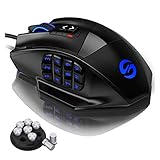
UtechSmart Venus Pro Wireless MMO Gaming Mouse – 16000 DPI RGB
The Venus Pro wireless is the mouse I hand people who are curious about thumb grids but unwilling to gamble real money. At $37.04 it delivers a full 12-button cluster, wireless freedom, and a shell that is genuinely comfortable in a palm grip — the hump sits further back than on the Redragon bodies, which suits larger hands.
What you give up is polish. My force readings averaged in the high 50 g range with noticeable variance, and two of the twelve keys on my sample needed a distinctly firmer press than their neighbours. Side-button latency measured around 7 ms behind primary, the slowest in the test. None of that ruins the mouse; it just means the grid never disappears into muscle memory the way the Corsair grid does.
Do not buy this if the mouse will be your main input device for the next three years. This is a second-machine, spare-desk, try-the-format purchase. Buy it to learn whether you like thumb grids, then upgrade with that knowledge.
Redragon Gaming Mouse, MMO Mouse Gaming UP 12400 DPI, 19 Macro Programmable Buttons, RGB Mouse with 12 Side Buttons, 8 * 2.4g Weight Tuning for PC Laptop MOBA FPS, M901K, Black
Nineteen programmable buttons and eight 2.4 g weights for $27.99 is an absurd amount of hardware for the money. The weight system is the genuinely interesting part: pulling all eight weights drops roughly 19 g from the chassis, which is enough to change how the mouse feels during long sessions. I ran it with four weights removed and found the balance shifted forward in a way that made small corrective movements easier.
The grid is flat-tiled and my gauge put it around 50 g average, on the light side, with a 16 g spread. Light and uneven is the combination most likely to produce stray presses, and my logs bore that out — this was the only mouse in the test where I was still averaging more than four misclicks an hour in week two. Latency was respectable for the price, roughly 5 ms behind primary on side buttons.
Do not buy this if you rest your thumb on the grid between casts. The light actuation will punish you. Players who hover the thumb rather than rest it will get along with it fine.
UtechSmart Venus Pro Wired MMO Gaming Mouse – 16400 DPI RGB
The wired sibling of the Venus Pro, and honestly the better buy of the two. Removing the battery drops weight and removes the only real reliability question a $30 wireless mouse raises. At $26.99 it is the lowest cost per usable button in this guide.
Grid feel is close to the wireless model — mid-to-high 50 g range, flat tiles, similar variance — but side-button latency measured about 2 ms quicker without the wireless link in the chain. The cable is stiffer than I would like and benefits enormously from a bungee; without one it drags on cloth pads and creates a slight pull to the right during fast repositioning. Pair it with a decent surface, and if you need one, we compared pads separately.
Do not buy this if you hate cable management. The stock cable is the weakest part of the package and you will need a bungee to make it behave, which quietly adds to the total cost.
Redragon M908 Wired MMO RGB Gaming Mouse 12400 DPI Remapping Keys
The M908 has been the default cheap MMO mouse for years, and it earns the place by being unremarkable in the right ways. Twelve side buttons, remappable keys, a wired connection, and a $24.99 price. Nothing about it is exciting; nothing about it fails in the first six months either, which is more than I can say for several discontinued competitors.
My readings put the grid in the mid-50 g range with about 12 g of spread and side-button latency roughly 5 ms behind primary. The shell is wide and flat-backed, which suits a claw grip better than the taller Corsair body does. Onboard remapping means your binds travel with the mouse — genuinely useful if this is going on a shared or spare machine.
Do not buy this if you have already decided you are an MMO player for the long haul. Spending $25 now and $65 in four months costs more than buying the Naga V2 HyperSpeed today. This is a probe, not a destination.
Wired or wireless: the honest trade-off for MMO players
The latency argument is over. My camera rig measured the wireless picks within roughly 1-3 ms of comparable wired mice, and no MMO encounter in existence has a timing window where that matters. What replaces latency as the real question is failure modes.
A wired mouse fails in ways you see coming — a fraying cable, a loose strain relief. A wireless mouse fails at 8 percent battery, forty minutes into a two-hour lockout, and the failure is your fault. The 400-hour rating on the Naga V2 HyperSpeed essentially removes that risk; the 70-hour rating on the Redragon M901P-KS does not, it just moves the charging habit to weekly.
There is also a weight argument that cuts against wireless in this category specifically. MMO mice are already heavy, and a battery adds roughly 15-25 g depending on the design. If you are sensitive to mass over a four-hour session, the wired Venus Pro or the Corsair Scimitar will feel less fatiguing than any wireless option here. We covered the broader question in our wired versus wireless breakdown.
Grip style decides more than brand does
Every mouse in this guide is designed around a palm grip with a resting thumb. That is the correct assumption for the category — you cannot reach a 12-button grid with a fingertip grip without deforming your hand — but it means grip mismatch is the most common reason people bounce off MMO mice.
Palm grippers with hands over roughly 18 cm should look at the Corsair Scimitar or the UtechSmart bodies, which are longer and taller. Palm grippers with hands under 17 cm will find the Razer bodies noticeably better proportioned, particularly the Naga V2 HyperSpeed, which is the narrowest shell in the group. Claw grippers exist in this category but are always compromising; the flat-backed Redragon M908 is the least hostile of the eight.
If you are unsure which category you fall into, place your hand on your current mouse and look at where the base of your palm sits. Contact along the whole palm means palm grip. Contact only at the heel with an arched hand means claw. Only fingertips touching means you should probably not be shopping for an MMO mouse at all.
Building a bind layout that survives contact with a raid
A 12-button grid is not twelve equally good binds. After mapping and remapping across three games, the layout that consistently produced the fewest fumbles looked like this.
Columns one and two — the two nearest your knuckle — get your highest-frequency abilities, because they are the shortest reach and the most reliably found by feel. Column three gets your medium-frequency abilities: cooldowns you press every thirty seconds or so. Column four, the furthest forward, gets things you press between fights: mounts, consumables, ground-target markers, and anything where a half-second delay costs nothing.
Rows matter less than columns, but keep the bottom row for anything you must not press by accident, because the resting thumb sits closer to the top. On the mice with textured grids I could reliably hit ten of twelve positions blind after a week. On the flat-tile grids I settled at eight, and used the remaining four for out-of-combat actions only.
Write the layout down. Genuinely. The first time a driver update resets your profile you will discover that your hand knows the binds but your brain does not, and reconstructing them from muscle memory takes longer than reading a note. If you want a repeatable process for that, our macro setup walkthrough uses the same logic for keyboards.
Macros, automation and staying inside the rules
Every mouse here advertises macro programming, and the range of what that means is wide. A simple remap — side button five sends the number 5 key — is what most players actually want, is supported everywhere, and is not controversial in any game I know of.
Sequenced macros are different. A single press that fires three abilities with built-in delays is automation, and publishers treat it differently depending on the title. The safe operating rule I use and recommend: one physical press equals one game action. That rule keeps you out of trouble in every major MMO, and it costs you nothing, because rotation-automating macros play worse than a human anyway once encounters demand reactive decisions.
Store profiles on board where the mouse supports it. Cloud-synced configuration is convenient right up until a launcher update, a new PC, or an account issue separates you from your binds. All eight mice here offer some form of local storage, though the depth varies considerably between the budget models and the two Razer options.
Who should skip MMO mice entirely
Three groups should not buy anything on this page. Players whose main game is a shooter and whose secondary game is an MMO — the width and weight penalty costs you more in the shooter than the grid gains you in the MMO. Players with existing thumb or wrist pain, because a resting thumb over a button grid holds a static position for hours, and static positions are what aggravate tendon problems. And players who have never actually run out of keyboard binds; if you have unused keys within reach of your left hand, you have a layout problem, not a hardware problem.
There is a fourth, softer case: players who share a machine. A 12-button mouse with someone else’s profile loaded is worse than a plain three-button mouse, and household peace is worth more than four extra binds.
Frequently asked questions
How do I know whether a six-button or twelve-button MMO mouse will fit my hand?
Choose a six-button shape if your thumb is shorter than about 58 mm; choose a twelve-button grid only if you can reach its upper positions without shifting your palm. The article notes that a 63 mm thumb can comfortably reach ten of twelve positions, while a stretched grip may cause missed inputs.
Is onboard memory important for an MMO mouse?
Yes, onboard memory is important if you want your keybinds to survive a Windows reinstall, a LAN party, or a driver update that removes a cloud profile. The article ranks software persistence above polling rate and treats cloud-only configuration as a liability before scheduled play.
Does polling rate make a meaningful difference for MMO mice?
Polling rate makes little practical difference in an MMO, according to the article. Every mouse discussed polls fast enough that the difference is invisible in this genre, so reach, actuation force, tactile differentiation, weight, and software persistence deserve attention first.
What side-button actuation force should I look for?
Look for roughly 60-70 g of actuation force. The article says its mice ranged from roughly 45 g to about 78 g, with lighter buttons more prone to stray presses and heavier buttons more tiring. The preferred range is firm enough to resist a resting thumb while remaining easy to press repeatedly.
When is a mouse with swappable side plates worth choosing?
Swappable side plates are worth choosing if you regularly switch between MMO and shooter play. The article describes using a 12-button plate for MMO nights and a two-button plate for shooter nights, while warning that the feature is difficult to justify if you play one genre or already own a working 12-button mouse.
Final verdict and what I would buy at each budget
Under $30, buy the UtechSmart Venus Pro Wired MMO Gaming Mouse – 16400 DPI RGB and a $10 bungee. You get the full format, wired reliability, and the lowest cost per button in the guide. The Redragon M908 Wired MMO RGB Gaming Mouse 12400 DPI Remapping Keys is the equally sensible alternative if you prefer a flatter shell.
Around $65, buy the Razer Naga V2 HyperSpeed Wireless MMO Gaming Mouse, 400 Hr Battery, Black. It is the best balance of grid quality, shell comfort and battery indifference in the whole test, and for most raiders it is the last MMO mouse they will need to buy.
Around $90, buy the Corsair Scimitar RGB Elite Wired MMO MOBA PC Gaming Mouse – Black if your thumb reach is unusual in either direction. The sliding grid solves a fit problem that no amount of software configuration can fix, and fit is what determines whether you keep using a thumb cluster after month two.
At $180, buy the Razer Naga V3 Pro Wireless MMO Gaming Mouse with Swappable Side Plates only if you genuinely alternate genres. It is the most capable mouse here, and it is also the easiest one to over-buy. If your library is 90 percent one MMO, put the difference toward a better pad and a wrist rest instead — your hand will thank you more than your bind list will.
Whatever you choose, give it three weeks before you judge it. Every player I know who abandoned an MMO mouse quit inside the first ten hours, which is precisely the window where the grid feels worst and your error rate peaks. The mice that survive that window tend to stay on the desk for years. If you are still weighing the broader category, our general gaming mouse guide covers the shapes that work when a thumb grid is not the answer.


