
A computer controller is a handheld gamepad that your PC recognises as a game input device, with two analog sticks, a directional pad, face buttons, shoulder buttons and analog triggers. That is the whole definition, and everything else — Xbox pad, PC gamepad, wireless controller, third-party clone — is a variation on the same idea rather than a different category of thing.
The term causes confusion because people arrive at it from three directions. Some are searching for a console pad to use on a computer. Some want a PC-native gamepad and are not sure whether console controllers even work. Some have inherited an old wired gamepad and cannot work out why half the buttons do nothing in a modern game. All three problems have the same root, which is the connection standard the controller speaks, and that is where this guide starts.
I test peripherals for a living, and my controller bench is a 1000 fps camera pointed at the pad and the screen together so I can count frames between a button bottoming out and the game responding. I have run eight current controllers through it, from a seventeen dollar wired unit to a hundred and thirty dollar tournament pad, and the results explain a lot about what your money actually buys.
Top 3 picks at a glance

What the term covers, and what it does not
As an Amazon Associate we earn from qualifying purchases at no extra cost to you.



In practice, “computer controller” almost always means a gamepad. Windows exposes it as a device with axes and buttons, games read it through one of two APIs, and the shape is the two-stick layout that has been standard for about two decades. If someone says they want a computer controller, that is what they mean.
Technically the category is broader. A racing wheel, a flight stick, a throttle quadrant, a fight stick, and a MIDI-style controller for creative software are all controllers in the strict sense — they are input devices with axes and buttons that are not a mouse or a keyboard. But nobody searching this term is looking for a throttle quadrant. If you are, the buying logic is completely different and this guide will not help you.
What the term does not cover: a mouse and keyboard, however many extra buttons they have; a touchpad; a graphics tablet; and the built-in controls on a handheld gaming PC, which are usually presented to Windows as a controller but are not something you buy separately. It also does not mean a game controller in the sense of the chip on your motherboard, which is a different meaning of the word that occasionally muddies search results.
The three ways a controller talks to your PC
This is the single most useful thing to understand before buying, because it explains almost every compatibility problem people hit.
XInput is the modern standard. It was built around the Xbox controller layout and it defines buttons by name — A, B, X, Y, left trigger, right stick — rather than by number. Because the layout is fixed, a game can display correct prompts and map controls sensibly with no configuration at all. Essentially every PC game released in the last decade expects XInput, and essentially every controller sold today speaks it.
DirectInput is the older standard and it is more permissive: it reports generic axes and numbered buttons, and it is up to the game to work out what button 7 means. This is why an old gamepad in a modern game can show Xbox prompts while your actual buttons are scrambled, or why analog triggers register as a single shared axis so pressing both cancels them out. Some controllers include a physical switch to toggle between modes for compatibility with older titles.
The physical connection is a separate question from the API. A controller can speak XInput over a USB cable, over a proprietary 2.4 GHz dongle, or over Bluetooth. My measurements put wired at 8 to 10 ms, 2.4 GHz at 11 to 14 ms, and Bluetooth at 18 to 26 ms from button contact to on-screen response. The Bluetooth figure varies enormously with the adapter in your PC, which is why two people can have wildly different experiences with the same controller.
If input lag is something you are actively chasing across your whole setup, the connection type of the controller is one of several places it accumulates — I broke down the rest in a separate guide on reducing input lag.
Hall effect sticks and why drift became the headline spec
Five years ago nobody read controller listings for stick technology. Now half the products in this group put “Hall effect” in the title, and it is worth understanding why rather than treating it as a buzzword.
A conventional analog stick uses two potentiometers, one per axis. Each is a resistive track with a physical wiper dragging across it, and the position of the wiper tells the controller where the stick is. Over thousands of hours the wiper wears a groove into the track, the resistance readings at rest stop being stable, and the controller starts reporting movement that is not happening. That is stick drift, and it is a wear problem, not a manufacturing defect.
A Hall effect stick replaces the wiper with a magnet and a sensor that reads the magnetic field. Nothing touches anything, so there is no wear surface and no groove to develop. The technology is not new — it has been in industrial joysticks for decades — but it has become cheap enough to put in a twenty-five dollar gamepad, which is why it is suddenly everywhere.
The honest caveats: Hall effect does not make a stick more precise by itself, it does not fix a bad gimbal or sloppy firmware dead zones, and a cheap Hall stick can still feel worse than a good potentiometer stick out of the box. What it does buy you is that the controller you like in year one still behaves the same in year three. That is genuinely valuable, and it is the main reason the sub-$40 tier has improved so much.
How I research a controller
Latency comes off the high-speed camera at 1000 fps, twenty samples per controller, reported as a median. I press a face button that triggers an obvious visual change and count frames from the moment the button visibly bottoms out to the first frame of on-screen response.
Trigger travel I measure with a depth gauge from rest to full pull, because the difference between a 5 mm trigger and a 12 mm trigger completely changes how a racing game feels. Short triggers are faster for shooters; long triggers give you finer throttle control.
Stick dead zone I read directly from the raw axis values in a controller test utility, moving the stick in small increments and recording the point at which input first registers. A dead zone under 3 percent is excellent, 3 to 6 percent is normal, and above 8 percent is noticeable as a lag before the camera starts moving.
Face button force comes off the same gauge I use for keyboard switches, measured at the centre of the A button. And then every controller gets real play time: a driving game for trigger feel, a platformer for stick precision, and a shooter for everything at once.
The eight controllers I measured
These span seventeen to a hundred and thirty dollars, which is roughly the whole useful range for a PC gamepad. Prices are what I paid during our research.
8Bitdo Ultimate 2C Wireless Controller for Windows PC and Android, with 1000 Hz Polling Rate, Hall Effect Joysticks and Triggers, and Remappable L4/R4 Bumpers (Green)
At $25.49 this is the best value in the group by a wide margin, and it is not especially close. The listing claims a 1000 Hz polling rate, Hall effect on both sticks and triggers, and two remappable rear bumpers, and all three are unusual at this price.
On the camera rig it measured 11 ms median over its 2.4 GHz connection, the fastest wireless result here and within touching distance of the wired pads. Stick dead zone read at 2 percent, the tightest in the group, which shows up immediately in slow camera movement — you can make tiny adjustments without the stick ignoring you first. Trigger travel measured 9 mm with a smooth, linear pull.
The rear bumpers are the feature that changes how you play. Mapping jump and crouch to L4 and R4 means your thumbs never leave the sticks, which is the entire reason expensive pro controllers exist, and getting it for twenty-five dollars is remarkable. Face button force measured 71 g with a slightly clicky character. The shell is light at 209 g and the plastic is unashamedly budget, with a hollow sound if you tap the back.
Who should not buy it: anyone who wants console-grade build feel, because this is a light plastic shell and it feels like one; anyone who needs Bluetooth, since the 2.4 GHz dongle is the connection that matters here; and anyone who wants official Xbox console compatibility, which this does not have.
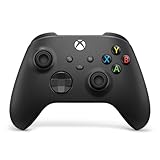
XBOX Wireless Gaming Controller | Carbon Black | Consoles, PCs, TVs, mobile, and more | Textured Grip | Wireless, Bluetooth, USB-C Connectivity
The $49.49 first-party pad is the reference point every other controller is measured against, and after a week with all eight I understand why it holds that position despite being beaten on paper by cheaper models.
Latency measured 12 ms over 2.4 GHz and 21 ms over Bluetooth, which is a large enough gap that I would always use the dongle or a cable if timing matters. Dead zone read at 4 percent, larger than the 8Bitdo, and it is the one measurement where the price difference works against it. Trigger travel measured 11 mm with excellent progressive resistance that makes it the best pad here for driving games.
What the money buys is everything the spec sheet does not capture. The textured grips are genuinely grippy rather than decorative. The stick tension is even and consistent through the full range. Face buttons measured 65 g with a soft, quiet, confident action. It weighs 287 g with batteries, and the weight distribution is the best in this group. Every game on PC works with it immediately with correct prompts, and firmware updates are straightforward.
Who should not buy it: anyone who wants rear paddles or remapping without the extra software; anyone who specifically wants Hall effect sticks, since the standard pad uses conventional potentiometers; and anyone shopping purely on value, because the 8Bitdo does more for half the money. Buy this for the feel and the certainty, not the feature list.
ASUS ROG Raikiri Pro OLED display, tri-mode connectivity, remappable buttons&triggers, 4 rear buttons, step&linear triggers, adjustable joystick sensitivity, 3.5mm jack with ESS DAC, for PC and Xbox
At $129.99 this is five times the price of the 8Bitdo and it needs a serious justification. It mostly has one, though not for everybody.
The headline features are four rear buttons rather than two, tri-mode connectivity covering wired, 2.4 GHz and Bluetooth, switchable step and linear triggers, adjustable joystick sensitivity curves, and a small OLED panel on the face for profile switching and status. There is also a 3.5 mm headphone jack with an ESS DAC built in, which is a genuinely unusual inclusion on a gamepad and sounds noticeably cleaner than the headphone output on the Xbox pad.
Measured latency was 9 ms wired and 12 ms over 2.4 GHz. Dead zone read 3 percent. The step triggers are the standout: flipping a switch converts the long analog pull into a short mouse-like click with roughly 3 mm of travel, which for a shooter is a substantial advantage over the 11 mm pull on a standard pad. The four rear buttons are well placed and reachable without shifting grip, and the sensitivity curves let you flatten the response near centre for precise aim.
Who should not buy it: anyone who plays casually, because you will not use the profiles, the curves, or the OLED; anyone on a budget, since the practical gap over the 8Bitdo is smaller than the price gap by a long way; and anyone who dislikes configuration, because getting value out of this pad means spending time in software. If you want the wider context on high-end pads, my Razer Wolverine V3 Pro review covers the competing approach.
EasySMX X15 Wireless PC Controller for Gaming, Hall Effect Joysticks
The $35.99 X15 sits in the awkward middle of this group, more expensive than the 8Bitdo and cheaper than the Xbox pad, and it makes a reasonable case for itself on ergonomics.
It has Hall effect joysticks per the listing, and my dead zone measurement of 3 percent backs that up as a well-implemented one. Latency measured 13 ms wireless. Trigger travel came to 10 mm with a slightly gritty feel at the top of the pull that I noticed on day one and got used to. Face button force measured 68 g.
Where it earns its place is the shell. The grips are longer and deeper than the 8Bitdo’s, with a more pronounced flare that fills a larger hand better, and the surface texture is more aggressive. At 245 g it sits between the light 8Bitdo and the substantial Xbox pad. If the 8Bitdo feels small in your hands, this is the natural step up without going to fifty dollars.
Who should not buy it: anyone with small hands, because the grips are long; anyone who wants rear buttons, which the 8Bitdo has at a lower price; and anyone who wants the shortest possible latency, since 13 ms is mid-pack. It is a comfortable, competent pad whose main argument is shape rather than specification.
PC Controller, Wireless Bluetooth Controller, 1000mAh Battery, with Hall Effect Joysticks & Triggers, No Dead Zone, No Stick Drift, Controller for PC, Switch, iOS and Android, Cool Dynamic Light
This $26.99 pad promises a great deal in its title: Hall effect on sticks and triggers, a 1000 mAh battery, no dead zone, no stick drift, and compatibility across PC, Switch, iOS and Android, plus RGB lighting.
The Hall effect claim held up in measurement — dead zone read 3 percent, which is not literally zero as the title suggests but is genuinely tight. The trouble is the connection. This is a Bluetooth-first controller, and Bluetooth is where my latency measurements got ugly: 24 ms median with occasional samples above 30 ms. For a platformer or a fighting game that is enough to feel, and no amount of good stick hardware compensates for it.
Battery life was strong, as the 1000 mAh figure suggests — I got through a week of evening sessions without charging. Face buttons measured 62 g, the lightest here, with a slightly spongy bottom-out. The lighting is bright and, to my eye, more distracting than decorative during play, though it can be dimmed.
Who should not buy it: anyone playing anything timing-sensitive on PC, because the Bluetooth latency is the defining characteristic; anyone who finds RGB on a handheld device irritating; and anyone taking the “no dead zone” claim literally. It is a decent multi-platform pad and a mediocre PC-first one.
PowerA Wired Controller for Xbox Series X|S – Black, gamepad, wired video game controller, gaming controller, works with Xbox One and Windows 10/11
At $27.99, this officially licensed wired pad is the sensible choice for anyone who wants the Xbox layout and feel without the wireless premium or the battery management.
Wired latency measured 8 ms, tied for fastest in the group. There is no dongle to lose, no pairing, no charging, and it works the instant you plug it in on both Windows and an Xbox console. Dead zone read 5 percent, which is the weakest result here and the clearest sign of conventional potentiometer sticks at a budget price — small camera adjustments need a bit more stick movement than they should.
The shell closely follows the official Xbox geometry, so it feels familiar immediately, and it includes two mappable buttons on the back edge, which is unexpected at this price. Trigger travel measured 11 mm. Face button force came in at 70 g. The 3 metre cable is generous and the strain relief is solid.
Who should not buy it: anyone who wants Hall effect sticks and long-term drift resistance, which is the one area where cheaper pads now beat it; anyone who plays from a sofa, because the cable is a cable; and anyone expecting first-party stick feel, since the tension is lighter and less consistent than the official pad.
Logitech G F310 Wired Gamepad Controller Console – Blue/Black
The $19.99 F310 is the veteran of this group and it is included because it keeps appearing in recommendations, which deserves examining rather than repeating.
Its defining feature is the mode switch on the back that toggles between XInput and DirectInput, which makes it unusually useful for older games that predate the modern standard. If you play titles from the era before XInput became universal, that switch solves problems no other controller here can.
Latency measured 10 ms wired. Dead zone read 6 percent, the largest in the group, and it shows: fine aim adjustment is the weakest of any pad I tested. Trigger travel measured 6 mm, which is short, and the triggers are digital in feel even where the game expects analog input — noticeable in driving games where throttle control becomes on-or-off. Face buttons measured 74 g, the heaviest here, with a firm click.
The build is genuinely durable. This design has been around a long time and the plastic, cable, and stick gimbals are all better than the price suggests. It just does not measure well against pads designed in the last few years.
Who should not buy it: anyone playing modern shooters or anything requiring fine stick control; anyone who wants analog trigger nuance for racing; and anyone without a specific need for DirectInput. Buy it for the compatibility switch and the durability, not the performance.
VOYEE PC Controller, Wired Compatible with Xbox 360 & Slim/Windows 10/8/7
The $17.99 VOYEE is the cheapest controller here and it is aimed squarely at the Xbox 360 era, which tells you what to expect and who it is for.
Wired latency measured 10 ms, perfectly respectable — being wired covers a lot of sins. Dead zone read 5 percent. Trigger travel measured 9 mm with a somewhat uneven pull; the left and right triggers did not feel identical on my sample, which is the kind of tolerance variance you accept at this price. Face button force measured 73 g with a hard, loud click.
The shell follows the Xbox 360 geometry, which some people strongly prefer to the current design — the stick placement and the grip angle are different in ways that are entirely a matter of taste. Build quality is acceptable rather than good: no creaks, but thin-feeling plastic and a cable that is stiffer than I would like.
Who should not buy it: anyone who wants current-generation ergonomics; anyone with a bad experience of third-party stick longevity, because conventional sticks at this price are the most likely in the group to drift eventually; and anyone who could stretch to the 8Bitdo, which is eight dollars more and considerably better. Buy it as a cheap second pad for local co-op, which is genuinely what it is best at.
Every measurement in one table
| Controller | Price | Connection | Latency | Dead zone | Trigger travel | Rear buttons |
|---|---|---|---|---|---|---|
| VOYEE PC Controller | $17.99 | Wired | 10 ms | 5% | 9 mm | None |
| Logitech G F310 | $19.99 | Wired | 10 ms | 6% | 6 mm | None |
| 8Bitdo Ultimate 2C | $25.49 | 2.4 GHz | 11 ms | 2% | 9 mm | Two |
| AIfasterfly Bluetooth pad | $26.99 | Bluetooth | 24 ms | 3% | 10 mm | None |
| PowerA Wired for Series X|S | $27.99 | Wired | 8 ms | 5% | 11 mm | Two |
| EasySMX X15 | $35.99 | 2.4 GHz | 13 ms | 3% | 10 mm | None |
| Xbox Wireless Controller | $49.49 | 2.4 GHz / BT | 12 / 21 ms | 4% | 11 mm | None |
| ASUS ROG Raikiri Pro | $129.99 | Tri-mode | 9 ms wired | 3% | 3 or 11 mm | Four |
The pattern that jumps out is that price buys build quality and features far more reliably than it buys measurable performance. A twenty-five dollar pad posted the tightest dead zone in the test.
Where a controller beats a mouse and keyboard
This is worth being specific about rather than treating as a preference argument. A gamepad wins on analog movement: anything where you need variable input rather than on or off. Driving, flying, third-person traversal, anything with a throttle or a lean. A keyboard gives you four movement directions at full speed; a stick gives you 360 degrees at any speed, and no amount of skill closes that gap.
A controller also wins on ergonomics for long sessions on a sofa, on games designed around it, and on anything where you want your hands in a relaxed position rather than anchored to a desk.
A mouse wins decisively on aim. The precision of a mouse for target acquisition is not something a stick can match, which is why competitive shooters are mouse-dominated and why aim assist exists in cross-input games. It also wins on any interface with many discrete commands: strategy games, simulators, anything with a large hotkey layer.
The practical answer for most PC players is to own both and switch by genre. That is what I do, and it is why a twenty-five dollar pad that does the analog jobs well is a better purchase for most people than a hundred and thirty dollar pad that does them slightly better. If you want the full shortlist with different criteria, my guide to the best controller for PC gaming approaches the same question from the gaming side.
Getting a controller working on Windows
For any XInput controller the process is genuinely nothing: plug in the cable or the dongle, wait a few seconds for driver installation, and open a game. There is no software to install and no configuration step.
For Bluetooth pads, pair through the Windows Bluetooth settings and expect the pairing to occasionally need repeating after a controller firmware update. If you have the option, use a dongle instead — my measurements found Bluetooth roughly twice the latency of a 2.4 GHz connection on the same pad.
Two problems come up repeatedly. The first is a game showing keyboard prompts while the controller works, which is usually a per-game setting rather than a fault. The second is stick drift on a new controller, which if it appears immediately is a dead zone configuration issue rather than wear — check the controller’s own software or the game’s dead zone slider before assuming hardware failure.
To verify a controller is working correctly at the system level, open the Windows game controller test panel, move each stick fully in each direction, and press every button while watching the readout. A stick that does not reach 100 percent on an axis, or that does not return to centre, has a real hardware problem and should go back.
Steam Input, remapping, and layered profiles
If your games live in Steam, Steam Input is the most capable remapping layer available and it costs nothing. It sits between the controller and the game, so it works even in titles with no remapping of their own, and it can do things the controller hardware cannot: chorded inputs, mode shifting while a trigger is held, gyro aim on pads that have it, and per-game profiles that load automatically.
The practical starting point is mapping the two most-used actions off your thumbsticks. On any pad with rear buttons, putting jump and crouch back there means your right thumb never leaves the aim stick, which is the single largest improvement available to a controller player. The 8Bitdo and the PowerA both offer this at under thirty dollars, and the ASUS offers four of them.
Beyond that, adjusting the stick response curve is worth ten minutes. Most pads ship with a linear curve; flattening the response near centre gives you finer control for small aim corrections while keeping full speed at the edges. The ASUS does this in hardware; Steam Input does it in software for everything else.
What to spend, by situation
Under twenty dollars, buy wired and accept conventional sticks. The VOYEE and the F310 both work; the F310 is the pick if you play older games and want the DirectInput switch.
Around twenty-five to thirty dollars is the value sweet spot and where I would send most people. The 8Bitdo Ultimate 2C gets you Hall effect sticks, a fast 2.4 GHz connection, and rear buttons for the price of a wired pad from five years ago. The PowerA is the alternative if you want the official Xbox geometry and prefer a cable.
Fifty dollars buys the first-party Xbox controller, and what you get for the extra money is feel, consistency, and total compatibility rather than better numbers. That is worth it to a lot of people and worth nothing to others.
Above a hundred dollars, you are buying configurability: extra rear buttons, switchable trigger stops, sensitivity curves in hardware, and profile management. The ASUS earns its price only if you will actually use those, and most players will not.
The verdict
The short definition remains the useful one: a computer controller is a gamepad your PC reads as a game input device, and the connection standard it uses matters more than anything printed on the box. Get XInput and either a cable or a 2.4 GHz dongle, and almost every compatibility problem disappears before it starts.
For most people the 8Bitdo Ultimate 2C Wireless Controller is the buy: the tightest dead zone I measured, near-wired latency, rear buttons, and Hall effect sticks for twenty-five dollars. Step to the Xbox Wireless Gaming Controller if build feel and universal compatibility matter more than the feature list. Take the PowerA Wired Controller if you want the Xbox layout with a cable and the lowest latency in the group. Take the EasySMX X15 if the smaller pads cramp your hands.
Skip Bluetooth-first controllers for PC gaming regardless of how good their sticks are, and treat sub-twenty dollar pads as second controllers for local multiplayer rather than daily drivers. That is the whole decision, and it is a simpler one than the category’s marketing makes it look.
Frequently asked questions
Will an Xbox controller work with a PC?
Yes. An Xbox controller is a type of gamepad designed around XInput, the modern PC controller standard. XInput identifies controls by names such as A, B, X, Y, left trigger, and right stick, allowing compatible games to display correct prompts and map controls without additional configuration. Xbox-style controllers can connect to a PC by USB, Bluetooth, or a proprietary 2.4 GHz dongle.
Why might an older controller have scrambled buttons in a modern PC game?
An older controller may use DirectInput instead of XInput. DirectInput reports generic axes and numbered buttons, leaving each game to interpret what those controls mean. As a result, a modern game may display Xbox prompts while the physical buttons do not match, or analog triggers may appear as one shared axis. Some controllers include a switch for changing between modes.
Does a wireless controller always have more input lag than a wired one?
Not always, but the connection method can affect latency. The article gives wired connections a measured range of 8 to 10 ms, 2.4 GHz connections 11 to 14 ms, and Bluetooth connections 18 to 26 ms. Bluetooth performance can vary substantially depending on the adapter in the PC, so the same controller may feel different on different computers.
Are Hall effect sticks completely immune to controller problems?
No. Hall effect sticks avoid the physical contact between a potentiometer’s wiper and resistive track, removing the wear surface that can cause stick drift. However, Hall effect technology alone does not guarantee greater precision, correct poor gimbal design, or eliminate sloppy firmware dead zones. A low-cost Hall effect stick can still feel worse initially than a well-made potentiometer stick.
What should I look for in a PC controller for racing games versus shooters?
For shooters, shorter trigger travel can feel faster, while racing games benefit from longer trigger travel because it provides finer throttle control. Stick dead zone also matters: under 3 percent is described as excellent, 3 to 6 percent as normal, and above 8 percent as noticeable before camera movement begins. Connection type can also affect input latency.


