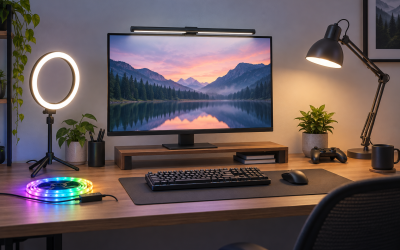
Your monitor light bar was supposed to be a clean, even strip of illumination behind your display — a bias-lighting upgrade that reduces eye strain and makes long gaming sessions easier on your eyes. Instead, it’s strobing, pulsing, or flashing at random intervals, and every flicker pulls your attention away from the game. The symptom usually shows up in one of three ways: a rapid, high-frequency shimmer you catch in your peripheral vision; a slow pulse that brightens and dims every few seconds; or full dropouts where sections of the LED strip cut out entirely, sometimes in sync with mouse movement or in-game action.
Here’s the good news: a flickering light bar is almost never a sign that your monitor is dying. It’s a separate accessory (or a built-in ambient-light feature) with its own power and control pathway, and most fixes take under fifteen minutes. That said, don’t ignore it indefinitely — a failing power adapter or a shorting USB cable can degrade further, and constant flicker genuinely contributes to headaches and eye fatigue. Work through this guide from the easiest fix down, and in most cases you’ll be done before your next match starts.
Likely Causes
| Cause | How to confirm | Fix difficulty |
|---|---|---|
| USB power draw exceeded | Flicker worsens when other devices share the same USB hub or monitor USB port; bar runs dimmer than usual | Easy |
| Software conflict (RGB suites) | Flicker syncs with in-game lighting effects or stops when you close iCUE, Synapse, or G HUB | Easy |
| Sync frequency mismatch | Flicker appears as rolling bands visible on camera, worse at certain refresh rates | Easy |
| Loose or damaged connections | Flicker changes when you wiggle the cable or the mounting clip; visible pin damage | Moderate |
| Camera/sensor interference | Flicker only appears in the light bar’s own sensor readings or a specific app’s controls | Moderate |
| Failing LED strip or driver | Individual LED segments stay dark, flicker persists across different ports and PCs | Hard (likely replacement) |
Fix 1: Swap USB Ports
What causes it
Light bars draw power from USB, and most need a full USB 2.0 spec of 500 mA — some RGB models want 900 mA or more from a USB 3.0 port. Front-panel case ports, unpowered hubs, and monitor passthrough ports often deliver less, causing brownouts that show up as flicker.
How to check
Note where the bar is currently plugged in. If it’s on a keyboard passthrough port, a monitor’s USB hub, or a front-panel connector, that’s your prime suspect. Flicker that intensifies when you plug in a second device on the same hub confirms a power problem.
What to do
Unplug the light bar and connect it directly to a rear-panel USB port on your motherboard — ideally a USB 3.0 or 3.2 port (the blue or blue-tinted one). Avoid hubs entirely, powered or not, during our research.
How to undo it
There’s nothing to undo — just move it back if you need the front port for something else, but only if the flicker doesn’t return.
Fix 2: Close Conflicting RGB Software
What causes it
Multiple lighting controllers fighting over the same device can cause rapid mode-switching that looks like flicker. Software like Corsair iCUE, Razer Synapse, Logitech G HUB, SignalRGB, and OpenRGB each try to claim control of RGB devices, and some light bars get detected by more than one suite.
How to check
Press Ctrl + Shift + Esc to open Task Manager, go to the Processes tab, and look for iCUE, Synapse, G HUB, SignalRGB, or Aurora. End each one (right-click > End task) and watch the light bar for a minute.
What to do
If flicker stops, relaunch only the one suite you actually want controlling the bar. In that suite, disable integration or plugin features that grab third-party devices — for example, in iCUE go to Settings and uncheck third-party integrations you don’t use. Then stop the other suites from launching at boot: in each app’s settings, disable “Start with Windows” or remove them from Task Manager’s Startup apps tab.
How to undo it
Re-enable startup launches and integrations in the same settings panels if the software wasn’t the culprit.
Fix 3: Change the Refresh Rate or Ambient Sync Setting
What causes it
Some light bars use a screen-facing sensor to sample your display’s colors and mirror them. When the sensor’s sampling rate beats against your monitor’s refresh rate — common at 144 Hz and above — you get rhythmic pulsing.
How to check
Right-click the desktop > Display settings > Advanced display settings, and note your current refresh rate. Temporarily drop it to 60 Hz. If the flicker calms down, you’ve found a sync mismatch. Alternatively, record the bar with your phone’s camera: rolling bright/dark bands moving across the strip indicate a frequency beat.
What to do
In the light bar’s own app (or its physical control button), turn off screen-sync or “ambient” mode and run it in a static color or fixed brightness mode. If you want to keep sync enabled, try refresh rates in 10–15 Hz steps (e.g., 120 Hz instead of 144 Hz) until the pulsing stops. Also lower the sync sampling speed in the bar’s software if it has a “speed” or “response” slider — setting it to medium instead of maximum often eliminates the beat.
How to undo it
Set your refresh rate back in Advanced display settings and re-enable ambient mode in the bar’s app.
Fix 4: Reseat and Inspect All Cables and Connectors
What causes it
Light bars typically connect via a short proprietary cable or a USB extension running to a controller puck or clip. Vibration, cable tension, or a bent pin can create intermittent contact that reads as flicker.
How to check
With the system on, gently wiggle the cable at each connection point — the bar end, any inline controller, and the USB plug. If flicker stutters or changes with pressure, you’ve found the fault. Unplug and inspect the connector for bent, corroded, or pushed-in pins, and check the cable jacket for kinks or pet-chew damage.
What to do
Unplug everything and reconnect firmly, making sure USB plugs are fully seated (they often sit 1–2 mm short). Route the cable with slack — no tension pulling on the connectors — and secure it with a velcro tie, not a zip tie, to avoid pinching. Clean the USB contacts with a dry cotton swab or a blast of compressed air if you see dust. If the cable is visibly damaged, contact the manufacturer for a replacement part rather than splicing it.
How to undo it
Nothing to undo; rerouting cable paths is harmless. Just keep the slack in place.
Fix 5: Update or Reinstall the Light Bar’s Firmware and Drivers
What causes it
Buggy firmware in RGB controllers can cause PWM (pulse-width modulation) dimming to glitch, especially after a software update changes how the app talks to the device.
How to check
Open the bar’s companion app and look for a firmware version under Settings or Device info. Compare it against the latest version listed on the manufacturer’s support page for your exact model. If the app has a built-in updater, run it.
What to do
In the app, apply any pending firmware update with the bar plugged directly into the PC — never through a hub — and leave the PC awake for the entire update (disabling sleep in Settings > System > Power & battery first is a good precaution). If no update exists or the problem started after one, do a clean reinstall: uninstall the companion app via Settings > Apps > Installed apps, unplug the bar, reboot, reinstall the latest app from the manufacturer’s site, then plug the bar back in.
How to undo it
Firmware downgrades usually aren’t possible; if a new firmware causes the issue, contact the manufacturer’s support with your model and firmware version. You can always reinstall an older app version manually if the app itself is the problem.
Fix 6: Adjust Brightness and PWM Settings
What causes it
Many light bars dim using PWM — switching LEDs on and off thousands of times per second. At the lowest brightness settings, some cheap controllers drop the PWM frequency into visibly flickering territory, and marginal power delivery makes it worse.
How to check
Slowly cycle the brightness up from minimum using the bar’s button or app slider. If flicker disappears above roughly 30–50% brightness, PWM at low duty cycle is the cause. Viewing the bar through your phone camera at each level can make the flicker obvious even if it’s subtle to your eye.
What to do
Run the bar at a brightness level above the flicker threshold — in practice, anything from 40% up. If the app exposes a “PWM frequency” or “flicker-free” option, set it to its highest value. If you need lower ambient light, add a diffuser: a strip of matte white tape or a paper diffuser over the LEDs lets you keep brightness high while cutting perceived output.
How to undo it
Return the brightness slider and any PWM setting to their previous values in the app.
Fix 7: Test on Another Computer
What causes it
Before blaming hardware, rule out your PC — a flaky USB controller, aggressive USB power management, or a corrupted driver can all starve the device intermittently.
How to check
Plug the light bar into a different computer, laptop, or even a USB wall charger if the bar supports data-free operation. Run it for ten minutes. If it’s rock solid elsewhere, your PC is the variable.
What to do
Back on your PC, stop Windows from suspending the USB device: open Device Manager (Win + X > Device Manager), expand Universal Serial Bus controllers, and for each “USB Root Hub” and “Generic USB Hub,” open Properties > Power Management and uncheck “Allow the computer to turn off this device to save power.” Then reinstall the USB controllers: right-click each entry under the controllers list > Uninstall device, and reboot — Windows will rebuild them automatically.
How to undo it
Re-check the Power Management boxes if you want Windows power saving back; it’s a trade-off, not a risk.
Fix 8: Reset the Light Bar to Factory Settings
What causes it
A corrupted configuration profile — often after an app crash or a botched profile import — can put the controller into a broken lighting mode that loops or strobes.
How to check
If the flicker started right after changing a lighting profile, syncing effect, or firmware update, a corrupted config is likely. Flicker that survives a full PC reboot into a different user account points the same direction.
What to do
Most light bars reset one of two ways: hold the physical control button on the unit for 10–15 seconds until the strip flashes twice, or use the app’s “Restore defaults” / “Reset device” option, usually found under Settings or the device’s gear icon. After resetting, reconfigure brightness and mode from scratch rather than importing an old profile.
How to undo it
A factory reset is itself the clean slate — just rebuild your preferred lighting profile manually.
If Nothing Works
If the bar flickers identically on multiple computers, across different ports, with all software closed, and after a factory reset, the LED strip or internal driver has failed. At that point, check your warranty: most light bar makers (BenQ, Logitech, Govee, and similar) carry one to two years of coverage, and a flickering unit in 2026 is almost always replaced rather than repaired. Keep your proof of purchase and a short video of the flicker — support teams process video evidence far faster than written descriptions. If the bar is out of warranty, replacing it is usually cheaper than any board-level repair, and while you wait, running your monitor with no bias light is perfectly fine; the flicker was likely straining your eyes more than the absence of the light ever would.
FAQ
Can a monitor light bar flicker damage my monitor?
No. The light bar is an independent accessory — it shares nothing electrically with your monitor’s panel. Flickering affects only the bar itself, and the worst consequence for you is eye strain, not display damage.
Why does my light bar flicker only when I open games?
Games frequently trigger RGB integration effects, and fullscreen exclusive mode can change how USB devices are polled. Close or disable RGB suite integrations (see Fix 2) and test in borderless windowed mode; if flicker stops, the game’s lighting hooks were the trigger.
Is flicker visible on camera normal?
Some of it, yes. Nearly all LED lighting shows banding or rolling lines through phone cameras because camera shutters and PWM frequencies don’t align. Judge flicker with your own eyes; only treat camera-visible artifacts as a problem if you can also see them directly.
Should I use a powered USB hub for my light bar?
You can, and a quality powered hub is a fine long-term home for RGB devices — but only after confirming the bar isn’t flickering for a software reason. If flicker persists on a powered hub plugged into a different PC, no amount of power will fix it, and you should move on to the hardware checks above.