
The Short Answer
Yes — a desk mat is worth it for a hardwood desk if you write, use a mouse heavily, or eat and drink at your workspace. It protects the finish from scratches, spills, and the slow dulling that comes from daily friction. The one condition: if your desk sits in a low-traffic corner and you mostly type on a keyboard tray or laptop stand, the surface rarely takes enough abuse to justify the cost, and a basic $15 mat won’t change your experience much.
What You Actually Get
A quality desk mat for a hardwood desk is typically a rectangular pad measuring around 31.5 x 15.7 inches (80 x 40 cm) for standard setups, or up to 36 x 17 inches (90 x 43 cm) for extended versions that fit a full-size keyboard, mouse, and notebook side by side. Thickness runs from 2 mm for slim PU leather mats to 4–5 mm for felt or multi-layer designs. Weight ranges from roughly 10 ounces for thin synthetic mats to 1.5–2 pounds for cork or leather-backed versions, which matters more than you’d think — heavier mats stay put when you sweep your mouse across them.
As an Amazon Associate we earn from qualifying purchases at no extra cost to you. Product prices and availability are accurate as of the date shown and are subject to change.

The materials that matter for hardwood tops: PU leather (easy to wipe, can develop a slight sheen over time), cork (natural look, gentle on finish, less spill-resistant), felt (soft but absorbs liquids), and rubber-backed fabric (best grip, occasionally leaves a faint residue on fresh lacquer if left for years without lifting). Prices cluster in three bands: $10–18 for basic synthetic mats, $20–35 for mid-range leather or cork options, and $40–60-plus for full-grain leather or custom-sized pieces.
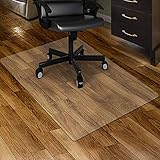
Note that a desk mat is different from a chair mat, even though product listings blur the lines. Chair mats — like the Kuyal Clear Chair Mat for Hardwood Floor at 36 x 48 inches ($29.66) or the SHAREWIN Heavy Duty Office Chair Mat at 36″ x 47″ ($27.99) — protect your floor from casters, not your desk from your elbows. If your actual problem is chair wheels denting hardwood flooring, those are the products to look at, not a desk mat.
Pros
- Finish protection. Scratches from bracelets, watch clasps, pen tips, and mouse feet are the main killers of hardwood desk tops. A mat absorbs all of that friction.
- Spill containment. Coffee rings and water bottle condensation ruin polyurethane finishes. A PU leather or rubber-backed mat wipes clean in seconds.
- Better mouse tracking. A consistent low-friction surface improves glide and accuracy compared to bare wood, especially on open-grain species like oak.
- Comfort. A 3–5 mm pad cushions forearms during long writing or mousing sessions.
- Aesthetics. A well-chosen mat in leather, cork, or felt adds contrast and makes a workspace look deliberate rather than improvised.
- Sound dampening. Typing and setting objects down is noticeably quieter on a mat than on bare hardwood.
Cons
- It hides the wood. The entire point of a hardwood desk is often how it looks. Cover 60–70% of the surface and you lose most of that.
- Uneven color over time. Sunlight darkens or lightens exposed wood. Lift the mat after a year and you may find a visible outline.
- Residue risk. Cheap rubber backings left on freshly finished wood for years can leave a faint sticky patch. Air new mats out for a day and occasionally rotate or lift them.
- Curling edges. Thin mats (under 2 mm) that ship rolled can take weeks to lie flat, or never fully do.
- Cost creep. Once you buy a mat, a matching mouse pad, coaster set, and cable organizer tend to follow.
Who Should Buy It
Buy a desk mat if you write by hand regularly, drag a mouse hundreds of times a day, eat lunch at your desk, or own a hardwood desk whose finish you want to keep original for resale value. It’s also a clear yes if your desk sits near a window — UV exposure plus friction is a bad combination for any clear coat. A $20–30 mid-range mat is cheap insurance on a $400–1,500 piece of furniture.
Who Should Skip It
Skip it if your desk is more display piece than daily driver, or if you use an external keyboard tray and rarely touch the desktop itself. Also skip it if you’re hoping to fix an already-damaged finish — a mat covers scratches but doesn’t repair them, and you may not like the two-tone look of damaged wood peeking out around the edges. In that case, sand and refinish first, then decide.
Cheaper Alternatives
| Option | Cost | Trade-off |
|---|---|---|
| Felt furniture pads under keyboard and mouse zones | $5–8 for a multi-pack | Protects only contact points; no spill protection and pieces slide around |
| Standard mouse pad only | $6–12 | Covers maybe 10 x 8 inches of the surface; nothing else is protected |
| Coasters plus a desk blotter (paper or faux leather) | $10–15 | Handles spills but wears out in 6–12 months and looks disposable |
| Microfiber kitchen mat cut to size | $8–14 | Absorbs spills but stains permanently and traps crumbs at the edges |
| Nothing, plus annual polish | $10–20/yearFine for light use; does nothing against a single dropped pen or hot mug |
FAQ
Will a desk mat damage the finish on my hardwood desk?
Rarely, but it can happen with low-quality rubber backings on fresh lacquer, especially in warm rooms. Choose mats with fabric, cork, or suede backings, let any new mat off-gas for 24 hours, and lift it once a month to let the wood breathe and to check for discoloration.
What size desk mat do I need?
Measure your keyboard plus mouse footprint and add 3–4 inches on each side. A 31.5 x 15.7 inch mat suits most 48–60 inch desks; go 36 x 17 inches if you keep a notebook or tablet on the surface too. Leave at least 4–6 inches of visible wood around the mat so the desk still reads as hardwood.
Desk mat or mouse pad — can’t I just use a mouse pad?
If mousing is your only concern, yes. A mouse pad costs $6–12 and does that job fine. The desk mat earns its price when you want whole-surface protection, a unified look, and forearm cushioning in one piece.
Is a chair mat the same thing?
No. Chair mats protect flooring from chair casters and are much larger — the Kuyal 36 x 48 inch and SHAREWIN 36 x 47 inch models mentioned above are floor protectors in the $28–30 range. Putting one on your desktop would be awkward, heavy, and pointless. Match the product to the surface you’re protecting.
As desk accessories keep trending toward natural materials through 2026, the mid-range cork and PU leather mats have gotten noticeably better without getting pricier — which makes the “yes” answer a little easier to give than it was a few years ago.
