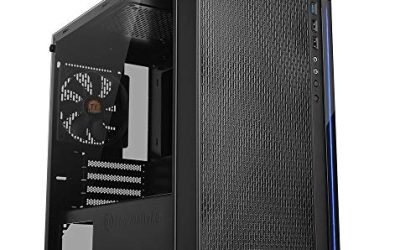
A PC case decides how hot the parts inside run, and that decision shows up in frame rates, fan noise, and how long components last. A case with a solid front panel and one small exhaust fan forces the graphics card to breathe its own warm air, while a case with a mesh front, several fan mounts, and room for a large radiator gives heat somewhere to go. The choice is not about the prettiest box on the shelf; it is about matching the front panel, the fan layout, and the cooler clearance to the parts already planned.


This guide covers builders who cool with air, builders who cool with liquid, and builders who have not decided yet, so every case here handles both: strong intake airflow for tower coolers and enough radiator mounts for a 240mm or 360mm all-in-one. Each case was picked from its Amazon listing for stated fan support, radiator sizes, and clearances.
Quick Picks
As an Amazon Associate we earn from qualifying purchases
| Product | Best for | Key spec from title |
|---|---|---|
| Corsair 4000D Airflow | A first airflow build in a mid-tower | High-airflow front panel, two 120mm fans |
| Lian Li Lancool 216 | Strong cooling with no extra fans to buy | Two 160mm front fans, 360mm radiator support |
| Fractal Design Meshify 2 | A large radiator and a flexible interior | Up to 420mm radiator at the top |
| Phanteks XT Pro Ultra | Four large fans included from the start | Four 140mm D-RGB fans included |
| Lian Li O11 Dynamic EVO | A showcase build with several radiators | Supports up to 3x 360 radiators |
How to Choose
Read the Front Panel Before Anything Else
The front panel sets the ceiling for every other cooling choice. A fine mesh panel lets intake fans pull cool air straight onto the graphics card, while a solid glass or metal front forces air through narrow side vents and leaves the same fans working harder for less result. Look at the listing photos and the description: a case that names its front panel as mesh or high-airflow is telling the buyer where its cooling comes from. Also check the top panel, because a mesh top gives warm air an exit, and a filtered top keeps dust out when the case sits under a desk. If the front and top both breathe, the rest of the cooling plan gets easier.
Count the Included Fans and Their Size
Included fans decide whether the case cools well on day one or needs extra spending before the first boot. Two 120mm fans cover a basic intake and exhaust, but three or four fans, especially 140mm or 160mm models, move more air at lower speeds and keep the build quieter under load. Check the listing for the fan positions as well as the count: front intake matters most for the graphics card, rear exhaust clears heat from the processor area, and top mounts help when a radiator or tall air cooler sits near the roof. A case that ships with large fans already installed saves the buyer from guessing which sizes fit each mount.
Check Air-Cooler Height and Graphics Card Length
A tall tower cooler and a long graphics card both need room the listing must confirm. The maximum CPU cooler height tells the buyer whether a large dual-tower cooler fits without pressing against the side panel, and the maximum graphics card length shows whether a triple-fan card clears the front fans or a front radiator. Measure the cooler and the card before ordering, then compare both numbers with the listing, because a case can be wide enough for one and too short for the other. Also look at the power supply shroud and drive cages: fixed cages near the front can shorten the usable card length even when the headline number looks generous.
Leave Room for a Radiator, Even on an Air-Cooled Build
Many builders start with air cooling and add a liquid cooler later, so radiator support protects the case from becoming the next upgrade. A front mount for a 360mm radiator and a top mount for a 280mm or 360mm radiator cover the common all-in-one sizes, while a rear 120mm mount suits a small cooler in a compact build. Check each position separately, because a case can fit 360mm at the front and only 280mm at the top, and a thick radiator with fans can collide with tall memory. Dust filters on the intake positions matter too: they keep the radiator fins and fan blades clean, which keeps temperatures steady over months of use.
The 5 Best Options
Corsair 4000D Airflow
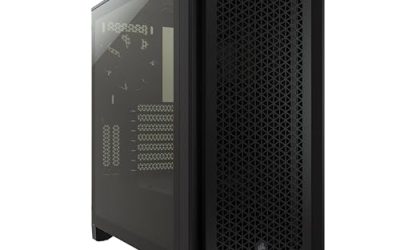
The 4000D Airflow fits builders who want a mid-tower that cools well without a complicated layout. Its high-airflow front panel feeds the two included 120mm AirGuide fans, which use shaped vanes to push intake air toward the processor and graphics card instead of scattering it inside the case. Six 120mm fan positions, or four 140mm positions, leave room to add fans later, and radiator mounts up to 360mm at the front and 280mm at the top cover the common all-in-one sizes. The RapidRoute cable channel keeps cables behind the motherboard tray, so airflow through the chamber stays clear. A tempered glass side panel shows the build without blocking the intake.
Specs
- High-airflow front panel with two included 120mm AirGuide fans
- Fits up to 6x 120mm or 4x 140mm cooling fans
- Radiator support: up to 360mm front, 280mm top
- Motherboard support: E-ATX, ATX, Micro-ATX, Mini-ITX
- Graphics card clearance up to 360mm
- CPU cooler clearance up to 170mm
- Tempered glass side panel
- Dimensions: 453mm x 230mm x 466mm
Best for: A first mid-tower build that needs strong airflow and room for a 360mm all-in-one cooler later.
Watch out for: Only two fans are included, so a build with a hot graphics card may need extra fans to fill the remaining mounts.
Lian Li Lancool 216
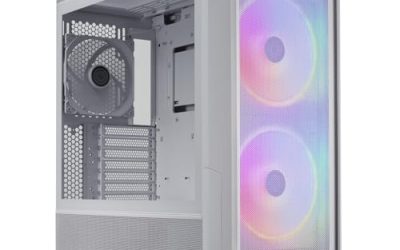
The Lancool 216 suits builders who want strong cooling the moment the case arrives, because it ships with two 160mm front fans and a 140mm rear fan installed. Large fans move more air at lower speeds, so the case can keep temperatures down without the whine of small fans spinning fast. Both the front and the top accept a 360mm radiator, and a removable top bracket makes fitting a radiator simpler than reaching inside the case. The fine mesh panels at the front, top, and power supply cover let intake air through while filtering dust, and the modular motherboard tray can shift to suit an air-cooled or liquid-cooled layout.
Specs
- Includes two 160mm PWM front fans and one 140mm PWM rear fan
- Radiator support: front 360mm, top 360mm, bottom 240mm
- Fits up to 10 fans
- Motherboard support: E-ATX, ATX, Micro-ATX, Mini-ITX
- Graphics card clearance up to 392mm
- CPU cooler clearance up to 180mm
- Tempered glass side panel
- Dimensions: 480.9mm x 235mm x 491.7mm
Best for: Builders who want large included fans and a 360mm radiator mount without buying extra fans first.
Watch out for: Fitting a front radiator means removing or moving the two 160mm front fans, so plan the fan layout before the build.
Fractal Design Meshify 2
The Meshify 2 fits builders who want the biggest radiator options in a mid-tower. Its top accepts a radiator up to 420mm, while the front accepts up to 360mm, so a 360mm all-in-one cooler fits at either position. Nine fan mounts give the build space for a radiator plus separate intake and exhaust fans, and the included fan hub connects three PWM fans and six 3-pin fans from one point. The dual-layout interior can shift between storage space and open room for a reservoir, and the angular mesh front panel filters intake air without choking it. It is larger than a typical mid-tower, so check desk space before ordering.
Specs
- Radiator support: up to 360mm front, 420mm top, 280mm base
- Total of 9 fan mounts for 120mm or 140mm fans
- Nexus+ 2 fan hub connects 3x PWM fans and 6x 3-pin fans
- Adaptable dual-layout interior fits E-ATX motherboards up to 285mm wide
- Light-tinted tempered glass window
- Motherboard support: E-ATX, ATX, Micro-ATX, Mini-ITX
- Dimensions: 542mm x 240mm x 474mm
Best for: A large top radiator or a custom loop in a case with a flexible interior and many fan mounts.
Watch out for: The case is wider and deeper than a typical mid-tower, so measure the desk or shelf space before ordering.
Phanteks XT Pro Ultra
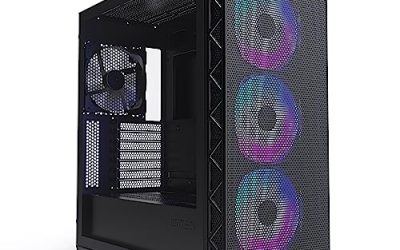
The XT Pro Ultra suits builders who want the fans included. Four 140mm D-RGB fans come in the box, three at the front and one at the rear, which covers intake and exhaust before any extra fan is added. The top accepts a radiator up to 360mm, the front up to 240mm, and the rear a 120mm radiator, giving a liquid-cooled build three separate positions to choose from. Mesh panels at the front and top keep intake air moving, and the interior fits a graphics card up to 415mm long, which covers most triple-fan cards. Support for rear-connector motherboards also helps builders who want cables hidden behind the tray.
Specs
- Includes four M25-140 D-RGB fans
- Radiator support: top up to 360mm, front up to 240mm, rear 120mm
- Fits up to 10x 120mm or 6x 140mm fans
- Motherboard support: E-ATX up to 280mm wide, ATX, Micro-ATX, Mini-ITX
- Graphics card clearance up to 415mm
- CPU cooler clearance up to 184mm
- Tempered glass side panel
- Dimensions: 450mm x 230mm x 500mm
Best for: A top-mounted 360mm all-in-one cooler in a case that already includes four large fans.
Watch out for: The front only accepts a radiator up to 240mm, so a 360mm radiator must go at the top, where tall memory can limit clearance.
Lian Li O11 Dynamic EVO
The O11 Dynamic EVO fits builders who treat cooling hardware as part of the build itself. Its top, side, and bottom each accept a 360mm radiator, so a custom loop can cool the processor and the graphics card with separate radiators instead of sharing one. The dual-chamber layout hides the power supply and cables behind the motherboard tray, leaving the main chamber open for tubes, fittings, and a reservoir. Tempered glass on the front and side shows the loop clearly, and the case fits a graphics card up to 400mm long. No fans are included, so the buyer chooses every fan for the radiators and the remaining mounts.
Specs
- Supports up to 3x 360 radiators
- Maximum of 10 fans
- Motherboard support: E-ATX (width under 280mm), ATX, Micro-ATX, Mini-ITX
- Graphics card clearance up to 400mm
- CPU cooler clearance up to 170mm
- Tempered glass front and side panels
- Material: 4mm aluminum, 4mm tempered glass, 1mm steel structure
- Dimensions: 465mm x 285mm x 459mm
Best for: Builders planning a multi-radiator custom loop or a 360mm all-in-one cooler with room to expand.
Watch out for: No fans are included, so budget for the fans a multi-radiator layout needs before the build is complete.
Which One Fits Your Situation
You Are Building Your First Gaming PC and Want Cool Temps Quickly
Choose the Corsair 4000D Airflow or the Lian Li Lancool 216. The 4000D Airflow gives a simple mid-tower layout with a mesh front and two fans to start from, while the Lancool 216 adds larger fans and a second 360mm radiator position. Either case keeps a first build cool without demanding extra parts on day one.
You Run a Hot Graphics Card and a Tall Air Cooler
Choose the Fractal Design Meshify 2 or the Phanteks XT Pro Ultra. The Meshify 2 offers nine fan mounts and a wide interior for a long card, while the XT Pro Ultra fits a card up to 415mm and already includes four 140mm fans. Both leave room for a tall tower cooler and steady intake air across the card.
You Plan an All-in-One Cooler Now and a Custom Loop Later
Choose the Lian Li O11 Dynamic EVO. Its three 360mm radiator positions and dual-chamber interior suit a loop that grows over time, and a single 360mm all-in-one cooler fits easily at the top, side, or bottom while the rest of the mounts stay free for fans. No other case here leaves that much room to expand.
You Want Strong Cooling Without Loud Small Fans
Choose the Lian Li Lancool 216 or the Phanteks XT Pro Ultra. Both ship with large 140mm or 160mm fans that move more air at lower speeds than small fans, which keeps noise down under load. The Lancool 216 suits a builder who wants the biggest front fans, while the XT Pro Ultra suits a builder who wants four fans covering every position.
Common Mistakes
- Choosing a case for its glass front panel without checking whether intake air can reach the graphics card.
- Buying a 360mm radiator before checking which mounting positions in the case actually support that size.
- Filling the case with fans but leaving no clear path from intake to exhaust, so warm air circles inside.
- Forgetting that a front radiator or thick front fans can shorten the space left for a long graphics card.
- Skipping the dust filter and fan mount check, then finding the case needs extra fans before the first boot.
Frequently Asked Questions
Do mesh front panels really cool better than glass front panels?
Yes, in most builds, because a mesh panel lets intake fans draw cool air directly onto the graphics card and processor. A glass front panel forces air through narrow side vents, which slows intake and leaves fans working harder. Glass looks tidy in a showcase build, but a mesh front is the safer choice when temperatures matter more than the view.
How many case fans does a gaming PC need?
Three fans cover the basics: two at the front for intake and one at the rear for exhaust. Four or more fans help when the graphics card runs hot or a radiator occupies the front mounts, because the remaining positions still need airflow. Check how many fans the case includes first, then add fans only for the empty intake or exhaust positions.
Can I use an air cooler in a case built for water cooling?
Yes. Every case in this guide fits a tall tower cooler as well as a radiator, with CPU cooler clearance from 170mm to 184mm. A case with radiator mounts still works well with air cooling, because the same mesh panels and fan mounts move air across the processor heatsink. Pick the cooler first, then confirm its height against the listing.
Should the radiator go at the front or the top?
Either position works when the rest of the build fits around it. A front radiator usually receives cooler intake air, which can lower liquid temperatures, but it can shorten graphics card clearance. A top radiator keeps the front free for a longer card and lets warm air leave through the roof, but tall memory can limit the space. Choose the position that fits the radiator, card, and memory together.
Related guides
More from Amazon
Programs that pair well with the guide above. Offers and eligibility are set by Amazon and may change.
Free shipping on eligible items, Prime Video and more. Eligible new members can start with a free trial.
Start a Prime free trialAd-free music streaming. Eligible new subscribers can start with a free trial.
Try Music Unlimited freeA Prime membership for ages 18-24 with a trial period. Eligibility is set by Amazon.
See Prime for Young AdultsAudiobooks and podcasts to listen to on the go. Eligible new members can start with a free trial.
Try Audible freeAs an Amazon Associate we earn from qualifying purchases.