The word “wireless” means two different things in the trail camera aisle, and the difference decides whether a camera suits your land. Cellular models send photos to your phone over a mobile network, so you can check a feeder from the couch, but they need a signal at the spot and usually a data plan. Wi-Fi and Bluetooth models, on the other hand, talk to your phone only when you walk within range, which saves on plans but not on trips to the woods.
This guide is for hunters, landowners, and wildlife watchers comparing seven wireless trail cameras in 2026: four cellular units and three solar models that use Wi-Fi and Bluetooth. Cameras that do no wireless transfer at all are left out, because the point here is getting pictures without pulling a card every time. The comparison uses only what each title states, such as megapixels, trigger speed, battery, and carrier support, so read the full listing for plan costs and mounting accessories.
Our Top Picks

Top 3 picks at a glance
Quick Picks
As an Amazon Associate we earn from qualifying purchases at no extra cost to you.



| Product | Best for | Key spec from the title |
|---|---|---|
| Moultrie Edge 3 Cellular 2-Pack | Watching two spots remotely | 40MP, 0.5s trigger, multi-carrier |
| MAXDONE Solar Trail Camera (6000mAh) | Solar power with included storage | 4K 64MP, Wi-Fi, Bluetooth, 32GB included |
| MAXDONE Solar Wi-Fi Trail Camera | Deer and wildlife near the cabin | 4K 64MP, solar, Wi-Fi and Bluetooth |
| SPYPOINT Flex-M Twin | Cellular with a free photo plan | LTE, GPS, 0.5s trigger, 28MP |
| MAXDONE Solar Trail Camera (0.1s) | Fast trigger on a budget | 0.1s trigger, IP66, 6000mAh battery |
| Moultrie Edge 2 Cellular 2-Pack | Two cellular cameras for less reach | 36MP, low-glow flash, multi-carrier |
| Tactacam REVEAL X 3.0 | No-SD-card cellular setup | 4K photo, 1080p video, auto-connect LTE |
How to Choose
Cellular versus Wi-Fi and Bluetooth
Cellular cameras suit remote ground where you want alerts without driving out. They need a carrier signal at the mounting spot, so test your phone’s bars on site. Wi-Fi and Bluetooth models are cheaper to run but require you to be nearby to pull images, which leaves you hiking to the camera, though the visit is less disruptive than swapping a card.
Trigger speed and detection
Trigger speed is how fast the camera fires after sensing motion. Listings here range from 0.1 to 0.5 seconds. A faster trigger catches animals walking quickly across the frame, while a slower one may only capture a tail. For trails and feeders where animals slow down, 0.5 seconds can be acceptable.
Power, flash, and weather
Solar charging, like the 6000mAh built-in battery on the MAXDONE models, reduces battery swaps. Low-glow flash, mentioned on the Moultrie cameras, is less likely to startle animals at night than a bright white flash. Look for a waterproof rating such as IP66, and ignore megapixel claims above what the sensor can really resolve.
Plans, storage, and what to skip
Cellular cameras may require a monthly plan, though one listing mentions a free photo plan. A camera without an SD card, like the Tactacam, stores images differently, so read how it works. Budget models cut corners on night range and app reliability. Before placing any camera, check hunting and wildlife rules where you are, since some areas limit baiting, trail cameras on public land, or cellular transmission.
The 7 Best Options
Moultrie Edge 3 Cellular Trail Camera 2-Pack
This two-pack of cellular cameras lists 40MP photos, a 0.5-second trigger, 1080p video, multi-carrier connectivity, and low-glow flash, with an app that lets you scout from anywhere. Two units let you watch a feeder and a trail crossing at once. It suits hunters who want remote alerts without hiking in during the season. Every trip into the woods leaves scent and disturbance, so a camera that reports back by phone can keep pressure low while still showing which deer visit at what hour.
- Multi-carrier support improves the odds of finding a signal.
- Low-glow flash is less likely to alarm animals.
- Trade-off: cellular service usually involves a data plan on top of the hardware.
Skip it if you have no cell signal on your property. Without coverage at the mounting spot, the cellular features go unused.
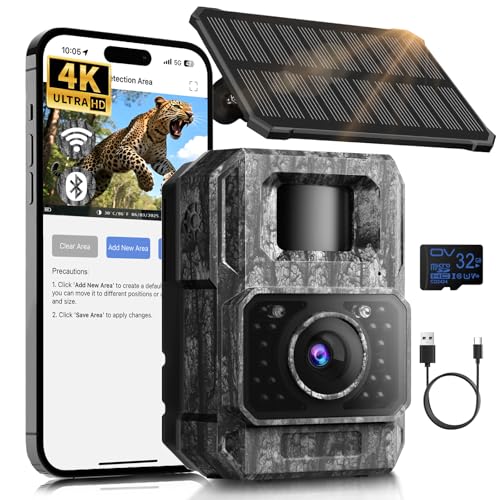
MAXDONE Solar Trail Camera with 32GB Card
This solar camera lists 4K video, 64MP photos, Wi-Fi and Bluetooth, night vision, a 6000mAh battery, and a 32GB card included. Solar charging keeps the battery topped up between visits. It suits landowners who check a camera near a cabin or barn and want to avoid cellular plans. The built-in battery and panel mean you can leave it for long stretches, and the 4K and 64MP claims give you plenty of pixels to crop into when a buck steps out at the edge of the frame.
- Included 32GB card gets you started right away.
- Solar power cuts down on battery swaps.
- Trade-off: you must be within Wi-Fi or Bluetooth range to retrieve images.
Skip it if you need remote alerts from far away. A Wi-Fi connection only works within a short distance of the camera, so scouting a distant ridge from home is not something this model can do.
MAXDONE Solar WiFi Trail Camera for Deer
This MAXDONE listing repeats the 4K, 64MP, Wi-Fi and Bluetooth, night-vision, solar-powered package and mentions deer hunting and wildlife use. The solar panel suits spots with good sun exposure. It fits hunters scouting a food plot near a road, where walking up to pull data is no hardship. Because the listing calls out deer hunting and wildlife, it is aimed at the same buyer who wants to learn when animals use a spot, then plan a hunt or a photo session around that pattern without spending money on a monthly service.
- Solar panel helps with long deployments.
- Wi-Fi and Bluetooth avoid monthly plans.
- Trade-off: it is nearly identical to the other MAXDONE listings, so compare kit contents.
Skip it if the camera will sit in dense timber with little sun. A panel under heavy canopy gathers less energy, and a cellular camera with a replaceable battery may be the more dependable pick in that setting.
SPYPOINT Flex-M Twin Cellular Trail Camera
The Flex-M Twin lists LTE with automatic multi-network switching, GPS, a 0.5-second trigger, 28MP photos, waterproofing, night vision, and a free photo plan. Auto network switching helps in marginal coverage areas. It suits buyers who want a recognized cellular brand and a simple plan option. The twin in the name points to a two-lens design, so it is worth reading the full description to see how that works.
- Auto multi-network connection helps reliability.
- GPS helps keep track of a camera’s location.
- Trade-off: the free plan may limit features, so read the terms.
Skip it if you want 4K resolution. At 28MP for photos, it trails the MAXDONE models on paper, though megapixel counts are only one part of image quality and night performance matters just as much.
MAXDONE Solar Trail Camera with 0.1s Trigger
This variant highlights a 0.1-second trigger, a built-in 6000mAh rechargeable battery, an IP66 waterproof rating, 4K and 64MP claims, and Wi-Fi and Bluetooth. The faster trigger is the standout among the listings. It suits fast game trails where animals pass quickly. A quick trigger shows the whole animal rather than a rump leaving the frame, which is the most common complaint with slow cameras on a narrow trail. The built-in battery also removes the hunt for cells before each season.
- 0.1s trigger is the fastest of this group.
- IP66 rating suits wet conditions.
- Trade-off: no cellular option, so checking images means a trip to the camera.
Skip it if you want live alerts at a distance. Without a cellular link, you will need to visit the site or stand near enough for a Wi-Fi connection, which can disturb the area you are trying to watch.
Moultrie Edge 2 Cellular Trail Camera 2-Pack
The Edge 2 is a two-pack with 36MP photos, low-glow flash, multi-carrier connectivity, 1080p video, and app-based scouting. It sits one step below the Edge 3 on the megapixel count. It suits buyers who want two cellular cameras and are happy with slightly lower resolution. The difference between 36MP and 40MP is unlikely to be obvious on a phone screen, so the older model can make sense when the app and carrier support are what you care about most and savings matter more than top specs.
- Two cameras cover multiple spots.
- Low-glow flash is gentler on wildlife.
- Trade-off: the listing does not state a trigger speed.
Skip it if you want the highest megapixel count or a trigger speed stated in the title. The listing leaves out that detail, which makes it harder to compare against faster cameras.
Tactacam REVEAL X 3.0 Cellular Trail Camera
The REVEAL X 3.0 lists 4K photo, 1080p video, night vision, waterproofing, auto-connect multi-carrier LTE, and no SD card needed. Skipping a card removes one thing to forget and one more part that can fail in cold or damp weather. It suits hunters who value a streamlined cellular unit and plan to monitor over the app. Because images travel over the network, the experience depends heavily on the signal at your mounting spot, so check coverage carefully and consider how you will handle a service outage during a key week of the season.
- Auto-connect LTE reduces setup fuss.
- No SD card requirement simplifies upkeep.
- Trade-off: relying on the network means little backup if service drops.
Skip it if you prefer local card storage. Hunters who like a physical backup of every image may feel uneasy about a camera with no card slot, and a model with a card would give them that comfort.
Which One Fits Your Situation
You hunt remote ground and want alerts
The Moultrie Edge 3 Cellular 2-Pack gives you two remote views with multi-carrier support.
You manage a food plot near your cabin
The MAXDONE Solar Trail Camera with 32GB Card works, since you can pull images over Wi-Fi when you visit.
You have patchy coverage
Choose the SPYPOINT Flex-M Twin for its automatic network switching.
You want to watch fast-moving animals
The MAXDONE Solar Trail Camera with 0.1s Trigger offers the quickest trigger in this guide.
Common Mistakes
- Placing a cellular camera without checking the signal first.
- Aiming a camera into the sun, which causes false triggers.
- Ignoring local hunting and wildlife rules for cameras, baiting, and transmitting devices.
- Skipping a plan check and finding that remote features cost extra.
- Mounting too high or too low, which misses animals or records only legs.
Related guides
- What Is The Best Budget Most Responsive Gaming Mouse Wired
- Low Latency Gaming Headphones Usb-C 2.4 Ghz Wireless
- Mechanical Gaming Keyboards Competitive Pc Gaming
Frequently Asked Questions
Do wireless trail cameras need cell service?
Cellular models do. Wi-Fi and Bluetooth models do not, but you must be nearby to retrieve images.
What is a good trigger speed?
Faster is better for moving animals. 0.1 to 0.5 seconds works for most trails, with the fastest suited to game paths.
Is solar charging reliable?
It helps where the panel gets sun, but dense cover or winter shade reduces its benefit. Treat it as a top-up rather than a guarantee.
Are there rules for using trail cameras?
Yes. Check hunting and wildlife regulations in your area, including limits on public land, baiting, and cellular devices, and respect private property boundaries.