
Nothing ruins the clean lines of a carefully curated home office faster than a tangle of stray cables, blinking dongles, and devices that constantly disconnect. In the era of remote work and high-design workspaces, our desks are crowded with external solid-state drives (SSDs), webcams, mechanical keyboards, audio interfaces, and desk lighting. Most modern laptops and sleek all-in-one desktops offer only one or two ports, leaving users starved for connectivity.
The most common mistake people make when trying to solve this port shortage is buying a cheap, unpowered USB splitter. These passive hubs draw all their power directly from the computer’s single host port—usually limited to a meager 4.5 to 9 watts. Plug in a portable hard drive, a webcam, and a phone to charge, and the hub will quickly choke, dropping connections, corrupting data, or failing to power the devices altogether. To build a stable, high-performance workstation, you need a dedicated, externally powered USB hub that plugs directly into a wall outlet.
As an Amazon Associate we earn from qualifying purchases at no extra cost to you.


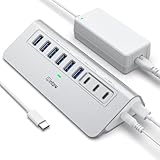
But navigating the sea of technical jargon, confusing USB naming standards, and varying power profiles can be overwhelming. This guide breaks down exactly what to look for in a powered USB hub so you can choose a reliable device that fits your aesthetic and performance needs.
Top 3 picks at a glance
Decide These 3 Things First
Before diving into technical specifications and price points, you must define how the hub will integrate into your daily workflow. Answering these three questions first will narrow your options immediately:
- What is your device inventory? Count the devices you plan to connect. High-draw devices like external SSDs, backup drives, and capture cards require both high data bandwidth and stable power. Low-draw peripherals like mice, keyboards, and USB dongles for wireless gear only need basic connectivity. Ensure you select a hub with at least two more ports than your current inventory to account for future expansion.
- Are you transferring data, charging devices, or both? Standard USB data ports output very low amperage (usually 0.9A), which will charge a modern smartphone at a painfully slow rate. If you want to fast-charge a tablet, phone, or wireless headphones at your desk, you must look for a hub that features dedicated “smart charging” ports or supports USB Power Delivery (PD).
- Where will the hub live? A hub can be a hidden utility tucked under your desk, a sleek aluminum command center sitting flat next to your keyboard, or a vertical tower designed to minimize its footprint. Your desk layout will dictate the ideal physical size, weight, and cable orientation of the hub.
Port Count and Physical Size
The physical footprint of a powered USB hub is directly tied to its port capacity. Desktop hubs generally fall into three size categories:
- Compact Hubs (4 to 5 Ports): These units typically measure between 3.5 and 4.5 inches in length, about 1.2 inches wide, and weigh under 3 ounces. They are ideal for minimalist setups or hybrid workers who occasionally need to pack up their gear. While small, because they are powered externally, they can easily run multiple portable hard drives without issue.
- Medium Hubs (7 to 8 Ports): Measuring around 5.5 to 6.5 inches in length, these are the sweet spot for most home offices. They provide plenty of room for permanent desktop peripherals (webcams, microphones, keyboards) while leaving a couple of ports open for thumb drives or temporary connections.
- Expanded Command Centers (10 to 11+ Ports): These heavy-duty hubs measure 7 to 9 inches long and weigh 6 to 10 ounces. They are designed to sit permanently on a desk, often featuring a mix of USB-A data ports, USB-C ports, and dedicated charging ports.
Housing Material and Thermal Management
Because powered USB hubs handle both high-speed data transmission and electrical currents from an external wall adapter, they generate heat. The chassis material plays a major role in how well the device performs over long hours of operation.
Aluminum Alloy: Premium and mid-range hubs are typically housed in anodized aluminum. Aluminum acts as a passive heat sink, pulling heat away from the internal chipsets and dissipating it into the air. This keeps the internal components cool, ensuring stable data transfer speeds and preventing thermal throttling. Additionally, aluminum hubs have a premium, metallic weight that prevents them from sliding around your desk when cables are tugged.
ABS Plastic: Budget-friendly hubs often utilize impact-resistant ABS plastic. While modern plastics are durable and lightweight, they are poor thermal conductors. Under heavy loads—such as transferring large files to multiple drives while charging a phone—a plastic hub will run noticeably warmer to the touch. If you opt for a plastic hub, look for models that feature ventilation slots along the sides or bottom.
Power Adapter Capacity and Wattage
The defining feature of a powered USB hub is its external power supply (often called a “wall wart”). A hub is only as capable as its power adapter. When reviewing specs, do not just look at the number of ports; look at the total wattage of the included power supply.
To understand the math, a standard USB 3.0 data port requires 5V/0.9A (4.5 watts) to run at full capacity. If you have a 7-port data hub, you need at least 31.5 watts of power just to run all data ports at maximum draw simultaneously. If you add a dedicated smart charging port (which typically draws 5V/2.4A or 12 watts), your power needs jump.
Budget hubs often ship with underpowered 5V/2A (10-watt) or 5V/3A (15-watt) adapters. If you populate all the ports on these hubs, devices will begin to disconnect randomly. For stable performance, look for these power thresholds:
- 4-Port Hubs: Minimum 5V/2.5A (12.5W) to 5V/4A (20W) adapter.
- 7- to 8-Port Hubs: Minimum 12V/3A (36W) or 12V/4A (48W) adapter.
- 10+ Port Hubs: Minimum 12V/5A (60W) up to premium 65W GaN (Gallium Nitride) power delivery systems.
Speed, Performance, and Protocol Standards
As we look ahead to workspace trends in 2026, the demand for high-bandwidth capabilities is higher than ever. To future-proof your desk, you must pay close attention to the USB generation standards listed on the box:
USB 3.0 / USB 3.1 Gen 1 / USB 3.2 Gen 1 (5 Gbps): These three terms refer to the exact same speed. Capable of transferring data at up to 500 Megabytes per second (MB/s), this standard is perfectly adequate for mechanical keyboards, mice, standard webcams, audio interfaces, and traditional spinning hard drives.
USB 3.1 Gen 2 / USB 3.2 Gen 2 (10 Gbps): Doubling the bandwidth to 1,000 MB/s, this standard is essential if you regularly work with external NVMe SSDs, edit 4K video directly from external storage, or use high-resolution capture cards. If your work involves moving large files, ensure at least a few ports on your hub support 10 Gbps transfer speeds.
The Bandwidth Bottleneck: Remember that a hub splits a single connection to your computer. If you plug three 10 Gbps external drives into a single 10 Gbps hub and attempt to transfer files on all of them at the same time, they will share that single 10 Gbps highway, slowing down individual transfer speeds. For high-performance workflows, space out your high-demand tasks.
Price Tiers and Value Proportions
The market for powered USB hubs is divided into three distinct price tiers, each offering different combinations of materials, port speeds, and power capacities:
- Budget ($15 to $25): Usually constructed of ABS plastic or lightweight aluminum, these hubs typically offer 4 to 7 ports running at USB 3.0 (5 Gbps) speeds. They often feature simple 5V power adapters (10W to 20W). These are excellent for basic desktop peripherals like printers, mice, and keyboards, but may struggle with multiple high-powered external drives.
- Mid-Range ($25 to $45): This is the sweet spot for most home offices. Constructed with sturdy aluminum enclosures, these hubs offer 7 to 11 ports, often including one or two dedicated smart charging ports (2.4A). They come with robust power supplies (36W to 48W) and individual mechanical LED power switches for each port, allowing you to turn off specific devices without unplugging them.
- Premium ($45 to $80+): Built for professional workstations, these high-end units feature heavy aluminum housings, advanced chipsets supporting USB 3.2 Gen 2 (10 Gbps) speeds, and USB-C integration. They are powered by high-wattage adapters (60W to 65W+) that can fast-charge devices or even provide power back to a host laptop.
Cable Length and Desk Integration
A frequently overlooked detail is the length and type of the host cable—the cord that connects the hub to your computer. Many budget hubs feature a hardwired host cable that is only 12 to 18 inches long. While fine for a laptop sitting right next to the hub, this short distance is completely impractical if you want to route cables cleanly, use a laptop stand, or connect to a desktop tower sitting on the floor.
For a clean, ergonomic workspace, look for a hub that features a detachable host cable. This allows you to purchase a high-quality, braided 3-foot or 6-foot cable that matches your desk aesthetic and routes cleanly through your cable management trays. If the cable is integrated, ensure it is at least 3.3 feet (1 meter) long to give you placement flexibility.
Spec Checklist
Use this quick-reference table to match your specific setup requirements with the appropriate hub tier:
| Specification | Budget Tier | Mid-Range Tier | Premium Tier |
|---|---|---|---|
| Price Range | $15 – $25 | $25 – $45 | $45 – $80+ |
| Chassis Material | ABS Plastic / Thin Aluminum | Anodized Aluminum | Heavy-Duty Machined Aluminum |
| Data Transfer Speeds | Up to 5 Gbps (USB 3.0) | Up to 5 Gbps (USB 3.0) | Up to 10 Gbps (USB 3.2 Gen 2) |
| Power Supply Rating | 10W – 20W (5V/2A to 5V/4A) | 36W – 48W (12V/3A to 12V/4A) | 60W – 65W+ (including GaN adapters) |
| Port Configurations | 4 to 7 USB-A Ports | 7 to 10 USB-A + 1 Smart Charge Port | Mixed USB-A & USB-C Ports |
| Key Features | Basic plug-and-play | Individual On/Off switches, LED indicators | Detachable host cables, Power Delivery (PD) |
Red Flags to Avoid
When shopping for a powered USB hub, watch out for these common warning signs that point to poor design, unreliable performance, or safety hazards:
- “Passive/Active Hybrid” without an included power brick: Some listings claim the hub is “powered” but do not actually include the power adapter in the box, requiring you to purchase a separate 5V wall plug. If it doesn’t ship with a dedicated power adapter, pass on it.
- Extremely short, non-detachable host cables: A fixed 12-inch host cable limits your desk layout options and puts physical strain on your computer’s USB port. Avoid these unless you are strictly using the hub for travel with a laptop.
- Vague electrical specifications: If a manufacturer lists a “high-power adapter” but refuses to state the exact voltage, amperage, or total wattage in the product description, it is highly likely the power supply is underpowered.
- Lack of safety certifications: Ensure the hub and its power adapter carry recognized safety certifications such as UL (Underwriters Laboratories), CE, or FCC. Uncertified high-wattage power bricks pose a genuine fire hazard and can ruin your expensive computer.
- “Phantom” charging ports: Beware of hubs that claim to charge devices but do not specify the amperage of those ports. Standard data ports only provide 0.5A to 0.9A of power, which will barely keep a modern smartphone alive while in use. True charging ports should offer at least 2.4A (12W) of dedicated power.
Frequently Asked Questions
Can I use a powered USB hub without plugging it into the wall?
Yes, most powered USB hubs can function as passive (unpowered) hubs if you do not plug them into a wall outlet. However, doing so limits their power draw to whatever your computer’s port can output (usually 4.5W to 9W total). High-draw devices like external hard drives, microphones, and webcams will likely fail to connect or operate stably in this mode.
Will a powered USB hub charge my laptop?
Generally, no. Standard powered USB hubs are designed to deliver power to the downstream peripherals connected to them, not upstream to the host computer. If you want a hub that charges your laptop while expanding your ports, you need to look for a specialized USB-C Multiport Adapter or a Thunderbolt Docking Station that explicitly supports “USB Power Delivery (PD) Pass-Through” of at least 60W to 100W.
What is the benefit of individual on/off power switches on a hub?
Individual switches are a fantastic feature for both convenience and digital security. They allow you to disconnect external backup drives when not in use (protecting them from potential malware or power surges) or disable your webcam and microphone when you want absolute privacy, all without having to physically pull the cables out of the hub.
Is it safe to leave a powered USB hub plugged in 24/7?
As long as you buy a high-quality hub from a reputable manufacturer that features built-in safety protections (over-current, over-voltage, and short-circuit protection) and carries a UL or CE certification, it is completely safe to leave plugged in. The hub’s internal smart controllers will only draw power from the wall when connected devices actively demand it.


