
Managing a modern home office desk setup often means juggling multiple external hard drives, portable SSDs, and desktop storage arrays. When your workstation accumulates several drives for video archives, system backups, and media libraries, relying on standard host computer ports quickly leads to connection drops and disorganized cable clutter across your workspace furniture. Unpowered hubs simply cannot supply enough amperage to spin up multiple mechanical drive platters or power high-speed flash drives simultaneously, leading to unmounted volumes and potential data corruption.
Investing in the best powered usb hub for multiple external hard drives solves this power bottleneck by pairing dedicated wall-adapter electricity with high-speed data architecture. A dedicated hub stabilizes voltage rails across all ports, keeping your desk neat while protecting valuable backup systems. In 2026, finding the right hub depends on balancing total wattage output, transfer protocol speeds, physical port arrangements, and individual toggle switches. We evaluated the top models on the market to help you streamline your desk setup and keep your storage running reliably.
As an Amazon Associate we earn from qualifying purchases at no extra cost to you.


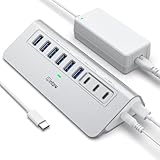


Top 3 picks at a glance
Quick Picks
| Product | Best for | Price |
|---|---|---|
| Powered USB Hub 3.0, Atolla 8-Port USB 3.0 Data Hub Splitter with One Smart Charging Port and Individual On/Off Switches and 5V/4A Power Adapter USB Extension for MacBook, Mac Pro/Mini and More | Budget Multi-Drive Setups | $23.99 |
| Powered USB Hub, Wenter 11-Port USB Splitter Hub (10 Faster Data Transfer Ports+ 1 Smart Charging Port) with Individual LED On/Off Switches, USB Hub 3.0 Powered with Power Adapter for Mac, PC | High-Capacity Desk Workstations | $29.99 |
| SABRENT 4-Port Powered USB 3.0 Hub, LED Power Switches (HB-UMP3) | Compact & Small Desks | $19.99 |
| SABRENT 10-Port 60W Powered USB 3.0 Hub, Power Switches & LEDs (HB-BU10) | Heavy-Duty Workstation Power | $47.49 |
| intpw Powered USB Hub 10Gbps, 9-Port USB 3.2/USB C Hub, 65W Power Adapter | High-Speed 10Gbps SSD Arrays | $55.99 |
| ONFINIO Powered USB Hub 3.0, 10-Port USB Splitter Hub | Ultra-Affordable 10-Port Expansion | $17.99 |
| TP-Link Powered USB Hub – 7 USB 3.0 Data Ports & 2 Smart Charging USB Ports | Clean Desktop Power & Charging | $29.99 |
| ACASIS Powered 7 Ports USB 3.2 Hub, 10Gbps Data Transfer, 24W Adapter | Slim High-Speed Transfers | $35.99 |
How We Picked
To identify the ideal powered USB hubs for supporting multiple external storage drives on a home office desk, we established strict performance and design criteria. First, we evaluated total electrical output. External 2.5-inch hard drives draw significant peak power when spinning up, so external power adapters rated from 20W up to 65W are essential to prevent drive disconnects.
Second, we assessed physical design and desktop integration. Hubs featuring individual mechanical power switches allow users to safely unmount and switch off specific drives without removing cables, reducing wear on desk connectors. Third, we looked at transfer protocols, contrasting standard 5Gbps USB 3.0 speeds against fast 10Gbps USB 3.2 standards. Finally, we prioritized cable management features, port orientation, and overall casing durability across price points ranging from $17.99 to $55.99.
The 8 Best Picks
Powered USB Hub 3.0, Atolla 8-Port USB 3.0 Data Hub Splitter with One Smart Charging Port and Individual On/Off Switches and 5V/4A Power Adapter USB Extension for MacBook, Mac Pro/Mini and More
Designed for home office workers who need a balanced mix of peripheral connectivity and drive storage, this Atolla unit features 7 dedicated USB 3.0 data ports alongside 1 smart charging port. The included 5V/4A (20W) power adapter ensures steady current for everyday external storage units while individual illuminated toggles allow quick control of each drive right on your desktop.
- Pro: Individual illuminated power switches make drive management simple.
- Pro: Dedicated smart charging port powers phones without taking up data bandwidth.
- Con: 20W total power supply limits running more than three power-heavy magnetic drives at once.
Skip this pick if you require higher wattage to continuously spin four or more unpowered desktop drives simultaneously.
Powered USB Hub, Wenter 11-Port USB Splitter Hub (10 Faster Data Transfer Ports+ 1 Smart Charging Port) with Individual LED On/Off Switches, USB Hub 3.0 Powered with Power Adapter for Mac, PC
The Wenter 11-port hub is built for creative professionals running expansive backup arrays. Offering 10 USB 3.0 data transfer ports and 1 smart charging port, it provides immense expansion for photo and video archives. Individual LED switches give immediate visual confirmation of active connections, preventing accidental ejects during busy editing sessions on your desk.
- Pro: Massive 10-data-port capacity accommodates extensive drive setups.
- Pro: Clear LED power indicators for every connected port.
- Con: Lightweight plastic casing can slide across smooth wooden desk surfaces when fully cabled.
Skip this pick if you need faster 10Gbps USB 3.2 transfers for high-end solid-state drives.
SABRENT 4-Port Powered USB 3.0 Hub, LED Power Switches (HB-UMP3)
Ideal for compact writing desks or minimalist computer setups, this Sabrent 4-port hub delivers basic power expansion without cluttering your workspace furniture. Each USB 3.0 port features a push-button toggle switch with blue LED power status, making it easy to isolate backup drives when they are not actively performing background syncs.
- Pro: Extremely compact footprint fits easily into tiny desk configurations.
- Pro: Highly affordable price point under $20.
- Con: Limited to only four total connection ports.
Skip this pick if you plan on managing more than three external hard drives simultaneously.
SABRENT 10-Port 60W Powered USB 3.0 Hub, Power Switches & LEDs (HB-BU10)
Engineered for demanding pro-sumer workstations, this Sabrent 10-port hub features an impressive 60W power adapter. This substantial wattage ensures that even multiple power-hungry 2.5-inch magnetic hard drives receive consistent voltage without causing drive dropouts. The individual switches offer tactile control over each drive bay connection.
- Pro: Robust 60W power supply handles multiple heavy spinning drives with ease.
- Pro: Individual toggles prevent unnecessary wear on external drive power cycles.
- Con: Larger power adapter block requires extra room behind desk cable trays.
Skip this pick if you are on a tight budget and only need to connect lightweight USB flash drives.
intpw Powered USB Hub 10Gbps, 9-Port USB 3.2/USB C Hub, 65W Power Adapter
Targeted at video editors and photo catalogers utilizing modern high-speed storage, this intpw hub offers fast 10Gbps USB 3.2 data transfer rates across its 9 USB-A and USB-C ports. Backed by a hefty 65W power adapter, it supplies ample current for fast external NVMe SSD enclosures and traditional drives alike, optimizing demanding workstation workflows.
- Pro: Fast 10Gbps transfer speeds double standard USB 3.0 throughput.
- Pro: Powerful 65W adapter easily feeds modern high-draw SSD enclosures.
- Con: Highest price point among all reviewed hub options.
Skip this pick if your existing storage media consists solely of older USB 3.0 mechanical drives limited to 5Gbps.
ONFINIO Powered USB Hub 3.0, 10-Port USB Splitter Hub
The ONFINIO 10-port hub provides maximum port expansion at an entry-level price point. Designed for users who need to plug in a wide array of low-draw drives, accessories, and desktop gadgets, it expands a single computer connection into ten individual 5Gbps USB 3.0 ports for clean wire routing around your office desk.
- Pro: Unbeatable value for a 10-port powered expansion unit.
- Pro: Generous port spacing helps accommodate wider thumb drives and dongles.
- Con: Included power supply is basic, limiting heavy load potential across all ten ports.
Skip this pick if you routinely run several unpowered mechanical hard drives at the exact same time.
TP-Link Powered USB Hub – 7 USB 3.0 Data Ports & 2 Smart Charging USB Ports
Known for networking reliability, TP-Link brings sturdy build quality to desk storage management with this 9-port model. It features 7 standard USB 3.0 data ports paired with 2 dedicated smart charging ports (5V/2.4A max output per charging port), ensuring your phone and tablet charge quickly while your storage array stays mounted.
- Pro: Exceptional build quality and electrical stability for home offices.
- Pro: Two dedicated 2.4A charging ports operate independently of host data connection.
- Con: Lacks individual mechanical power switches on the data ports.
Skip this pick if you prefer individual power switches to turn drives on and off manually.
ACASIS Powered 7 Ports USB 3.2 Hub, 10Gbps Data Transfer, 24W Adapter
Combining modern speed protocols with a sleek metal-inspired design, the ACASIS 7-port hub offers 10Gbps bandwidth for users moving large files across modern external SSDs. The package includes a 24W power adapter and individual port switches, giving desktop users responsive transfer speeds alongside physical control over connected drives.
- Pro: Full 10Gbps USB 3.2 capability accelerates media backups.
- Pro: Compact layout with responsive individual power toggles.
- Con: 24W adapter output is best suited for SSDs rather than many power-hungry HDDs.
Skip this pick if you require dedicated fast-charging ports for mobile device power.
Buying Guide
Understanding Power Adapter Capacity for External Drives
When selecting a powered USB hub for storage expansion, power supply wattage is the critical specification. Unpowered hubs rely entirely on the host computer’s port, which typically outputs only 4.5W to 7.5W total. Mechanical 2.5-inch external hard drives require high initial voltage spikes to spin up internal platters. A powered hub with a dedicated wall brick—ranging from 20W to 65W—ensures that every port receives stable voltage, preventing unexpected disk dismounts, write errors, and data corruption on your home office desk.
Data Transfer Rates: USB 3.0 vs. USB 3.2 10Gbps
Data transfer speed dictates how quickly your computer can execute background system backups or transfer large video files. Standard USB 3.0 hubs support transfer speeds up to 5Gbps (roughly 625MB/s bandwidth shared across ports). This speed is more than sufficient for traditional mechanical hard drives, which rarely read or write faster than 140MB/s. However, if your desk setup includes external portable solid-state drives (SSDs) or NVMe enclosures, choosing a USB 3.2 hub offering 10Gbps throughput prevents performance bottlenecks during file transfers.
Desk Layout and Cable Organization
Physical hub design directly impacts desk organization. Hubs with top-facing ports make plugging and unplugging drive cables effortless, while rear-facing port layouts hide messy cables behind monitors or desk risers. Models featuring individual physical power switches allow you to turn off back-up drives when not in use, reducing continuous background fan noise, heat buildup, and power consumption without forcing you to pull cables out of ports repeatedly.
Our Verdict
For general home office setups needing dependable performance, the Atolla 8-Port USB 3.0 Hub ($23.99) offers the best overall balance of price, individual port switches, and everyday utility. Workstations handling multiple heavy mechanical drives should step up to the high-capacity SABRENT 10-Port 60W Hub ($47.49) for its robust power supply. Finally, content creators operating fast solid-state external arrays will benefit most from the top-tier speed and power of the intpw 10Gbps USB 3.2 Hub ($55.99).
FAQ
Why do external hard drives require a powered USB hub?
External mechanical hard drives contain spinning disks and magnetic heads that draw significant electricity, especially when booting up. A powered USB hub uses an external wall adapter to deliver independent, continuous current to each port, ensuring drives stay mounted reliably without overloading your computer’s motherboard.
Can a powered USB hub run 3.5-inch desktop hard drives without their own power brick?
No. Standard 3.5-inch desktop external hard drives require 12V electrical rails, which USB data ports cannot provide. 3.5-inch drives will always require their own dedicated power adapter plugged directly into a wall outlet, though the hub will handle the data connection cleanly.
Do individual power switches help protect connected drives?
Yes. Individual power switches allow you to electronically disconnect power to a specific drive without repeatedly pulling physical cables out of ports. This minimizes port wear and allows you to keep backup drives turned off when not actively in use, protecting them from power surges and unnecessary disk spin time.
Will using all ports simultaneously slow down data transfer speeds?
Yes, to a degree. All data ports on a hub share the total bandwidth of the single USB connection linked to your computer (e.g., 5Gbps or 10Gbps). If you write data to four external drives simultaneously, that total connection bandwidth is divided among the active transfers, though powered hubs prevent electrical dropouts during these heavy operations.


