
Buying a pc joystick for flight simulator can feel like a gamble when the price gap between a sub-$50 stick and a $200 yoke system is enormous but the on-screen result looks similar in screenshots. The real differences live in force feedback quality, axis precision, software stability, and how the hardware handles thousands of small control inputs across long sessions. A cheap stick might get you airborne in IL-2 or Microsoft Flight Simulator, but after an hour you notice the dead zones, the wobbly throttle quadrant, and the driver conflicts with Windows updates.
This roundup pulls together eight options spanning entry-level, mid-range, and premium tiers. We compared published specifications, retail pricing, and owner feedback from forums and verified purchase reviews to identify which sticks deliver real value at each price point. The best pc joystick for flight simulator in this group depends on whether you fly combat missions, airline routes, or general aviation circuits—and whether you want HOTAS ergonomics or a single-stick desk setup.
As an Amazon Associate we earn from qualifying purchases at no extra cost to you.


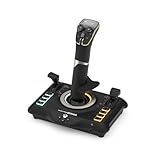
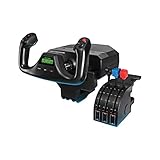


Top 3 picks at a glance
Quick Picks
| Product | Best For | Price |
|---|---|---|
| PXN 2113PRO | Ultra-budget casual flying | $49.99 |
| Thrustmaster T16000M FCS | Precision combat without throttle | $79.99 |
| Thrustmaster T-Flight Hotas X | First HOTAS setup | $71.39 |
| Logitech G X56 | Programmable controls and RGB | $199.99 |
| Turtle Beach VelocityOne Flightstick | Cross-platform sim racing and flight | $139.99 |
| Logitech G PRO Flight Yoke | Yoke-style general aviation and airliner flying | $149.99 |
| Thrustmaster TCA Sidestick Airbus | Airliner cockpit immersion | $89.99 |
| Logitech G Saitek X52 Pro | Full HOTAS with display panel | $162.97 |
How We Picked
We evaluated each stick on four criteria that consistently separate satisfying purchases from returns in this category: axis precision and dead zone behavior as reported by owners, build quality and switch feel under sustained use, software reliability across Windows updates and multiple sim titles, and value relative to the feature set at each price tier. A stick with four programmable axes but mushy buttons still frustrates; a stick with excellent software but a single axis can only do so much. We weighted those tradeoffs by the likely use case for each product.
The 8 Best Pc Joystick For Flight Simulator in 2026
PXN 2113PRO PC Joystick
The PXN 2113PRO targets the buyer who wants a working stick without spending more than a game itself. Owners consistently praise its USB plug-and-play simplicity and surprisingly firm spring return for the price. It handles basic combat sims and older titles like IL-2 Sturmovik well enough for casual sessions. The build quality is the obvious compromise: plastic joints flex under aggressive inputs, and the included software is minimal. Skip this if you fly complex airliners that demand multiple axes or if you plan to upgrade within a year.
- Pro: Lowest entry price in the group
- Pro: No driver installation needed for basic sims
- Con: Plastic housing flexes; long-term durability concerns
Thrustmaster T16000M FCS
Thrustmaster’s magnetic sensor approach gives the T16000M FCS a noticeably smooth axis response that owners compare favorably against potentiometer-based rivals at this price. The single-stick design suits dogfighting in War Thunder or DCS when paired with a separate throttle. Its compact footprint works on small desks, a practical advantage for apartment setups. The main complaint across reviews is the lack of a twist axis on the grip for rudder control, forcing keyboard use for coordinated turns. Skip if you need a complete cockpit-in-one or fly heavy transport aircraft where rudder input matters constantly.
- Pro: Magnetic sensors deliver consistent precision without wear
- Pro: Compact and lightweight for desk-limited setups
- Con: No twist rudder axis on the grip
Thrustmaster T-Flight Hotas X
This is the traditional gateway HOTAS: a stick plus a separate throttle quadrant with a working twist rudder axis. Owners appreciate the physical throttle quadrant detents that simulate military throttle gates, and the overall feel of a genuine two-handed setup. The software is functional but dated, and some reports note the throttle’s rubberized coating degrades after a year or two of sweaty hands. The included trim switches feel cheap to several buyers. Skip if your desk space is tight or if you want a modern software suite with profiles that survive Windows updates cleanly.
- Pro: Separate throttle quadrant with rudder twist axis
- Pro: Authentic HOTAS layout at a low price
- Con: Throttle coating durability and dated software
Logitech G X56 H.O.T.A.S
The X56 is a feature-heavy HOTAS with 189 programmable controls, three spring options for the stick, and RGB lighting that signals this is a Logitech product. Owners fly everything from DCS to Microsoft Flight Simulator on it and praise the sheer input surface area. The downside is complexity: the software can conflict with sim profiles, and the stick’s weight distribution feels top-heavy to some. At nearly $200 it also demands a large desk. Skip if you prefer a minimalist setup or if you find multi-page profile editors frustrating rather than empowering.
- Pro: Enormous programmable control surface with three spring options
- Pro: Separate throttle unit with detents and multiple axes
- Con: Top-heavy stick and software complexity
Turtle Beach VelocityOne Flightstick
Turtle Beach entered the flight sim space with a cross-platform stick that works on Xbox and PC, making it the rare option for console players who also fly on PC. Owners highlight the magnetic hall-effect sensors on the axes and a surprisingly solid build. The single-stick form factor means you add a separate throttle later for full HOTAS. Its RGB base looks aggressive for a desk that isn’t already dark. Skip if you exclusively fly on PC and want a mature software ecosystem, or if you need throttle integration out of the box.
- Pro: Hall-effect axes with long-term wear resistance
- Pro: Dual-platform compatibility with Xbox and PC
- Con: No throttle included in the package
Logitech G PRO Flight Yoke System
For pilots who fly airliners and general aviation in Microsoft Flight Simulator, the Logitech G PRO Flight Yoke delivers the control surface layout that a joystick simply cannot replicate. Owners praise the realistic column feel, the included throttle quadrant with three levers, and the magnetic sensors in both units. The tradeoff is size and price: it occupies a full desk width and costs more than most sticks here. Skip this if you fly combat aircraft where a stick’s speed and compactness win, or if your budget is under $150.
- Pro: Authentic yoke and throttle layout for airliner flying
- Pro: Magnetic sensors on all major axes
- Con: Large footprint; overkill for combat sims
Thrustmaster TCA Sidestick Airbus Edition
Modeled on the real Airbus A320 side stick, this product appeals to airline sim enthusiasts who want cockpit-level immersion in a single compact unit. Owners note the hall-effect sensor provides smooth, wear-free inputs and the form factor sits comfortably on a desk next to a keyboard. It is deliberately limited: one axis pair, minimal buttons, no throttle. Pair it with the TCA Quadrant for a functional airliner setup. Skip if you need combat-ready axes and buttons in one unit, or if the fixed spring tension feels too light for high-G maneuvering.
- Pro: Authentic Airbus side-stick ergonomics with hall-effect sensors
- Pro: Compact footprint ideal for airline sim workstations
- Con: Requires separate throttle purchase for complete setup
Logitech G Saitek X52 Pro
The X52 Pro is a veteran HOTAS that remains a popular choice thanks to its built-in LCD multifunction display on the throttle and full stick-and-quadrant package. Owners report that the display helps with fuel state, altitude hold, and sim-specific readouts without alt-tabbing. The tradeoff is that its potentiometer axes can develop dead zones over years, and its software is no longer actively updated by Logitech. Still, at $162.97 it undercuts the X56 while offering similar axis count. Skip if long-term sensor precision matters more to you than the convenience of an integrated display.
- Pro: Built-in LCD display on throttle quadrant
- Pro: Full HOTAS with good button and hat-switch density
- Con: Aging software support and potentiometer wear over time
Buying Guide
Sensor Type Determines Long-Term Feel
Potentiometer-based axes use physical contact that wears, causing dead zones and jitter after months or years of use. Magnetic hall-effect sensors eliminate this failure mode entirely, producing consistent input across the full travel range indefinitely. In 2026, hall-effect units are no longer premium-only—the PXN and Thrustmaster TCA models prove it. If you plan to keep a stick beyond two years, prioritize magnetic sensors or accept eventual recalibration and axis drift.
Axis Count and Rudder Control
A minimum of three axes (pitch, roll, throttle) gets you flying. Four axes (adding twist rudder on the stick) improves coordinated turns in combat sims. Five or six axes with a separate rudder pedal set approaches real-world control fidelity for airliner flying. Decide your primary sim genre first: combat pilots can live on three or four axes, while airline and GA pilots benefit from dedicated rudder pedals and a proper throttle quadrant with multiple levers.
Software Ecosystem and Profile Portability
Windows updates break drivers, and sim titles assign different input priorities. A manufacturer’s software suite should let you create per-profile button maps, adjust axis curves, and export profiles to cloud storage or USB. Logitech and Thrustmaster both offer this, though their interfaces differ in reliability. Before buying, check owner forums for your specific sim title: a stick that works perfectly in DCS might need manual remapping for Microsoft Flight Simulator due to how that title handles input priority.
Our Verdict
The Thrustmaster T16000M FCS is our top pick for most buyers: magnetic precision, compact size, and a price that leaves room for a rudder pedal upgrade later. For the budget-conscious, the PXN 2113PRO at $49.99 is the cheapest path to a functional pc joystick for flight simulator sessions without spending more than a new game. If you fly exclusively airliners or general aviation, the Logitech G PRO Flight Yoke is the one product here that wins outright because its form factor is irreplaceable.
FAQ
Do I need a full HOTAS setup for flight sim?
Not for casual or combat flying—a quality stick plus keyboard rudder covers most scenarios. A separate throttle quadrant becomes essential when flying multi-engine aircraft or when you want simultaneous pitch and power inputs during landing approaches.
Are rudder pedals worth adding to a joystick?
For coordinated turns in general aviation and airliner work, yes. For combat sims, many players use the stick’s twist axis instead. Pedals add realism but also desk clutter and a second driver to maintain.
Which sim titles have the best joystick support on PC?
Microsoft Flight Simulator, DCS World, IL-2 Sturmovik, and War Thunder all ship with native joystick and HOTAS support that auto-detects most major brands. Titles with poor support usually show up in the first few pages of any stick’s forum threads.
Can I use a console flight stick on PC?
The Turtle Beach VelocityOne is designed for both platforms, and many Xbox-branded sticks work over USB on PC with standard input mapping. However, console sticks often lack the axis precision and software depth that PC-exclusive models provide for demanding sims.


