
Buying a pc joystick in 2026 is not the simple purchase it used to be. The category spans from under-$50 entry sticks that barely clear the threshold of usefulness to $200 HOTAS setups that replicate a real cockpit on a desk. For flight sim enthusiasts, farming simulator players, and anyone who wants precise analog input over a gamepad, the right controller can make or break immersion. The wrong one introduces slop, dead zones, and unreliable centering that erodes confidence in every maneuver you attempt.
What separates a good joystick from a mediocre one comes down to a few measurable realities: sensor type (Hall effect versus potentiometer), the quality of the gimbal mechanism, the number and accessibility of programmable axes and buttons, and whether the base stays planted during aggressive inputs. Owner feedback consistently highlights that cheaper pots degrade within months, while quality sticks maintain their feel for years. Price alone does not guarantee performance—a $50 stick with a solid mechanism beats a $120 stick with loose tolerances—but the premium models do tend to earn their markup through longevity and precision. Below we compare eight distinct options across the full price spectrum so you can match a controller to your specific simulator, budget, and desk space.
As an Amazon Associate we earn from qualifying purchases at no extra cost to you.





Top 3 picks at a glance
Quick Picks
| Product | Best for | Price |
|---|---|---|
| PXN 2113PRO | First-time buyers on a tight budget | $49.99 |
| Thrustmaster T16000M FCS | Precision dogfighting and combat sims | $79.99 |
| Turtle Beach VelocityOne | Xbox-to-PC crossover with console convenience | $139.99 |
| Thrustmaster SimTask FarmStick | Farming Simulator players who need dedicated axes | $129.95 |
| Thrustmaster T-Flight Stick X | Casual flight sim without breaking the bank | $56.85 |
| Logitech X56 HOTAS | Enthusiasts wanting a complete two-unit setup | $199.99 |
| Thrustmaster T-Flight Hotas One | Beginner HOTAS that still feels substantial | $96.99 |
| Thrustmaster TCA Sidestick Airbus | Airliner enthusiasts who want a replica feel | $89.99 |
How We Picked
We narrowed this list by weighing four criteria that owner feedback and published specs consistently flag as decisive: sensor mechanism type (Hall effect sensors resist wear far better than potentiometers and maintain calibration longer), build quality of the gimbal and base (a wobbly stick is a frustrating stick regardless of price), input count and programmability (more axes and assignable buttons reduce reliance on keyboard shortcuts that break immersion), and platform compatibility (some sticks lock you into Xbox or PC ecosystems, while others work across both). We included products that span multiple use cases—combat flight, civilian flight, and farming—because the best pc joystick depends entirely on what you fly or drive.
The 8 Best Pc Joystick in 2026
PXN 2113PRO
This is the stick most people grab when they want to dip a toe into flight simulation without committing serious money. At $49.99, the PXN 2113PRO offers a multi-axis layout with twist rudder and a respectable button count for its price bracket. Owner feedback praises its plug-and-play simplicity over USB and the rubberized base grip that keeps it from sliding on a desk during light inputs.
- Pro: Lowest entry price on this list with adequate axes for basic flight and space sims.
- Pro: Lightweight enough for small desks and travel setups.
- Con: Potentiometer-based sensors mean the feel will drift and degrade over months of heavy use.
Skip it if you play demanding titles like DCS or Microsoft Flight Simulator where precision matters, or if you plan to upgrade within a year.
Thrustmaster T16000M FCS
The T16000M occupies a sweet spot that many budget-conscious enthusiasts call the best value in the category. Its Hall effect magnetic sensing eliminates the wear and dead-zone problems that plague pot-based sticks, and the slim, low-profile base keeps it from dominating your desk. Owners frequently cite the smooth gimbal action and the ability to use two sticks together for full dual-stick combat without a second throttle unit cluttering the workspace.
- Pro: Hall effect sensors deliver consistent precision with no measurable degradation over time.
- Pro: Compact footprint pairs well with a second unit or a separate throttle.
- Con: Single-unit design means you need a separate throttle or keyboard for power management in multi-axis aircraft.
Pass if your simulator demands a throttle quadrant with multiple levers or if you prefer an all-in-one HOTAS package.
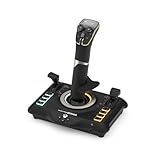
Turtle Beach VelocityOne Flightstick
Turtle Beach designed the VelocityOne for players who split time between Xbox and PC and want one controller that works on both. The stick features an adjustable resistance mechanism, integrated throttle quadrant, and a modular design that appeals to those who prefer a single-unit setup without committing to the bulk of a full HOTAS. At $139.99, it undercuts some two-unit packages while offering a similar button count.
- Pro: True universal compatibility lets you carry your muscle memory between console and PC sessions.
- Pro: Integrated throttle means you do not need a second base on your desk.
- Con: The integrated throttle layout sacrifices the granular axis control that dedicated HOTAS users expect.
Not ideal for hardcore PC flight simmers who want separate throttle levers with detents and multi-axis power management.
Thrustmaster SimTask FarmStick
Farming Simulator owners have unique control needs—forward and reverse gears, independent axis sliders for hydraulic functions, and a layout optimized for seated operation over long sessions. The SimTask FarmStick addresses these with a dedicated multi-function design that maps dozens of inputs to a single compact base. Its $129.95 price reflects the specialized button count rather than flight-precision tolerances.
- Pro: Purpose-built axis layout eliminates keyboard-hunting for common farm tasks like plow raising and PTO control.
- Pro: Sturdy construction handles long sessions where a standard flight stick would feel under-buttoned.
- Con: The gimbal feel and precision are tuned for farm equipment, not for aerodynamic combat or civilian flight.
If you also fly in Microsoft Flight Simulator or DCS, this stick will feel wrong; buy a dedicated flight controller for those titles.
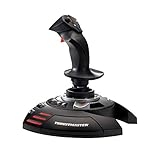
Thrustmaster T-Flight Stick X
A step up from the absolute entry tier, the T-Flight Stick X at $56.85 gives casual flight sim players a more ergonomic grip and a wider button array without pushing into mid-range pricing. The design favors comfort over competition-grade precision, making it suitable for someone who flies once or twice a week rather than daily. Owner feedback highlights the soft grip texture and the rubber feet that anchor the base to a desktop.
- Pro: Ergonomic handle shape reduces hand fatigue during extended flights.
- Pro: Affordable enough to experiment with flight sims before committing to a premium setup.
- Con: Uses potentiometer sensors that will introduce drift sooner than Hall effect alternatives.
Dedicated combat simmers will outgrow this quickly; the precision and button count fall short of what those games demand.
Logitech G X56 HOTAS
The X56 remains one of the most recognized two-unit packages in the category, bundling a joystick and throttle quadrant for $199.99. With spring-loaded handle options, over 189 programmable controls, and RGB-labeled axes, it targets players who want maximum customization without building a separate setup from individual components. The throttle quadrant offers a wide axis count and a realistic layout that appeals to both fighter and airliner pilots.
- Pro: Enormous programmable input count lets you map every sim command without touching a keyboard.
- Pro: Three interchangeable spring options let you tune handle resistance to your grip preference.
- Con: The full two-unit footprint demands a large desk and may feel oversized in smaller workspaces.
Not the best choice if desk real estate is limited or if you prefer the minimalist precision of a single stick with a separate yoke.
Thrustmaster T-Flight Hotas One
At $96.99, the Hotas One delivers a compact two-unit experience that fills the gap between budget sticks and full HOTAS rigs. The throttle unit includes a linear twist rudder on the joystick and basic axis levers, making it a practical first foray into coordinated flight control for Xbox and PC owners alike. Owners appreciate the build quality relative to price and the clean cable management between the two units.
- Pro: True HOTAS form factor at a mid-range price that undercuts competitors by a wide margin.
- Pro: Dual platform support (Xbox and PC) future-proofs the purchase across console upgrades.
- Con: Throttle axis count and detent quality are modest compared to dedicated PC-only HOTAS products.
Enthusiasts who need multiple throttle levers with realistic detents should look at the Logitech X56 or consider a separate throttle add-on.
Thrustmaster TCA Sidestick Airbus Edition
Civilian flight simmers who want to replicate the Airbus side-stick experience get a faithful, compact form factor here. At $89.99, the TCA offers the distinctive slim profile of an airline cockpit sidestick with a Hall effect sensing mechanism and a small button cluster focused on autopilot and flight-control functions rather than combat. Its desk footprint is minimal, which suits home offices where a full yoke or HOTAS would overwhelm the space.
- Pro: Authentic sidestick geometry and light force requirements match airliner sim immersion better than a generic center-stick.
- Pro: Hall effect sensing ensures long-term precision with no drift.
- Con: Limited button count means you will still reach for the keyboard frequently in complex airliner scenarios.
Combat pilots and multi-role simmers should avoid this stick; its axis mapping and button layout are tuned specifically for commercial aviation workflows.
Buying Guide
Sensor Technology and Longevity
The single most important internal specification in any pc joystick is the sensing mechanism. Hall effect sensors use magnetic fields to detect stick position with no physical contact, meaning they do not wear, do not develop dead zones, and maintain factory calibration for years. Potentiometer-based sticks rely on physical resistors that degrade with use, producing jitter and positional drift typically within six to eighteen months of daily play. If you fly more than a few times per week, the long-term value of Hall effect sensing far outweighs the initial price premium.
Gimbal Quality and Force Feel
A joystick’s gimbal is the mechanical joint assembly that allows the stick to tilt. Budget gimbals introduce play or wobble that makes fine corrections frustrating, while well-machined gimbals deliver smooth, repeatable centering that lets your hands do the flying rather than fighting a sloppy joint. Look for owner reviews that specifically mention centering behavior, not just overall build. Some sticks offer adjustable spring tension so you can tune the force curve to match your hand strength and fly style.
Axis Count, Buttons, and Throttle Integration
More inputs do not automatically mean a better controller, but they determine whether you can fly a given simulator without constantly reaching for the keyboard. A single stick with three axes (roll, pitch, twist rudder) covers most combat scenarios. A throttle quadrant adds power levers, mixture controls, and flaps that multi-engine aircraft demand. If your simulator has more than ten distinct control functions, prioritize a two-unit HOTAS or a stick with a high programmable-button count so your hands stay on the controller where they belong.
Our Verdict
For most PC flight sim enthusiasts in 2026, the Thrustmaster T16000M FCS is the top pick: Hall effect precision, a compact footprint, and a price that undercuts every premium alternative by a wide margin. Budget buyers should start with the PXN 2113PRO at $49.99 to confirm their interest before investing in a higher-tier stick. If your primary use case is Farming Simulator rather than flight, the SimTask FarmStick wins outright because its dedicated axis layout solves a problem that no flight stick addresses well.
FAQ
Do I need a throttle with a PC joystick?
Not always. Single-stick combat sims and space sims work well with just a joystick plus keyboard shortcuts for power. Multi-engine aircraft, helicopters, and detailed airliner simulations reward a dedicated throttle quadrant because managing multiple levers, mixture, and flaps simultaneously is impractical without one.
Can I use a console flight stick on PC?
Many modern sticks, including the Turtle Beach VelocityOne and Thrustmaster Hotas One, support both Xbox and PC. Sticks labeled Xbox-only may still register on Windows but could lack full axis mapping in PC-specific sims. Always check for a native PC driver before purchasing if flight simulators are your primary use.
How long do Hall effect joysticks last compared to potentiometer models?
Hall effect sensors have no physical contact point to wear, so they do not drift or develop dead zones under normal use. Potentiometer sticks typically show measurable degradation within a year of frequent play. Owners of Hall effect sticks regularly report unchanged feel after several years, making the technology a clear value for long-term users despite a modest price increase.
Is USB connection sufficient, or do I need a dedicated interface box?
A direct USB connection is sufficient for every joystick on this list. Dedicated interface boxes become relevant only for multi-unit setups or for pilots who want to add rudder pedals, collective sticks, and throttles into a single chain. For one or two units, USB handles the bandwidth and latency without issue.


