
| Quick verdict | Ryzen 5 7500F | Core i5-14400F |
|---|---|---|
| Best for | New builds that value an upgrade path and lower power | Budget builds, DDR4 reuse, multitasking |
| Cores / threads | 6 / 12 | 10 (6P + 4E) / 16 |
| Socket and memory | AM5, DDR5 only | LGA 1700, DDR4 or DDR5 by board |
| Graphics output | None built in | None built in (the F suffix) |
The Ryzen 5 7500F and the Core i5-14400F are close enough in gaming that the platform around them should decide the purchase: choose the 7500F for a fresh AM5 DDR5 build with room to upgrade, and the 14400F when a DDR4 motherboard or extra threads save money or help your workload.
As an Amazon Associate we earn from qualifying purchases at no extra cost to you.

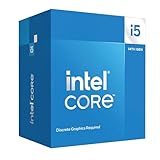
Why these two get compared
Both are 65 W-class, six-performance-core processors without integrated graphics, both are sold as the value choice from each company, and both pair well with mid-range graphics cards. Buyers searching for one usually land on the other, and the real question is which ecosystem to enter. Because neither maker publishes game frame rates, the useful comparison is built from official specifications plus the reports of independent reviewers.
Specifications as published
| Item | Ryzen 5 7500F | Core i5-14400F |
|---|---|---|
| Core design | Six Zen 4 cores | Six performance cores plus four efficiency cores |
| Threads | 12 | 16 |
| Max boost | 5.0 GHz | 4.7 GHz on performance cores, 3.5 GHz on efficiency cores |
| L3 cache | 32 MB | 20 MB |
| Headline power | 65 W TDP | 65 W base |
| Peak power | About 88 W package limit | About 148 W maximum turbo |
| Memory support | DDR5-5200 | DDR5-4800 or DDR4-3200 |
| PCIe | PCIe 5.0 from the processor on AM5 | PCIe 5.0 for graphics and 4.0 for storage lanes on LGA 1700 |
| Cooler in box | Depends on the retail package; confirm on the box listing | Depends on the retail package; confirm on the box listing |
The F in both names means no integrated graphics. Anyone building around either chip must plan on a graphics card from day one, and ideally keep an old card or a cheap spare for troubleshooting.
How they behave in games
Independent comparison sites disagree slightly. One large aggregator rates the Ryzen part about sixteen percent ahead across a wide set of games, another site says the two have similar gaming performance, and a third gives the Intel chip a small lead. A site that ran ten titles reported the Ryzen chip ahead in six, with the Intel chip winning heavy-graphics cases such as Starfield. Those mixed results suggest the processors sit in one performance class: neither is a clear winner at every setting.
Some practical reading of that:
- At 1080p with a high-end graphics card, small CPU differences show more, and the 7500F’s large cache and higher boost clock are the usual reasons it edges ahead in several suites.
- At 1440p or 4K, the graphics card sets the limit and the frame-rate gap between the two shrinks toward nothing.
- For games that spawn many background threads, the Intel chip’s extra efficiency cores can smooth frame times when other programs are running.
No exact frame rates are quoted here because they vary with the graphics card, memory kit, game patch and driver release.
Platform decides the long run
AM5 for the Ryzen 5 7500F
The socket is AM5, and AMD has said it will support future processors for several years. A buyer who starts with the 7500F can later drop in a faster Ryzen chip, possibly one with extra cache for gaming, without replacing the motherboard or memory. The cost of entry is DDR5 memory, since AM5 does not support DDR4.
LGA 1700 for the Core i5-14400F
LGA 1700 is the older Intel socket, with the 14400F among the last processors released for it. Boards are available with either DDR4 or DDR5 slots. Reusing DDR4 modules from an older system, or buying inexpensive DDR4, can lower the build cost. The tradeoff is that a future platform change would mean a new board.
Power and cooling
The Intel chip is allowed to draw far more than its 65 W label for short and sustained loads, up to roughly 148 W. The AMD chip’s package limit is about 88 W. For gaming alone the difference is modest because games rarely use every core fully. For rendering, encoding or compiling, the Ryzen chip tends to run cooler and quieter, while the Intel chip finishes some multi-thread jobs faster thanks to 16 threads. Choose a tower air cooler for either, and read the motherboard manual for any power-limit settings, because many boards raise limits by default.
Decision table
| If you want | Choose | Reason |
|---|---|---|
| A build you can upgrade in two or three years | 7500F | AM5 continues to receive new processors |
| The lowest total cost with existing DDR4 | 14400F | DDR4 boards are available for LGA 1700 |
| Streaming or heavy multitasking while gaming | 14400F | 16 threads |
| Lower heat and noise | 7500F | Lower package power limit |
| Overclocking headroom | 7500F | Ryzen multipliers are unlocked on AM5; non-K Intel chips are locked |
| Newest memory and PCIe standards | 7500F | DDR5-only platform |
Mistakes buyers make
- Forgetting there is no display output. With either F chip, plugging a monitor into the motherboard does nothing. A graphics card is required.
- Buying DDR4 for an AM5 board or DDR5 for a DDR4 board. The slot keying differs and the modules do not fit.
- Skipping the BIOS check. Older AM5 and LGA 1700 boards may need a BIOS update before they recognize newer processors. Check the motherboard maker’s support list and follow the update instructions closely, since an interrupted update can leave a board unusable.
- Assuming 65 W means a low-power chip. Turbo limits can push the Intel part well beyond that figure.
- Pairing a high-end graphics card with a weak power supply. Size the power supply for the graphics card first and the processor second.
Other options in the same class
- Ryzen 5 7600 or 7600X: adds basic integrated graphics on AM5 for a small step up.
- Core i5-14400 (non-F): same cores with integrated graphics for easier setup.
- Core i5-13400F: previous-generation Intel with a similar core layout.
- Ryzen 7 7800X3D: the gaming-focused step up when the budget allows.
Frequently Asked Questions
Which is better for gaming, the 7500F or the 14400F?
They sit in the same performance class. Several reviewers report a modest lead for the 7500F, while others find them level, and the winner changes between games and resolutions.
Do I need a graphics card with these processors?
Yes. The F suffix on the Intel chip and the design of the 7500F both mean there is no integrated graphics, so the monitor must connect to a dedicated graphics card.
Can the 14400F run on DDR4?
It can, on a motherboard with DDR4 slots. The maker lists DDR4-3200 and DDR5-4800 support, but a single board accepts only one memory type.
Is AM5 a better long-term platform than LGA 1700?
For upgrades, yes. AMD has stated it plans to support AM5 with new processors for several years, whereas LGA 1700 is the end of the line for Intel’s current socket.
Which processor runs hotter?
The Intel chip can draw more power under heavy loads, up to about 148 W maximum turbo against about 88 W for the Ryzen chip, so it usually needs more cooling for sustained work.
Does the 7500F work on any AM5 motherboard?
It is designed for AM5, but individual boards can need a BIOS update first. Read the board maker’s compatibility list for the exact BIOS version.
Related guides
More from Amazon
Programs that pair well with the guide above. Offers and eligibility are set by Amazon and may change.
Free shipping on eligible items, Prime Video and more. Eligible new members can start with a free trial.
Start a Prime free trialAd-free music streaming. Eligible new subscribers can start with a free trial.
Try Music Unlimited freeA Prime membership for ages 18-24 with a trial period. Eligibility is set by Amazon.
See Prime for Young AdultsAudiobooks and podcasts to listen to on the go. Eligible new members can start with a free trial.
Try Audible freeAs an Amazon Associate we earn from qualifying purchases.


