
Logitech’s sub-$100 mouse lineup covers four distinct shapes, and the right pick comes down to matching your hand length and grip style to the hump position and width, not the sensor spec sheet. Below are the exact dimensions, who each shape fits, and what tends to wear out first after a year or two of daily use.
As an Amazon Associate we earn from qualifying purchases at no extra cost to you.
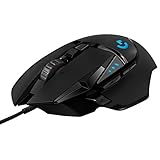


Top 3 picks at a glance
The sub-$100 Logitech lineup, by shape
At this price range Logitech sells roughly four body shapes repeated across wired and wireless versions: the ambidextrous low-profile shell (G203/G303-style), the ergonomic right-hand hump (G502/G402-style), the lightweight symmetrical shell (G305/G203 Lightspeed-style), and the compact low-hump shape (G Pro/G Pro Wireless-style). Each one suits a different hand size and grip, and the differences are big enough to cause wrist strain or a loose grip if you buy the wrong one.
| Model class | Length | Width | Hump height | Weight | Shape type |
|---|---|---|---|---|---|
| G203 / G203 Lightsync (wired, ambidextrous) | 116 mm | 62 mm | 38 mm | 85 g | Low, symmetrical hump centered mid-body |
| G305 (wireless, symmetrical) | 116 mm | 62 mm | 40 mm | 99 g (with AA battery) | Slightly taller symmetrical hump |
| G Pro Wireless (compact, low profile) | 125 mm | 63.5 mm | 40 mm | 80 g | Flat, low hump set further back |
| G402 Hyperion Fury (wired, ergonomic) | 130 mm | 70 mm | 42 mm | 120 g | Right-hand hump, pronounced thumb rest |
| G502 Hero / G502 Lightspeed | 132 mm | 75 mm | 43 mm | 121 g (wired) / 114 g (wireless) | Tall right-hand hump, wide rear |
| G303 Shroud Edition | 123 mm | 65 mm | 39 mm | 84 g | Low ambidextrous hump, slimmer waist |
Matching hand size to shape
Measure your hand from the base of the palm to the tip of your middle finger. That single number predicts fit better than any grip-style quiz.
- Under 165 mm (small hand): G203 or G Pro Wireless. Their shorter length (116-125 mm) keeps your fingertips from hanging off the front edge, and the low hump works for fingertip or claw grip without forcing your palm to arch.
- 165-185 mm (medium hand): G305 or G303. Both sit in the 116-123 mm range with a slightly taller hump that gives palm-grip users something to rest on, while still being short enough for claw grip.
- 185-200 mm (large hand): G402 or G502. The 130-132 mm length and 70-75 mm width give a full palm grip somewhere to land, and the 42-43 mm hump supports the arch of the hand instead of letting it collapse flat.
- Over 200 mm (very large hand): G502 is the practical ceiling in this price bracket. Nothing under $100 from Logitech goes wider than 75 mm, so if you need more surface area you’re moving into the G502 X Plus or a different brand’s larger ergo shells, which usually run $100-$150.
Grip style changes the recommendation
Hand size sets the range, grip style narrows it down within that range.
- Palm grip: wants hump height and width to fill the hand. G502 and G402 are built for this; a G203 under a full palm grip leaves the rear of the hand unsupported and tends to cause wrist fatigue within a few hours.
- Claw grip: wants a low, forward hump and a narrower waist so fingertips can arch down to the side buttons. G303 and G Pro Wireless are the better fits here even for medium-large hands, because the hump position matters more than raw size.
- Fingertip grip: wants low weight and a short body. G Pro Wireless (80 g) and G305 (99 g, but can drop to 92 g without the AA cover if you check Logitech’s lightweight mod info) are the lightest options, which keeps flick accuracy high since there’s less mass to decelerate mid-swing.
Durability notes from long-term use patterns
Spec sheets won’t tell you what degrades after a year of regular play. These are the common wear points reported across this lineup:
- Primary switches: G203 and G402 use mechanical switches rated around 10 million clicks, but the switch rating is a lab figure under controlled force. In practice, double-click or chatter issues on the left button tend to show up on 3-4 year old units more than on switches reaching the rated count, which points to debris and spring fatigue rather than pure click count as the real failure mode.
- Lightforce/optical switches (G Pro Wireless, newer G502 revisions): rated higher, around 50-70 million actuations, and in practice these units show far fewer chatter complaints over the same multi-year span, since optical switches don’t rely on a metal contact that oxidizes or wears.
- Side button coating: the matte-textured side grips on G502 and G402 wear smoother and shinier at the thumb contact point faster than the main shell coating, usually becoming noticeably glossy within 6-12 months of daily use. The rest of the shell coating holds up longer because it sees less direct skin contact and oil transfer.
- Cable vs. wireless shells: wired models (G203, G402) show less shell flex over time since there’s no battery door to loosen. The G305’s AA battery door latch is the single most common mechanical complaint in that model, as the latch tab is small and can wear loose after repeated battery swaps.
- Mouse feet: PTFE feet on all these models last roughly 300-500 hours of active use before glide starts degrading noticeably on a cloth pad, faster on hard pads with grit. Budget for a feet replacement around the one-year mark if you play daily.
Decision matrix
| Your situation | Best fit | Why |
|---|---|---|
| Small/medium hand, claw grip, wired preferred | G203 Lightsync | Short body, low hump, mechanical switches hold up fine at this price point |
| Small/medium hand, fingertip grip, wants lowest weight | G Pro Wireless | 80 g shell, optical switches avoid chatter long-term |
| Medium hand, palm grip, wants wireless | G305 | Taller hump than G203, AA battery gives long runtime, just mind the battery door latch |
| Large hand, palm grip, wants extra buttons for MMO/MOBA | G502 Hero or Lightspeed | Widest shell under $100, most side buttons, hump supports a full palm |
| Large hand, needs lightest possible shell | G402 Hyperion Fury | 120 g is lighter than G502 while keeping the ergo hump and width |
| Any hand size, tight budget under $50 | G203 or G203 Lightsync | Usually the cheapest model in the lineup, typically $25-$40 |
Price ranges to expect
These are general market ranges and vary by retailer and sale timing: G203 usually runs $25-$40, G305 usually $40-$60, G303 usually $50-$70, G402 usually $40-$60, and G502 Hero (wired) usually $40-$60 with the Lightspeed wireless version usually $70-$100. All of these stay under the $100 mark, which is why this lineup covers nearly every hand size and grip style without needing to step up to Logitech’s higher tier (G Pro X Superlight, G502 X Plus) models that start above $100.
FAQ
Is a heavier mouse always worse for aim?
Not necessarily. Heavier shells like the G502 (121 g) add stability for slower, precision-tracking aim styles, while lighter shells like the G Pro Wireless (80 g) favor fast flicks. The “best” weight depends on your sensitivity and game genre, not a universal rule.
Can I fix a chattering left click without replacing the mouse?
On mechanical-switch models (G203, G402), a loose spring or debris buildup is the usual cause. Opening the shell and cleaning around the switch contacts resolves it in many cases; if the chatter persists after cleaning, the switch itself has likely worn out and needs replacing, which is a cheaper fix than buying a new mouse if you’re comfortable with basic soldering.
Related guides
- Pulsar Xlite Crazylight Medium Review: Low Weight, 8K Support and Fit Questions
- SteelSeries Rival 3 Wireless Review: Dual Connectivity and Desk-Fit Tradeoffs
- Corsair Harpoon Wireless RGB Review: Three Connection Modes and Practical Tradeoffs
- Razer Orochi V2 Review: Compact Wireless Gaming With Replaceable Batteries


